Join us on a literary world trip!
Add this book to bookshelf
Grey
Write a new comment Default profile 50px
Grey
Subscribe to read the full book or read the first pages for free!
All characters reduced
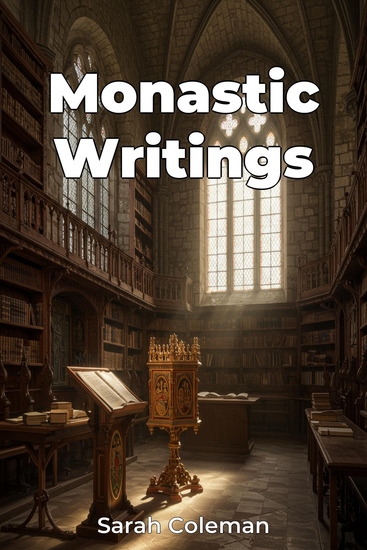
Monastic Writings - cover

Monastic Writings

Sarah Coleman

Translator A AI

Publisher: Publifye

  • 0
  • 0
  • 0

Summary

Monastic Writings explores the rich intellectual and spiritual legacy preserved within monastic communities, offering a unique historical perspective on religion and the preservation of knowledge. Delving into archives maintained by religious orders, the book highlights their crucial role in shaping theological discourse and safeguarding ancient wisdom. Intriguingly, monasteries served not only as centers of spiritual contemplation but also as vital hubs for scientific and philosophical advancements during eras of upheaval. The book examines the evolution of theological thought within monastic communities and their dedication to preserving and transmitting knowledge.

 
It begins by introducing the history and structure of monasticism, then progresses to explore the theological contributions of monastic scholars and the daily lives within monasteries.

 
Ultimately, Monastic Writings offers insights into contemplation, community, and connection to the natural world, revealing the enduring relevance of monastic life to contemporary discussions about spirituality and faith.
Available since: 03/29/2025.
Print length: 70 pages.

Other books that might interest you

  • Understandable Economics - Because Understanding Our Economy Is Easier Than You Think and More Important Than You Know - cover

    Understandable Economics -...

    Howard Yaruss

    • 0
    • 0
    • 0
    In this entertaining and informative guide, author Howard Yaruss breaks down our economic system in a straightforward way, avoiding jargon, formulas, graphs, and other technical material so common in books on this subject. Instead, he creates a compelling and comprehensive picture of our economy using accessible analogies, real-world observations, and entertaining anecdotes. 


    Understandable Economics will enable listeners to answer questions such as: Why is inequality soaring and what can we do about it?; Do tax cuts for the wealthy create jobs or just create more inequality?; Where does money come from, why does it have value, and who controls it?; What does the Fed do and how does it affect our lives?; Could alternative currencies like Bitcoin replace the dollar?; Is our national debt a threat?; Why do so many people believe free trade is good if it causes some people to lose jobs?; Why does the economy regularly turn down and how can we get it back on track?; and many more. 


    Understandable Economics provides the context, tools, and foundational knowledge listeners need to thoroughly understand our economy, determine which policies would work best, and champion those policies effectively.
    Show book
  • Heaven - cover

    Heaven

    Emerson Whitney

    • 0
    • 0
    • 0
    Emerson Whitney writes, "Really, I can't explain myself without making a mess." What follows is that mess-electrifying, gorgeous, defiant.
     
    At Heaven's center, Whitney seeks to understand their relationship to their mother and grandmother, those first windows into womanhood and all its consequences. Whitney retraces a roving youth in deeply observant, psychedelic prose-all the while folding in the work of thinkers like Judith Butler, Donna Haraway, and C. Riley Snorton-to engage transness and the breathing, morphing nature of selfhood.
     
    An expansive examination of what makes us up, Heaven wonders what role our childhood plays in who we are. Can we escape the discussion of causality? Is the story of our body just ours? With extraordinary emotional force, Whitney sways between theory and memory in order to explore these brazen questions and write this unforgettable book.
    Show book
  • Reincarnation - Conquering Repeated Birth & Death - cover

    Reincarnation - Conquering...

    Sripad Jaganantha Das

    • 0
    • 0
    • 0
    "Transmigration is not a question of religion. It is a question of science. You are a spiritual being, but because you are materially conditioned, you are under the spell of material nature. When your body is annihilated, you are not finished. You get another body, just as you may change your coat and shirt. Eternally the spirit soul within the body remains the same." Bhaktivedanta Swami 
     
    Throughout history, some of the most thoughtful minds have advocated that life does not end with the death of our body, but continues via a process known as reincarnation. The Vedic literature advocates that the soul, or atma, gives life to the body. Life does not arise from a particular combination of material elements as some modern scientists theorize. At the time of death, we leave one body and enter a new one. That is called reincarnation. 
     
    We can observe we change from one body to another throughout our lifetime. Our body at birth is completely different from our adult body. Yet throughout the conscious self remains the same. Similarly, the self remains the same at death and transfers from one body to the next in the cycle of reincarnation. Our present body is the result of a long series of actions and reactions in previous lives. The law that governs this is known as karma. Our previous actions have produced our present body, and our current actions will determine our next body. Only in the human form can we free ourselves from the endless cycle of reincarnation, of birth, and death. As Krishna states in Bhagavad Gita “From the highest planet in the material world down to the lowest, all are places of misery wherein repeated birth and death take place. But one attains to My abode.. never takes birth again.” 
     
    Here in this unique audio work are the ancient secrets of reincarnation from a 50-year devotee of the Vedas and devotional yoga. A rare and vitally important mystical audiobook adventure.
    Show book
  • Tsar Nicholas II - Biography of the Last Romanov Emperor of Russia - cover

    Tsar Nicholas II - Biography of...

    Kelly Mass

    • 0
    • 0
    • 0
    Nicholas II, or Nikolai II Alexandrovich Romanov (18 May [O.S. 6 May] 1868 – 17 July 1918), was the last Emperor of Russia, reigning from 1 November 1894 to 15 March 1917. Revered as Saint Nicholas the Passion-Bearer in the Russian Orthodox Church, he also held the titles of King of Congress Poland and Grand Duke of Finland. His reign marked the end of the Romanov dynasty's 304-year rule over Russia. Though Nicholas supported economic and political reforms proposed by his prime ministers, Sergei Witte and Pyotr Stolypin, his adherence to authoritarianism and reluctance to empower the Duma stymied significant progress. His reign was further undermined by aristocratic resistance and military defeats during the Russo-Japanese War and World War I, which eroded public confidence in his leadership. 
    Internationally, Nicholas sought to bolster Russia's position through alliances and diplomatic agreements. He signed the Anglo-Russian Convention of 1907, aiming to counter German influence in the Middle East and end the longstanding Great Game rivalry with Britain. Earlier, he had initiated the Hague Convention of 1899, a pioneering but ultimately unsuccessful effort to promote disarmament and peaceful conflict resolution. These measures were part of his broader vision to solidify the Franco-Russian Alliance and strengthen Russia's global standing. 
    Domestically, however, Nicholas' reign was plagued by crises and controversies. He faced widespread criticism for his government's repressive policies, particularly during moments of significant unrest. The Khodynka Tragedy, a catastrophic stampede at his coronation celebrations, set a grim tone for his rule. His apparent complicity in anti-Jewish pogroms, the violent crackdown on Bloody Sunday in 1905, and the brutal suppression of the Russian Revolution that same year further tarnished his reputation.
    Show book
  • Kofun Period - The Mysterious Tomb Builders and the Roots of Imperial Japan - cover

    Kofun Period - The Mysterious...

    Rolf Hedger

    • 0
    • 0
    • 0
    The Kofun Period, which lasted from approximately 250 to 600 AD, marks a significant era in early Japanese history. This period is named after the distinct burial mounds, or "kofun," that were constructed during this time. These mounds vary in size and shape but are most commonly recognized for their keyhole-like design. The Kofun Period is pivotal as it represents a time of political consolidation, the development of social structures, and the emergence of a powerful ruling elite that would lay the foundation for the imperial system in Japan. 
    The beginning of the Kofun Period is closely tied to the formation of more complex societies in the Japanese archipelago. By this time, a system of chiefdoms had developed, and the early Yamato state began to emerge as a dominant political force. The period sees the consolidation of power under a centralized leadership, which eventually paved the way for the establishment of the imperial family that still exists today. During the Kofun Period, society transitioned from small, localized groups to more organized and hierarchical structures, a shift that was reflected in the elaborate tombs built for the elites. 
    The most notable characteristic of the Kofun Period is the construction of large burial mounds for the ruling class. These tombs were not only elaborate final resting places for powerful individuals but also symbolized the political power and religious authority of the deceased. The kofun mounds varied in size, with some measuring several hundred meters in length. These tombs were often surrounded by moats and would contain a wealth of grave goods, such as weapons, jewelry, and pottery, which reflected both the material culture of the time and the importance of the individual being buried.
    Show book
  • How to Make People Like You - Things No One Wants to Tell You About Influence Attraction and Winning People Over to Increase your Likability and Become More Memorable - cover

    How to Make People Like You -...

    Christopher Kingler

    • 0
    • 0
    • 0
    Are you wondering how you can improve your relationships with your friends and family?Are you curious about how to get or keep your dream job?Would you like to quickly connect with whoever you want without making a bad impression? 
    This manual is divided into three parts to facilitate understanding: 
    The first part 
    ◆ Understanding people's psychological drives. 
    ◆ How social status can affect the behaviour of people towards you. 
    ◆ How to blow up your sympathy level. 
    ◆ Overcoming the obstacles and psychological barriers that block you. 
    The second part 
    ◆ Build a solid and lasting self-image. 
    ◆ How to be more engaging and charismatic. 
    ◆ Discover influencing techniques to make a killer first impression. 
    The third part 
    ◆ Countless communication techniques and exercises. 
    ◆ Body language to better express yourself and to decipher who is in front of you. 
    ◆ Techniques to seduce and bring anyone to your side. 
    ◆ Select the best people to keep by your side. 
    ◆ Turn enemies into friends. 
    And much more! 
    Finally, you will learn to adapt, conquer people and handle virtually any social situation. 
    When you finish reading this book, which is actually an intensive course, the "diploma" you will receive will not be a scroll with your name written on it, but an invaluable set of knowledge and skills that will allow you to influence people in all spheres of your life, regardless of the situation.
    Show book