Join us on a literary world trip!
Add this book to bookshelf
Grey
Write a new comment Default profile 50px
Grey
Subscribe to read the full book or read the first pages for free!
All characters reduced
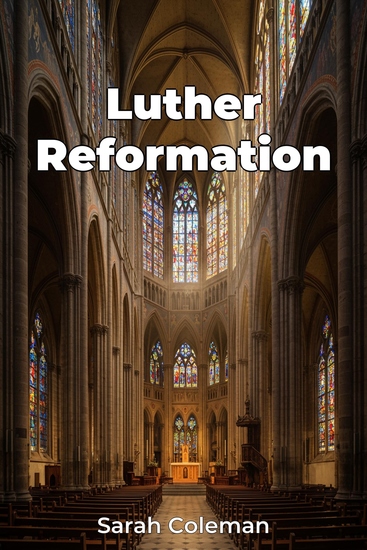
Luther Reformation - cover

Luther Reformation

Sarah Coleman

Translator A Ai

Publisher: Publifye

  • 0
  • 0
  • 0

Summary

"Luther Reformation" explores Martin Luther's pivotal role in the Protestant Reformation and its profound impact on European religion and politics. This historical analysis examines how Luther's theological innovations, like sola scriptura (Scripture alone), challenged established doctrines and triggered a fracturing of religious unity across Europe. The book highlights how Luther's challenge to papal authority unleashed a chain reaction that reshaped the religious landscape and led to significant political realignments.

 
The book begins by establishing the historical context of the late medieval Church, then delves into Luther's biography and theological breakthroughs. It further analyzes the spread of Luther's ideas through printing technology and the support of German princes seeking independence. By using primary sources like Luther's writings and papal bulls, the book provides a balanced and nuanced view of the Reformation, avoiding biased portrayals.

 
Finally, the book considers the long-term implications of the Reformation, including its influence on modern concepts of religious freedom and the separation of church and state. It adopts a scholarly yet accessible tone, making it valuable for both academic and general audiences interested in religious and European history. The book connects the Reformation to broader fields such as political science and sociology, enriching its narrative.
Available since: 03/20/2025.
Print length: 53 pages.
Other books that might interest you

  • Banksy: A short biography - 5 Minutes: Short on time – long on info! - cover

    Banksy: A short biography - 5...

    5 Minutes, 5 Minute Biographies,...

    • 0
    • 0
    • 0
    Banksy, most secretive artist of our time: Life and work in a short biography! Everything you need to know, brief and concise. Infotainment, education and entertainment at its best!
    Show book
  • The Oak and the Larch - A Forest History of Russia and Its Empires - cover

    The Oak and the Larch - A Forest...

    Sophie Pinkham

    • 0
    • 0
    • 0
    Russia's forests account for nearly one-fifth of the world's wooded lands. The Oak and the Larch is the first-ever English-language exploration of this vast expanse—a dazzling environmental history of Russia that offers an urgent new understanding of the nature of Russian power, and of Russia's ideas of itself. 
    Award-winning scholar Sophie Pinkham's magisterial account spans centuries, revealing how forests have nourished ancient Siberian indigenous societies, defended medieval Slavic settlements from Mongol invasion, and served as both an essential natural resource and a potent cultural symbol for Russia in all its incarnations. By examining the country from the forest's perspective, Pinkham pushes far beyond the contemporary political environment in Russia. She draws on literature, history, and art to connect the expanse of the Russian wilderness and the nature of Russian culture, with indelible portraits of the diverse figures who have inhabited and celebrated these forests. She confronts the forest's role in Russia's long history of imperial conquest, and in resistance to this conquest. 
    The Oak and the Larch offers a vision of Russia rarely seen in the west, as a land defined by its wilderness, shaped by its encounters with the frontier, and—much like our own—ultimately beholden to nature's whim.
    Show book
  • Derrida - Deconstruction and the Play of Meaning - cover

    Derrida - Deconstruction and the...

    Hector Davidson

    • 0
    • 0
    • 0
    Jacques Derrida, one of the most influential philosophers of the 20th century, revolutionized the way we think about language, meaning, and interpretation. His development of the concept of deconstruction has left a profound impact on philosophy, literary theory, and critical thought. To understand Derrida's legacy, it is essential to explore the key elements of his intellectual journey and how his ideas continue to shape contemporary discourse. 
    Derrida was born in Algeria in 1930, and his philosophical development was deeply influenced by the intellectual currents of post-war Europe, particularly phenomenology, structuralism, and existentialism. His work challenged the assumptions that underpinned much of Western thought, especially the metaphysical foundations of philosophy. One of his central concerns was the question of meaning and how it is constructed. He argued that meaning is never fixed, but instead is constantly shifting and dependent on a network of differences. This idea of différance, a term Derrida coined to describe the interplay of differences in language, became a cornerstone of his philosophy. 
    At the heart of Derrida's thought is the critique of the Western philosophical tradition, which he believed had centered itself around binary oppositions—such as presence/absence, speech/writing, and mind/body. These oppositions, Derrida argued, are not natural or inherent, but rather are constructed and perpetuated through language. By deconstructing these binaries, Derrida aimed to reveal the hidden power structures and assumptions that shaped our understanding of the world. He proposed that language itself is unstable, always in flux, and that meaning can never be fully contained or reduced to simple terms.
    Show book
  • Like A River To The Sea - Heartbreak and Hope in the Wake of United 93 - cover

    Like A River To The Sea -...

    Jack Grandcolas, Alan Shipnuck

    • 0
    • 0
    • 0
    The story of heartbreak to triumph in the wake of a tragedy. Their first date in college was a U2 concert and after that Lauren and Jack Grandcolas were inseparable. He was mesmerized by her sweetness, fierce intelligence and eyes that were as blue and alive as the ocean. They married and settled in San Francisco, each pursuing their dreams in the business world. After a decade of trying, Lauren finally got pregnant at the age of thirty-eight. On September 6, 2001, she flew to New Jersey—her beloved Little Grandma had died and following the funeral Lauren shared the joyous news of her pregnancy to lift her family’s spirits. Flying home to Jack on September 11th, she arrived at Newark airport early and walked on to a flight for which she hadn’t been ticketed: United 93. During that terrifying flight, Lauren left a calm and reassuring voice mail for Jack which remains a testament to her courage and selfless love, even in the face of her own mortality.Like a River to the Sea is a story of love overcoming loss. In this moving memoir, Jack Grandcolas brings to life his college sweetheart while taking the reader through his long journey to make peace with the loss of Lauren and their unborn child. Jack is honest about the depth of his despair and his battles with depression, PTSI, and heavy drinking. As he digs himself out of the deepest hole imaginable, Jack learns universal truths that will help anyone confronted with tragedy.Like a River to the Sea is also a deeply personal look at an event of historical importance. Jack takes us inside the White House to meet with President Bush and to the precipice of a still-smoldering hole in the earth outside of Shanksville, Penn. The book goes aboard United 93 in its final minutes, when this brave collection of Americans fought to retake control of the plane, ultimately preventing the hijackers from completing their mission and becoming the first heroes in the war against terror.As with Jack’s life, Like a River to the Sea is defined by the boundless depths of human love. Eighteen years after losing his wife and their unborn baby, Jack finally remarried, and his new bride so honors the love between him and Lauren that her wedding ring includes stones that Lauren once wore on her finger. This is the magic of Like A River To The Sea, which begins with heartbreak but becomes a story about the triumph of the human spirit.
    Show book
  • First Book of Corinthians The - The World English Bible Book 46 (Unabridged) - cover

    First Book of Corinthians The -...

    Various Authors

    • 0
    • 0
    • 0
    The First Epistle to the Corinthians is one of the Pauline epistles, part of the New Testament of the Christian Bible. The epistle is attributed to Paul the Apostle and a co-author, Sosthenes, and is addressed to the Christian church in Corinth. Scholars believe that Sosthenes was the amanuensis who wrote down the text of the letter at Paul's direction. It addresses various issues that had arisen in the Christian community at Corinth, and is composed in a form of Koine Greek.
    Show book
  • AUSCHWITZ CHILDREN AND MENGELE EXPERIMENTS - The Immoral and Atrocious Research on Children in the Auschwitz Concentration Camp during World War II - cover

    AUSCHWITZ CHILDREN AND MENGELE...

    Jack Stew Barretta

    • 0
    • 0
    • 0
    In the name of humanity, that was the explanation of Dr. Claus Karl Schilling for the execution of malaria experiments on 1,200 inmates of the Dachau concentration camp during the Second World War. The reputable Schilling had come to Dachau with the personal permission of the Reichsführer-SS Heinrich Himmler in 1942 because he could use the prisoners as research subjects without the restriction of obtaining their consent. Schilling was not an exception.  
    Many Nazi doctors seized the unique opportunity to execute human experiments without legal and ethical restrictions during the war. The SS and the Wehrmacht either initiated or supported the research of the Nazi doctors. The central question that puzzled jurists and scientists is how these doctors, who were educated to heal people, could execute human experiments and deliberately harm and even kill people. To some scientists, their acts stand out as ‘exemplars of evil.’ This judgment is based on the fact that prisoners did not give their informed consent, the cruel and sometimes sadistic character of the experiments, and because never before in medical experiments was the death of the research subjects a central element of the research design. Many people think that ‘science went mad’ in the Third Reich and that Nazi doctors who committed these crimes were pseudo-scientists, sadists, and even monsters. However, thinking these perpetrators were madmen or monsters is a false explanation.  
    It is confronting to know that physicians belonging to the most advanced medical community in the world at the time, who had sworn to ‘do no harm, ' could commit these crimes. 
    On this trail, Dr. Josef Mengele’s pseudo-scientific research at the Auschwitz concentration camp during World War II led to immeasurable suffering among the camp’s children.
    Show book