

Join us on a literary world trip!
Add this book to bookshelf
Grey
Write a new comment Default profile 50px
Grey
Subscribe to read the full book or read the first pages for free!
All characters reduced
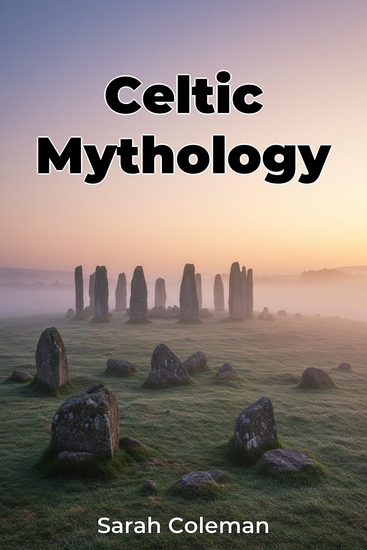
Celtic Mythology - cover

Celtic Mythology

Sarah Coleman

Translator A Ai

Publisher: Publifye

  • 0
  • 0
  • 0

Summary

Celtic Mythology explores the rich tapestry of Celtic beliefs, druids, and legendary figures, revealing their surprising and continued influence on modern culture. While complete written records from the Celts are scarce, archaeological findings and accounts from classical writers, along with medieval manuscripts, offer valuable insights. The book argues that core Celtic narratives have subtly shaped Western culture. One intriguing fact is the role of druids as spiritual leaders and keepers of knowledge, often misunderstood in popular culture.

 
The book begins by defining key terms and outlining the historical context, then explores the Celtic pantheon, the Otherworld, the druids, and legendary figures like Cú Chulainn and Queen Maeve. Analyzing sources such as the Mabinogion and the Ulster Cycle, the book avoids romanticized notions to engage with the complexities of Celtic history and culture.

 
Finally, it demonstrates the continuing presence of Celtic motifs in modern fantasy literature, film, and contemporary spirituality, illustrated with specific examples.
Available since: 03/29/2025.
Print length: 73 pages.
Other books that might interest you

  • God's Monsters - Vengeful Spirits Deadly Angels Hybrid Creatures and Divine Hitmen of the Bible - cover

    God's Monsters - Vengeful...

    Esther Hamori

    • 0
    • 0
    • 0
    The Bible is teeming with monsters. Giants tromp through the land of milk and honey; Leviathan swims through the wine-dark sea. A stunning array of peculiar creatures, mind-altering spirits, and supernatural hitmen fill the biblical heavens. 


    Traditional interpretations of the creatures of the Bible have sanded down their sharp, unsavory edges, transforming them into celestial beings of glory and light—or chubby, happy cherubs. Those cherubs? They're actually hybrid guardian monsters, more closely associated with the Egyptian sphinx than with flying babies. And the seraphim? Winged serpents sent to mete out God's vengeance. Demons aren't at war with angels; they're a distinct supernatural species used by Satan and by God. The pattern is chilling. Most of these monsters aren't God's opponents—they're God's entourage. 


    Killer angels, plague demons, manipulative spirits, creatures with an alarming number of wings (and eyes all over)—these shapeshifters and realm-crossers act with stunning brutality, each reflecting a facet of God's own monstrosity. Confronting God's monsters—and the God-monster—may be uncomfortable, but the Bible is richer for their presence. For anyone interested in monsters, myths, folklore, demons, and more, God's Monsters is an entertaining deep dive into the creaturely strangeness of the Bible.
    Show book
  • Blacked Out - Dilemmas of Race Identity and Success at Capital High - cover

    Blacked Out - Dilemmas of Race...

    Signithia Fordham

    • 0
    • 0
    • 0
    This innovative portrait of student life in an urban high school focuses on the academic success of African-American students, exploring the symbolic role of academic achievement within the Black community and investigating the price students pay for attaining it. Signithia Fordham's richly detailed ethnography reveals a deeply rooted cultural system that favors egalitarianism and group cohesion over the individualistic, competitive demands of academic success and sheds new light on the sources of academic performance. She also details the ways in which the achievements of sucessful African-Americans are "blacked out" of the public imagination and negative images are reflected onto black adolescents. A self-proclaimed "native" anthropologist, she chronicles the struggle of African-American students to construct an identity suitable to themselves, their peers, and their families within an arena of colliding ideals. This long-overdue contribution is of crucial importance to educators, policymakers, and ethnographers.
    Show book
  • Stoicism for Beginners A Complete Collection of Daily Stoic Wisdom - Learn How to Master the Art of Resilience with Philosophy Foundations and Marcus Aurelius' Timeless Teachings for Personal Growth and Self-Discipline - cover

    Stoicism for Beginners A...

    Marcus Gray

    • 0
    • 0
    • 0
    Feeling overwhelmed by stress, negativity, or chaos? It's time to take control of your mind and rediscover your inner strength! “Stoicism for Beginners: A Complete Collection of Daily Stoic Wisdom” is your ultimate guide to calm, clarity, and confidence—through every twist and turn life may bring. This powerful audiobook gives you everything you need to start living with purpose, resilience, and emotional balance. Each lesson is packed with ancient insights and modern tools that will shift your mindset, sharpen your focus, and help you rise above frustration, anxiety, and self-doubt. Whether you're navigating tough decisions or simply seeking more peace in your daily life, this audiobook will ground you in wisdom and ignite the courage within. By the end, you won’t just understand Stoicism—you’ll live it. Embrace the calm, reclaim your power, and begin your lasting transformation. Listen daily and watch your thoughts, habits, and life evolve—one intentional choice at a time.
    Show book
  • Freemasonic Symbolism - cover

    Freemasonic Symbolism

    Manly Palmer Hall

    • 0
    • 0
    • 0
    According to Freemasonic symbolism, Enoch, fearing that all knowledge of the sacred Mysteries would be lost at the time of the Deluge, erected the two columns mentioned in the quotation. Upon the metal column in appropriate allegorical symbols he engraved the secret reaching and upon the marble column placed an inscription stating that a short distance away a priceless treasure would be discovered in a subterranean vault. After having thus faithfully completed his labors, Enoch was translated from the brow Of Mount Moriah. In time the location of the secret vaults was lost, but after the lapse of ages there came another builder--an initiate after the order of Enoch--and he, while laying the foundations for another temple to the Great Architect of the Universe, discovered the long-lost vaults and the secrets contained within.
    Show book
  • This Isn't Love - cover

    This Isn't Love

    Ann Cusack, Hope Daniels

    • 0
    • 0
    • 0
    After a life in care, with both good and bad experiences of the system, Hope knows all too well what the risks are for children in care as they approach adolescence. Lacking any sense of self-worth or belonging, children in care are often dismissed by the authorities as impossible to manage and, worse, perceived as children who have invited sexual abuse by placing themselves in 'dangerous' situations. They quickly become invisible to the authorities - too old to be perceived as 'children' by the system and yet, far too young to be safe in an adult world. Hope was brought up in care from the age of nine. Until now, she has never spoken about what happened to her once she left the security of her Highgate children's home at the age of 13 and moved into a 'secure unit'. It may have been secure but it was never 'safe'. In this new book, she lifts the lid on this untold chapter of her story and the devastating effects she experienced when she reconnected with her past. This isn't Love is a book that not only casts blame on the men and women who abuse children in care, but also on those who avert their gazes in the belief that these children are 'asking for it'. Hope's story ends on a hopeful note, championing victims of abuse and encouraging others to tell their story.
    Show book
  • The Theory of the Leisure Class - cover

    The Theory of the Leisure Class

    Thorstein Veblen

    • 0
    • 0
    • 0
    "The Theory of the Leisure Class" is a book written by Thorstein Veblen, an American economist and sociologist. The book is a seminal work of economic sociology and a critique of the consumption-driven culture of the late 19th century United States. 
    Veblen's central thesis is that the upper class, or the "leisure class," engages in conspicuous consumption as a way of displaying their social status and wealth. This behavior, he argues, is not only wasteful and unproductive but also harmful to society as a whole, as it perpetuates a culture of inequality and social stratification. 
    Veblen also discusses the role of technology in shaping society, arguing that the development of machines and industrial processes has led to the emergence of a new class of technocrats who control the means of production and wield significant power over the rest of society. 
    Overall, "The Theory of the Leisure Class" is a critical examination of the social and economic structures that shape modern society. It remains a landmark work in the field of economic sociology and has had a profound influence on the study of consumption, social stratification, and the role of technology in society
    Show book
