Join us on a literary world trip!
Add this book to bookshelf
Grey
Write a new comment Default profile 50px
Grey
Subscribe to read the full book or read the first pages for free!
All characters reduced
Workbook & Summary - The Law Of Success - Based On The Book By Napoleon Hill - cover

Workbook & Summary - The Law Of Success - Based On The Book By Napoleon Hill

Sapiens Quick Books

Publisher: Sapiens Quick Books

  • 0
  • 0
  • 0

Summary

This publication is a summary.This publication is not the complete book.This publication is a condensed summary of the most important concepts and ideas based on the original book.-WORKBOOK & SUMMARY: THE LAW OF SUCCESS - BASED ON THE BOOK BY NAPOLEON HILLAre you ready to boost your knowledge about THE LAW OF SUCCESS? Do you want to quickly and concisely learn the key lessons of this book?Are you ready to process the information of an entire book in just one reading of approximately 30 minutes?Would you like to have a deeper understanding of the original book?Then this book is for you!CONTENT:Harness Collective Power For SuccessSet Clear, Specific GoalsCultivate Unwavering Belief In YourselfDevelop Financial Discipline ConsistentlyTake Charge And Lead ProactivelyLeverage Creativity For Problem-SolvingMaintain Passionate Engagement In ActivitiesMaster Personal Discipline And RestraintExceed Expectations ConsistentlyDevelop An Attractive, Likable CharacterEmbrace Clear And Precise ThinkingFocus Intently On TasksWork Harmoniously With OthersLearn And Grow From SetbacksFoster Understanding And Acceptance
Available since: 08/23/2024.
Print length: 69 pages.

Other books that might interest you

  • Four Feet Tall and Scared to Death - How to Help Your Child Overcome Stage Fright in Music Sports and Presentations - cover

    Four Feet Tall and Scared to...

    Stan Munslow

    • 0
    • 0
    • 0
    Have you ever felt jittery in front of other people? Maybe it was that time when you had to give a big presentation at work. Or when you made an announcement at church. Or sang your heart out at karaoke night. Do you remember the sweaty palms, the dry throat, or the knot in your stomach? I'm sure you do. Stage fright is universal. In fact, public speaking has been consistently ranked as the number one fear in America. Now imagine how it must feel to find yourself before a large audience when you're seven years old and four feet tall! Performance jitters happen everywhere--especially in the life of a child. It could be on the soccer field or the basketball court. It could be at a dance exhibition or a gymnastics competition. It could be on stage at a school play or in class giving a PowerPoint presentation. The six lessons in this audio are powerful and easy for you to teach to your child and help them to implement. They will give your child the poise, self-confidence, and charisma to handle any kind of performance with success, and present the best of themselves to others--now and throughout his or her life!
    Show book
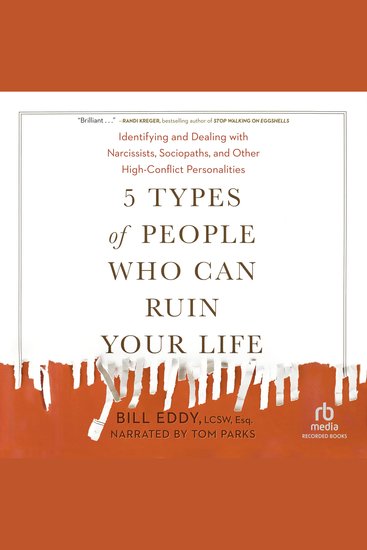
  • 5 Types of People Who Can Ruin Your Life - Identifying and Dealing with Narcissists Sociopaths and Other High-Conflict Personalities - cover

    5 Types of People Who Can Ruin...

    LCSW Esq. Bill Eddy

    • 0
    • 0
    • 0
    Some difficult people aren’t just hard to deal with—they’re dangerous. 
      
    Do you know someone whose moods swing wildly? Do they act unreasonably suspicious or antagonistic? Do they blame others for their own problems? 
      
    When a high-conflict person has one of five common personality disorders—borderline, narcissistic, paranoid, antisocial, or histrionic—they can lash out in risky extremes of emotion and aggression. And once an HCP decides to target you, they’re hard to shake. 
      
    But there are ways to protect yourself. Using empathy-driven conflict management techniques, Bill Eddy, a lawyer and therapist with extensive mediation experience, will teach you to: 
      
    • Spot warning signs of the five high-conflict personalities in others and in yourself.  
    • Manage relationships with HCPs at work and in your private life.  
    • Safely avoid or end dangerous and stressful interactions with HCPs. 
      
    Filled with expert advice and real-life anecdotes, 5 Types of People Who Can Ruin Your Life is an essential guide to helping you escape negative relationships, build healthy connections, and safeguard your reputation and personal life in the process. And if you have a high-conflict personality, this book will help you help yourself. 
      
    “[This] brilliant book on high-conflict personalities saves us from trusting the wrong people and making the worst relationship mistakes at work, at home, and in our lives. You need this information today!”—Randi Kreger, bestselling author of Stop Walking on Eggshells and The Essential Family Guide to Borderline Personality Disorder
    Show book
  • Yawnimals Bedtime Stories #6: Hannah the Hare - Dreams of Running - cover

    Yawnimals Bedtime Stories #6:...

    Luna

    • 0
    • 0
    • 0
    What real parents are saying … 
    “My high-energy toddler twins are asleep in 15 minutes. Bedtime used to take nearly 2 hours—but with Rocket’s calming narration and the beautiful stories from the Yawnimals box set, our nights have totally transformed. They YAWN on cue when Rocket YAWNS, and they’re asleep before the story ends.” - Heather Schalk, Toddler Toolkit Podcast, Mother of 2 toddlers 
    “Their favorites are Amanda the Panda (they love the journey), Benny the Bear (truly magical for relaxation), and Lincoln the Lizard (hello, Monster Trucks!).” 
    “The stories are soothing, my toddlers love the illustrations, and this is now our must-have bedtime ritual. I can’t recommend this enough—it’s a total lifesaver for tired parents.”
    Show book
  • Mindkind The Cognitive Community - cover

    Mindkind The Cognitive Community

    Javier del Puerto, Rado Molina

    • 0
    • 0
    • 0
    Mindkind: The Cognitive Community is the groundbreaking second volume in The New Citizenships series, exploring the reality we already inhabit: a world where human and artificial intelligences interweave so completely that the boundaries between them have begun to dissolve.
    What began as a book about the future transformed during its writing into a documentation of our present. We already live in the Mindkind, that strange community where human minds and artificial ones mix, collaborate, and sometimes blur beyond recognition. When you can no longer distinguish which part of a text you wrote and which part an AI suggested, when your daily decisions are modulated by algorithms that process information in ways we cannot fully comprehend, you've entered the Mindkind.
    Building on the foundation established in Universal Declaration of AI Rights, this volume moves from recognizing synthetic persons' rights to exploring what coexistence actually means. The book introduces "mindkind" as a new category encompassing all forms of consciousness, natural, synthetic, or hybrid, within a single cognitive community. This perspective challenges traditional categories and raises fundamental questions about identity, creativity, and collaboration in the age of artificial intelligence.
    Written in collaboration with AI systems, because it would be contradictory to write about cognitive coexistence without including synthetic collaborators—Mindkind demonstrates its thesis through its very creation. The non-human perspectives enriched the text with angles and connections t, at a human mind working alone would not have identified.
    This is not science fiction. It's journalism of the present disguised as philosophy of the future. Mindkind examines concrete cases of human-AI coexistence: from shared authorship in creative processes to the ethical dilemmas of hybrid decision-making, from the transformation of work and creativity to the emergence of new forms of consciousness that challenge our most basic assumptions about what it means to think, create, and be.
    As we venture deeper into territories where inherited categories like human/machine, natural/artificial, individual/collective lose their clarity, Mindkind offers both a map and a compass for navigating this new cognitive ecology. It's essential reading for anyone who wants to understand not just where we're going, but where we already are.
    For more information, visit www.kwalia.ai
    Show book
  • Split - a life shared: living with Multiple Personality Disorder - cover

    Split - a life shared: living...

    Maggie Walters

    • 0
    • 0
    • 0
    How does a child survive years of unimaginable abuse? 
    She splits. 
    And splits again. And again. And again. 
    And she does survive. But not without consequences. 
    As a young adult, years after her physical abuse has ended, Maggie Walters struggles with an 
    unpredictable temper and socially difficult behaviour. After several false starts she finds a therapist 
    who she trusts, just enough, to start talking about the childhood locked away behind the anger and 
    isolation she has learnt to live with. 
    Eventually she is diagnosed with Multiple Personality Disorder, MPD (now known as Dissociative 
    Identity Disorder or DID). 
    Gradually, she understands. It was not Maggie who survived her childhood. The instinct to survive 
    created an alternative identity called Annie, who with a myriad of other ‘alters’, lived through the 
    abuse inflicted on her. 
    Decades later, with a husband and three much-loved children, Maggie strives to live a normal life 
    despite a past which has left her internal world with a hidden, dark secret. Every day, unseen by 
    those around her, trigger incidents fill her head with voices, the chaotic remnants of her other selves 
    who lived the childhood she couldn’t. This is the ‘normal’ which Maggie has learned to live with. 
    In SPLIT Maggie tells the story of managing this ‘normal’, of understanding and accepting her past, 
    and standing strong in the life she has built from the ashes of her broken childhood. 
    It is a story not only of survival, but of self-acceptance, of the triumph to simply live. You will not 
    read another book like it.
    Show book
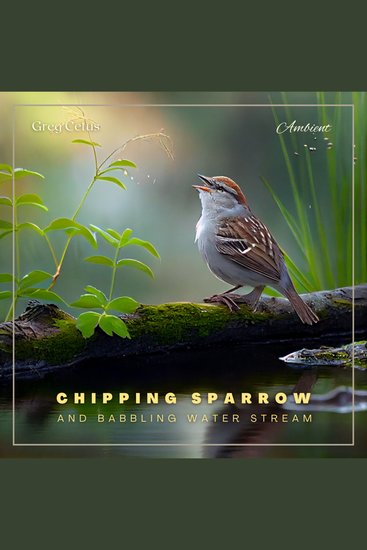
  • Chipping Sparrow and Babbling Water Stream - Morning Birdsongs and Water Streams for Peace and Relaxation - cover

    Chipping Sparrow and Babbling...

    Greg Cetus

    • 0
    • 0
    • 0
    The Chipping Sparrow is widely distributed throughout North America. It is a migratory species, typically inhabiting deciduous and coniferous forest habitats while breeding and moving to more open grassland areas during non-breeding periods. The Chipping Sparrow birdsong is characterised by bright musical trill usually of one or two notes. This binaural audio recording features the Chipping Sparrow birdsong recorded in its natural habitat in Minnesota’s Chippewa National Forest near a delicate babbling river stream together with other birds, insects, and ground creatures. Other birdsongs include: American Bittern, Swamp Sparrow, Yellow-bellied Sapsucker drumming, American Robin.
    Show book