Join us on a literary world trip!
Add this book to bookshelf
Grey
Write a new comment Default profile 50px
Grey
Subscribe to read the full book or read the first pages for free!
All characters reduced
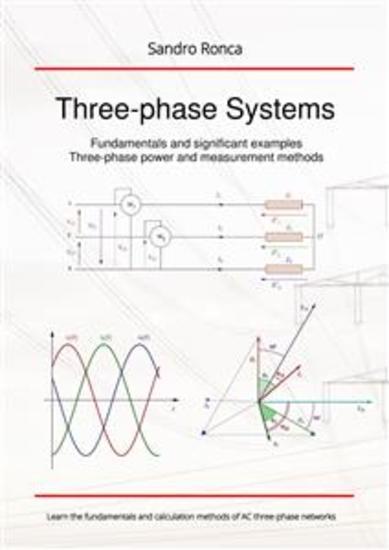
Three-phase Systems - Fundamentals and significant examples Three-phase power and measurement methods - cover

Three-phase Systems - Fundamentals and significant examples Three-phase power and measurement methods

Sandro Ronca

Publisher: Sandro Ronca - StreetLib

  • 0
  • 1
  • 0

Summary

The three-phase alternating current system is universally used in  production, transmission and utilization of electrical energy. Knowledge of the concepts and principles underlying its operation, as well as the methods of measuring characteristic quantities, is essential baggage for the technician skilled in electrical and electronic technologies.
The present volume, divided into three chapters: the three-phase system, three-phase power, and the measurement of three-phase power, enables the acquisition and deepening of the knowledge necessary to successfully tackle the courses of Electrical and Electronic Engineering of Technical Institutes, technological sector and is preparatory to university courses.
The text is accompanied by many illustrations that are particularly well edited for their didactic aspects. Each concept developed is followed by one or more explanatory examples and often concise summaries.
To test the knowledge acquired at the end of the chapters there will be significant problems to solve.

SANDRO RONCA
After studying Physics at the University of Padua, he dedicated himself to teaching Electrical and Electronic Technologies and Computer Science at Technical and Technological Institutes, paying attention to the didactic aspects of the subject. He has studied computer networks in depth and designed, at the request of industrial associations, courses for systems engineers and IT security workers.
Available since: 04/15/2024.
Print length: 133 pages.

Other books that might interest you

  • Is Mars Habitable? - cover

    Is Mars Habitable?

    Alfred Russel Wallace

    • 0
    • 0
    • 0
    In 1907 Wallace wrote the short book Is Mars Habitable? to criticize the claims made by Percival Lowell that there were Martian canals built by intelligent beings. Wallace did months of research, consulted various experts, and produced his own scientific analysis of the martian climate and atmospheric conditions. Among other things Wallace pointed out that spectroscopic analysis had shown no signs of water vapour in the Martian atmosphere, that Lowell's analysis of Mars's climate was seriously flawed and badly overestimated the surface temperature, and that low atmospheric pressure would make liquid water, let alone a planet girding irrigation system, impossible. (from Wikipedia)
    Show book
  • The Apothecary's Wife - The Hidden History of Medicine and How it Became a Commodity - cover

    The Apothecary's Wife - The...

    Karen Bloom Gevirtz

    • 0
    • 0
    • 0
    The running joke in Europe for centuries was that anyone in a hurry to die should call the doctor. As far back as ancient Greece, physicians were notorious for administering painful and often fatal treatments—and charging for the privilege. For the most effective treatment, the ill and injured went to the women in their lives. This system lasted hundreds of years. It was gone in less than a century. 


    Contrary to the familiar story, medication did not improve during the Scientific Revolution. Yet somehow, between 1650 and 1740, the domestic female and the physician switched places in the cultural consciousness: she became the ineffective, potentially dangerous quack, he the knowledgeable, trustworthy expert. The professionals normalized the idea of paying them for what people already got at home without charge, laying the foundation for Big Pharma and today's global for-profit medication system. A revelatory history of medicine, The Apothecary's Wife challenges the myths of the triumph of science and instead uncovers the fascinating truth. Drawing on a vast body of archival material, Karen Bloom Gevirtz depicts the extraordinary cast of characters who brought about this transformation. She also explores domestic medicine's values in responses to modern health crises, such as the eradication of smallpox, and what benefits we can learn from these events.
    Show book
  • Trivia That Make You Sleep Fast - cover

    Trivia That Make You Sleep Fast

    Meditative Sleep

    • 0
    • 0
    • 0
    Do you struggle to fall asleep at night? Are your thoughts racing, making it impossible to quiet your mind? Trivia That Makes You Sleep Fast is the perfect solution! This unique audiobook is packed with hilariously useless facts designed to lull you into a peaceful slumber. 
    From utterly random tidbits about obscure history to mind-numbing trivia about the most mundane things, every minute is crafted to gently bore your mind into tranquility. Did you know there’s a town in Norway that has a penguin for a knight? Or that honey never spoils? These are the types of irrelevant (but oddly fascinating) facts that will have you drifting off before you realize it. 
    Perfect for insomniacs, overthinkers, or anyone who just needs a break from the chaos of life, Trivia That Makes You Sleep Fast is like a cozy bedtime story for adults—minus the drama or complexity. Pop in your headphones, press play, and let your mind wander into dreamland. 
    Say goodbye to sleepless nights and hello to the most relaxing, oddly informative bedtime routine ever.
    Show book
  • Life on Mars - Myth Science and the Future - cover

    Life on Mars - Myth Science and...

    Aayush Agarawal

    • 0
    • 0
    • 0
    Life on Mars: Myth, Science, and the Future is a sweeping exploration of humanity’s long-standing fascination with the Red Planet—blending ancient myths, groundbreaking scientific discoveries, and the bold visions shaping our interplanetary future. From the god of war in ancient cultures to the canals imagined by 19th-century astronomers, from science fiction’s alien civilizations to the high-tech rovers searching for microbial life, Mars has always stirred the human imagination. 
    This book traces our evolving relationship with Mars—through culture, history, and cutting-edge research. It dives into the planet’s geology, climate, and potential for harboring life, while also confronting the challenges of colonization, terraforming, and space ethics. What does Mars teach us about life on Earth? Could it be our future home—or a silent witness to our ambitions? 
    Thoughtful, engaging, and deeply researched, Life on Mars offers readers a rich narrative of curiosity, discovery, and the unyielding human desire to reach for the stars.
    Show book
  • Creative Chemistry - cover

    Creative Chemistry

    Edwin E. Slosson

    • 0
    • 0
    • 0
    Slosson reviews the transformation of alchemistry from an obscure and imprecise practice to the science of chemistry. Along the way, he explains how the modern industrial world now relies on fertilizers, explosives, textile materials, polymers and metals.By exploring the properties of a once undervalued element, the high strength of vanadium steel made the Ford car possible. Another element, cerium, appears in butane lighters and was once seen as a threat to the match industry in France.In his chapter on oils, Slosson reviews the development of hydrogenated oils, especially during WWII, in the search for a way to reuse otherwise discarded components of corn and cottonseed. Through the revolutionary reaction of hydrogenation, waste materials became a stable product that wouldn't spoil when packaged or carried without refrigeration. Once thought of as a miracle, shoppers were once willing to pay more for fully hydrogenated oils than their natural, unsaturated forms. Only in recent years has evidence of health risks checked their popularity and given them the image of cheap, unhealthy fillers. (Summary by LivelyHive)
    Show book
  • From Terrain to Brain - Forays into the Many Sciences of Wine - cover

    From Terrain to Brain - Forays...

    Erika Szymanski

    • 0
    • 0
    • 0
    In From Terrain to Brain, Professor Erika Szymanski makes wine science accessible to non-experts. Rather than approach wine science as body of facts about wine, Szymanski explores how wine science can open up multiple ways of seeing, understanding, and appreciating wine. 


    Too often, wine science is presented as a comprehensive body of knowledge that enthusiasts aiming to become experts should memorize. This book instead uses scientific research to explore wine as an endlessly rich cultural phenomenon. By foregrounding recent research and developments in wine science, From Terrain to Brain presents wine science as a work-in-progress rather than a codified body of knowledge. 


    Each chapter takes listeners on a journey or "foray" through a topic in wine science, such as minerality, climate, microbiome, and yeast. Chapters are organized from "terrain" (geography, terroir, soil) and cell "membrane" (microbiology) through "brain" (the experience of tasting) and "drain" (sustainability). Throughout, From Terrain to Brain emphasizes that wine science, wine culture, and tradition are interconnected and places scientific research in social and historical context.
    Show book