Join us on a literary world trip!
Add this book to bookshelf
Grey
Write a new comment Default profile 50px
Grey
Subscribe to read the full book or read the first pages for free!
All characters reduced
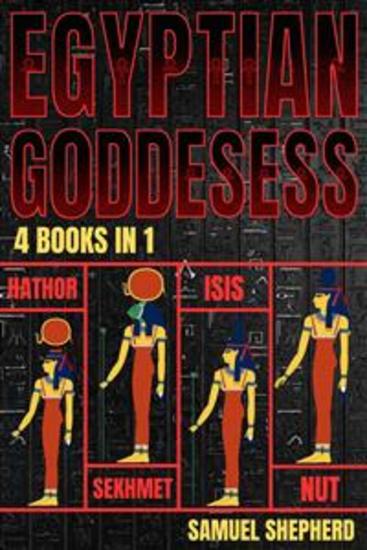
Egyptian Goddesses - Hathor Sekhmet Isis Nut - cover

Egyptian Goddesses - Hathor Sekhmet Isis Nut

Samuel Shepherd

Publisher: Samuel Shepherd

  • 0
  • 0
  • 0

Summary

🌟 **Discover the Divine Mysteries of Ancient Egypt** 🌟
Step into the world of ancient Egyptian mythology with our enchanting new series: **"Egyptian Goddesses: Hathor, Sekhmet, Isis, Nut"**. This collection unveils the profound roles and stories of four powerful goddesses who shaped the spiritual and cultural landscape of one of history's greatest civilizations. Each volume in this series explores a different deity, offering readers a deep dive into their divine attributes, rituals, and cosmic significance.
📚 **Book 1 - Hathor: Echoes of Joy** 🎶💃 
Explore the vibrant world of **Hathor**, the goddess of music, dance, and love. This volume delves into how her joyous essence influenced ancient Egyptian society, celebrated through music and rituals. Discover the rituals and celebrations dedicated to Hathor that embodied life’s exuberance and creativity.
📚 **Book 2 - Sekhmet: The Lioness's Roar** 🦁🔥 
Unveil the raw power of **Sekhmet**, the fierce lioness goddess known for her strength and wrath. This book reveals her dual role as both a warrior and a healer, showcasing how her ferocity was balanced with compassion. Learn about Sekhmet’s essential role in maintaining cosmic order and her revered place in Egyptian spirituality.
📚 **Book 3 - Isis: Veils of Magic** ✨🌟 
Dive into the mystical world of **Isis**, the goddess of magic and motherhood. This volume explores Isis’s magical prowess and her nurturing qualities, illustrating her influence on ancient Egyptian beliefs and practices. Discover how Isis’s spells and stories provided guidance and protection in both the mortal and divine realms.
📚 **Book 4 - Nut: Arch of the Sky** 🌌🌠 
Decode the celestial mysteries with **Nut**, the sky goddess who spanned the heavens. This book examines her role in the solar and lunar cycles and her significance as the cosmic vault. Explore the symbolism of Nut’s starry body and how her divine presence shaped the ancient Egyptians' understanding of the cosmos.
**Why You'll Love This Series**:
✨ Comprehensive insights into each goddess's divine attributes and cultural impact.
✨ Richly detailed illustrations and engaging narratives that bring ancient myths to life.
✨ A perfect blend of history, mythology, and spiritual exploration for enthusiasts and scholars alike.
Embrace the divine stories of these ancient goddesses and connect with the mystical essence of Egyptian spirituality. Whether you're a history buff, mythology lover, or just curious about the ancient world, this series offers a captivating journey into the heart of Egypt's most revered deities.
🛒 **Order Your Copies Today** and embark on a magical voyage through time with **"Egyptian Goddesses: Hathor, Sekhmet, Isis, Nut"**!
Available since: 07/25/2024.

Other books that might interest you

  • The Affair At Coulter's Creek - From their pens to your ears genius in every story - cover

    The Affair At Coulter's Creek -...

    Ambrose Bierce

    • 0
    • 0
    • 0
    Ambrose Gwinnett Bierce was born on 24th June 1842 at Horse Cave Creek in Meigs County, Ohio. His parents were poor but they introduced him to literature at an early age, instilling in him a deep appreciation of books, the written word and the elegance of language.  
    Growing up in Koscuisko County, Indiana poverty and religion were defining features of his childhood, and he would later describe his parents as “unwashed savages” and fanatically religious, showing him little affection but always quick to punish. He came to resent religion, and his introduction to literature appears to be their only positive effect. 
    At age 15 Bierce left home to become a printer’s devil, mixing ink and fetching type at The Northern Indian, a small Ohio paper. Falsely accused of theft he returned to his farm and spent time sending out work in the hopes of being published. 
    His Uncle Lucius advised he be sent to the Kentucky Military Institute. A year later he was commissioned as an Officer.  As the Civil War started Bierce enlisted in the 9th Indiana Infantry Regiment.  
    In April 1862 Bierce fought at the Battle of Shiloh, an experience which, though terrifying, became the source of several short stories. Two years later he sustained a serious head wound and was off duty for several months. He was discharged in early 1865.  
    A later expedition to inspect military outposts across the Great Plains took him all the way to San Francisco. He remained there to become involved with publishing and editing and to marry, Mary Ellen on Christmas Day 1871.  They had a child, Day, the following year.  
    In 1872 the family moved to England for 3 years where he wrote for Fun magazine. His son, Leigh, was born, and first book, ‘The Fiend’s Delight’, was published.  
    They returned to San Francisco and to work for a number of papers where he gained admiration for his crime reporting. In 1887 he began a column at the William Randolph Hearst’s San Francisco Examiner.  
    Bierce’s marriage fell apart when he discovered compromising letters to his wife from a secret admirer. The following year, 1889 his son Day committed suicide, depressed by romantic rejection. 
    In 1891 Bierce wrote and published the collection of 26 short stories which included ‘An Occurrence at Owl Creek Bridge’.  Success and further works including poetry followed.  
    Bierce with Hearst’s resources helped uncover a financial plot by a railroad to turn 130 million dollars of loans into a handout. Confronted by the railroad and asked to name his price Bierce answered “my price is $130 million dollars. If, when you are ready to pay, I happen to be out of town, you may hand it over to my friend, the Treasurer of the United States”.  
    He now began his first foray as a fabulist, publishing ‘Fantastic Fables’ in 1899.  But tragedy again struck two years later when his second son Leigh died of pneumonia relating to his alcoholism.  
    He continued to write short stories and poetry and also published ‘The Devil’s Dictionary’.  
    At the age of 71, in 1913 Bierce departed from Washington, D.C., for a tour of the battlefields where he had fought during the civil war. At the city of Chihuahua he wrote his last known communication, a letter to a friend. It’s closing words were “as to me, I leave here tomorrow for an unknown destination,” Ambrose Bierce then vanished without trace.
    Show book
  • A Home on Vorster Street - A Memoir - cover

    A Home on Vorster Street - A Memoir

    Razina Theba

    • 0
    • 0
    • 0
    As a young girl, Razina Theba makes her way every day to the tiny family flat on Vorster Street in Fordsburg. It is here, just outside of the Johannesburg city centre, where she grows up, playing in the Yard with countless cousins, learning to enjoy perfect syrupy paan and the best way to brew chai for her bajee. It is also where she observes her family’s harassment by the Security Branch, as well as her parents’ determination to make their business at the Oriental Plaza a success. 
      
    In A Home on Vorster Street, Razina witnesses the ebb and flow of a tight-knit neighbourhood trying to survive the forces of apartheid and, ultimately, where she learns of the value of family love and the enduring comfort it provides. 
      
    At times funny and charming and, at others, painful and tender, this dazzling collection of stories is a spirited exploration of a colourful Indian-Muslim family bound by loyalty to their culture, community, religion and each other.
    Show book
  • Life Unseen - A Story of Blindness - cover

    Life Unseen - A Story of Blindness

    Selina Mills

    • 0
    • 0
    • 0
    Imagine a world without sight. Is it dark and gloomy? Is it terrifying and isolating? Or is it simply a state of not seeing, which we have demonised and sentimentalized over the centuries? And why is blindness so frightening? 
     
    In this fascinating historical adventure, broadcaster and author Selina Mills takes us on a journey through the history of blindness in Western Culture to discover that blindness is not so dark after all. 
     
    Inspired by her own experience of losing her sight as she forged a successful journalistic career, Life Unseen takes us through a personal and unsentimental historical quest through the lives, stories and achievements of blind people - as well as those sighted people who sought to patronize, demonize and fix them. From the blind poet Homer, through the myths and moralising of early medieval culture to the scientific and medical discoveries of the Enlightenment and modern times, the story of blindness turns out to be a story of our whole culture.
    Show book
  • Mary Magdalene - Women the Church and the Great Deception - cover

    Mary Magdalene - Women the...

    Adriana Valerio

    • 0
    • 0
    • 0
    “Brilliant . . . Essential reading for anyone who cares about Church history and gender equality. . . . speaks to our times with impressive relevance.” —Reading in Translation 
     
    From one of Italy’s most renowned historians of religion, an exciting new portrait of one of Christianity’s most complex—and most misunderstood—figures: Mary Magdalene 
     
    Jesus’ favorite and most devoted disciple? A prostitute shunned from her community? A symbol of female leadership and independence? Who really was Mary Magdalene, and how does her story fit within the history of Christianity, and that of female emancipation? 
     
    In this meticulously researched, highly engaging book, Adriana Valerio looks at history, art, and literature to show how centuries of misinterpretation and willful distortion—aimed at establishing and preserving gender hierarchies—have stripped this historical figure of her complexity and relevance. 
     
    By revealing both the benign and the pernicious misrepresentations of Mary Magdalene, this thought-provoking essay reaffirms the central role played by women in the origins of Christianity and their essential contribution to one of the founding experiences of Western thought and society. 
     
    “Persuasive. . . . Academics working in Christianity should get much from this well-argued study.” —Publishers Weekly 
     
    “A masterful work.” —Osservatore Romano 
     
    “A short and readable yet sweeping and well-researched essay that stands out for its intellectual honesty [ . . . ] We are all Mary Magdalene.” —Cultura al femminile
    Show book
  • Famous Figures - Exploring the Lives of Extraordinary People (4 in 1) - cover

    Famous Figures - Exploring the...

    John Harpoon

    • 0
    • 0
    • 0
    This is a book bundle with four titles, which are: 
    - Eccentric Icons: Eccentricity has always held a peculiar charm, especially when it intertwines with fame. The world has an undeniable fascination with individuals who deviate from societal norms, and celebrities—already basking in the spotlight—amplify that intrigue when their beliefs and behaviors stray into the unconventional. These outliers captivate audiences not merely for their talents but for the mystique surrounding their lives and choices. 
    - Elites Unmasked: The power brokers of society have always operated behind a veil, their influence stretching across governments, corporations, and cultural institutions. These elites, shrouded in secrecy, wield disproportionate control over the mechanisms that shape our lives. This book seeks to unmask their agendas, exploring how they maintain power and why their influence often goes unchecked. 
    - Houdini's Last Trick: The story of Harry Houdini begins far from the glamour of theater stages and the awe-inspiring feats of magic that would later define his life. Born as Erik Weisz on March 24, 1874, in Budapest, Hungary, he was the fourth of seven children in a Jewish family facing the challenges of poverty. When Erik was four, his family emigrated to the United States, settling first in Appleton, Wisconsin. His father, Mayer Samuel Weisz, served as a rabbi, but his inability to sustain steady work placed the family in a constant struggle for survival. 
    - The Man Who Consumed Everything: Tarrare, a name that echoes through medical history as the embodiment of insatiable hunger, was a Frenchman whose life and condition baffled both his contemporaries and generations of scientists that followed. Born in 1772 in Lyon, France, to a poor farming family, Tarrare’s early years were marked by an extraordinary appetite that seemed to grow with him, quickly surpassing the needs of a typical child.
    Show book
  • My Secret Life Vol 8 Chapter 8 - cover

    My Secret Life Vol 8 Chapter 8

    Dominic Crawford Collins

    • 0
    • 0
    • 0
    My Secret Life is an anonymously penned memoir written during a period from the 1840s to the 1880s by a wealthy and sex obsessed English gentleman who refers to himself simply as ‘Walter’. Part confessional, part investigative erotic journalism, it meticulously documents every detail of the author’s prolific sexual encounters, offering us in the process an eye and thigh opening account of life behind closed doors in the Victorian age.
    
    Women, in both mind and body, were the all consuming object of Walter’s interest. From early youth through to old age his quest for erotic discovery and adventure with them was never diminished.
    
    Unlike contemporary 19th century erotic texts, such as The Pearl, whose sole object was to titillate, Walter’s interest in his subjects did not end with the extinguishing of the carnal flame. His hunger to understand the circumstances and minds of the women he encountered is never upstaged by the sex. Their potted life histories, their most intimate desires and acts were shared with him and in turn meticulously recorded by him, written down verbatim while still fresh in his mind.
    
    The resulting poignant record of a lost era and the intimate moments of the women who inhabited it offer us a remarkable insight into the 19th century that cannot be gleaned from any other source.
    
    The complete unabridged text is being released as a fully scored audiofilm (an audio book with accompanying music soundtrack) by film composer Dominic Crawford Collins.
    
    VOLUME 8 CHAPTER 8
    Lizzie's form and cunt. • Our next meeting. • Sarah frigs Lizzie. • The second gamahuche. • "What-ever is it." • The dress made up. • A dog fashion poke. • A stercoraceous furrow. • My disgust. • Lizzie's relations and antecedents. • About little boys' cocks. • Sarah's impecuniosity. • Lizzie's disclosures. • Sarah's Lesbian tastes. • "I don't like her thinging me." • A lupanar reminiscence. • A flat fucking baud. • Lizzie on Sarah. • Sarah's admissions. • Sarah drinks. • A flat fucking baud. • Lizzie on Sarah. • Sarah's admissions. • Sarah drinks. • A flat fucking exhibition. • Lizzie's sexual ignorance. • A masturbating essay. • "It spits."
    Show book