Join us on a literary world trip!
Add this book to bookshelf
Grey
Write a new comment Default profile 50px
Grey
Subscribe to read the full book or read the first pages for free!
All characters reduced
Essays on Life Art and Science - cover

Essays on Life Art and Science

Samuel Butler

Publisher: BookRix

  • 0
  • 0
  • 0

Summary

It is hardly necessary to apologise for the miscellaneous character of the following collection of essays. Samuel Butler was a man of such unusual versatility, and his interests were so many and so various that his literary remains were bound to cover a wide field. Nevertheless it will be found that several of the subjects to which he devoted much time and labour are not represented in these pages. I have not thought it necessary to reprint any of the numerous pamphlets and articles which he wrote upon the Iliad and Odyssey, since these were all merged in “The Authoress of the Odyssey,” which gives his matured views upon everything relating to the Homeric poems.
Available since: 12/19/2023.
Print length: 180 pages.

Other books that might interest you

  • On Youth and Old Age - Aristotle’s Reflections on Aging and Human Development - cover

    On Youth and Old Age -...

    Aristotle

    • 0
    • 0
    • 0
    What if you could unlock ageless wisdom to navigate life’s transitions with grace and understanding? 
    In this enlightening work, Aristotle reflects on the nature of youth and old age, offering insights into human development, energy, and vitality. Adapted for the modern reader, this timeless guide explores how we change physically, mentally, and socially across the lifespan—helping you embrace each stage of life with clarity and purpose. 
    What You’ll Discover in This Modern Translation:Aristotle’s perspectives on growth, maturity, and declinePractical ways to appreciate and optimize each life stageHow youth and old age shape our goals, desires, and actionsTimeless guidance for fostering well-being at any age 
    Imagine having a roadmap that helps you honor the gifts of youth, appreciate the wisdom of old age, and approach every chapter of life with renewed insight. Aristotle’s reflections illuminate a path toward greater fulfillment and self-awareness. 
    Begin your journey toward a deeper understanding of life’s stages. Get your copy now and tap into the enduring wisdom of one of history’s greatest thinkers.
    Show book
  • No Ordinary Day - Espionage betrayal terrorism and corruption - the truth behind the murder of WPC Yvonne Fletcher - cover

    No Ordinary Day - Espionage...

    Mat Johnson, John Murray

    • 0
    • 0
    • 0
    Winner of the Book of the Year and Reader's Choice awards at the 2024 CrimeCon True Crime Awards. Highly commended at the same awards for Outstanding Investigative Reporting. 
    Winner of the 2024 Capital Crime Fingerprint Award (True Crime). 
    Shortlisted for the 2024 Crime Writers Association ALCS Gold Dagger for non-fiction. 
    Behind one of the greatest tragedies in UK policing history lies an incredible political scandal 
    ‘An important book, especially now’ Lee Child 
    ‘Espionage, betrayal, terrorism, corruption and murder. All the ingredients of a Le Carré novel, only it’s real’ Matthew Hall 
    ‘A powerful and timely account’ John Sutherland 
    On 17 April 1984, as demonstrators gathered outside the Libyan embassy in London, two gunmen lay in wait inside. At 10.18 a.m. automatic gunfire rained down on the protestors and WPC Yvonne Fletcher fell, mortally wounded. 
    As his friend lay dying, PC John Murray made her a promise that he would not rest until those responsible had been brought to justice. Thirty-seven years would pass before he was able to fulfil that undertaking. 
    While researching this moving account of one man’s dogged pursuit of justice for a murdered colleague, Matt Johnson uncovered secret-service deals and government duplicity, all part of a plan to force an end to the National Union of Mineworkers’ strike. He discovered the real reason Yvonne’s killers were allowed to go free and how events that day led to thirty years of growing political control of policing, resulting in the disarray increasingly evident today. 
    This compelling account pulls seemingly unconnected threads into a coherent – and shocking – whole. It provides startling insights into how decisions taken by our politicians and the actions of our intelligence agencies, supposedly in our best interests, may be anything but.
    Show book
  • Holding the Line - A Lifetime of Defending Democracy and American Values - cover

    Holding the Line - A Lifetime of...

    Ronny Jackson

    • 0
    • 0
    • 0
    A behind-the-scenes political memoir written by a prominent White House physician. 
     
    I would talk to the president before the chief of staff even saw the president in the morning. I walked into work, and I was already in the Oval Office talking to President Trump. 
     
    It was rarely medical, to be honest with you; it was whatever was going on in the news. I’d be the first person he’d see in the morning. The president was completing tasks two to three hours before anybody else showed up in the West  
    Wing to work. He’d get up at five o’clock in the morning and would be watching TV, tweeting, making phone calls, and doing all types of other tasks. 
     
    President Trump would poke his head into my office or I’d walk out, and we would say, “Good morning. Did you see this or that?” He was always asking me about things on TV and what was going on, from Iran to Stormy Daniels. 
     
    He’d say, “Walk with me.” So I’d walk him to the Oval Office, and we’d talk about everything. I’d walk out through the outer Oval Office and the chief of staff, national security advisor, and even the CIA briefer would be standing there,  
    waiting to get in and talk to him. I’d walk out, they’d walk in, and his day would start. I was the first person he saw every morning and the last person he saw every evening when he went to bed.
    Show book
  • Phocion - Good Citizen in a Divided Democracy - cover

    Phocion - Good Citizen in a...

    Thomas R. Martin

    • 0
    • 0
    • 0
    "Elegant and enlightening." —Dominic Green, Wall Street Journal 


    Phocion (402–318 BCE) won Athens's highest public office by direct democratic election an unmatched forty-five times and was officially honored as a "Useful Citizen." A student at Plato's Academy, Phocion gained influence and power during a time when Athens faced multiple crises stemming from Macedonia's emergence as an international power under Philip II and his son Alexander the Great. Following Athens's defeat by Macedonia, Phocion unsuccessfully sought mild terms of surrender. Oligarchy was imposed on democratic Athens, and more than twelve thousand "undesirable" Athenians were exiled. When the oligarchic regime was overthrown and the exiles returned, dispossessed Athenians took out their volcanic anger on Phocion, who throughout his career had often been a harsh critic of the citizens' political decisions. His inflammatory rhetoric contributed to the popular conclusion that he lacked a genuine sense of belonging to the community he wished so desperately to preserve. When he was eighty-four, the Athenians convicted him of treason and condemned him to die by hemlock. In this fresh biography, Thomas R. Martin explores how and why Phocion ultimately failed as a citizen and as a leader. His story offers unsettling lessons for citizens in democracies today.
    Show book
  • Songbook - The Lyrics and Music of Steven Heighton - cover

    Songbook - The Lyrics and Music...

    Steven Heighton

    • 0
    • 0
    • 0
    From the award-winning, multi-genre author and musician Steven Heighton, Songbook brings together Heighton’s lyrics and music for the first time in a single volume, including his final songs, which have never been heard or seen until now. When Steven Heighton died suddenly of cancer in 2022, he was in the middle of an intensely creative period of songwriting. He released his first album of original material, The Devil’s Share, in 2021 and was preparing to record his second album. Known first as a poet, Heighton had always held that “music and poetry are two words for the same thing.”
    		 
    As in his songwriting, in Songbook, Heighton moves fluidly between genres and subjects, from political songs like “The Butcher’s Bill,” about the carelessness of nations sending their youth to war, to reimagining the myth of Orpheus (“I'll hold my breath the whole way down / And find your soul in the undertown”), to blues tunes like “Last Living Woman Alive,” and a tribute to the late John Prine, the “Buddha of Song.” With chords accompanying the lyrics, readers and musicians have the ability to bring the songs to life with their own interpretations. The music in Songbook was the final work of Heighton’s life, and it is not only a gift to have his lyrics and chords but an invitation from Heighton himself, challenging his readers to answer the call and keep singing along.
    Show book
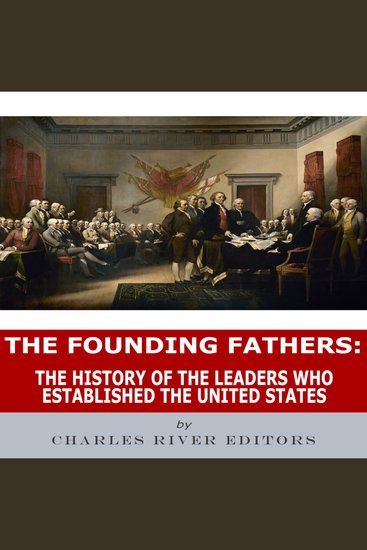
  • Founding Fathers The: The History of the Leaders Who Established the United States - cover

    Founding Fathers The: The...

    Editors Charles River

    • 0
    • 0
    • 0
    Before the United States of America even existed, the first American celebrity was Benjamin Franklin. In his career, Franklin was an author, printer, political theorist, politician, postmaster, scientist, musician, inventor, satirist, civic activist, statesman, and diplomat. After having his hand in all kinds of community service in Philadelphia, and inventing important devices like lightning rods, Franklin used his unique status as an international celebrity to become the colonies’ best diplomat, first as an ambassador to Britain and then as an ambassador to France during the American Revolution. Franklin was particularly revered in Enlightened France. 
    	Every American is taught a pristine narrative of the life and legacy of George Washington and can easily recite the highlights of the “Father of Our Country”. The remarkable Virginian led an under-resourced rag-tag army to ultimate victory in the American Revolution before becoming the nation’s first president, setting it on its path toward superpower status. He may not have actually chopped down a cherry tree or tossed a silver dollar across the Potomac, but his contemporaries considered his character above reproach. When Washington voluntary resigned as commander of the armies, he stunned the world. Everyone in the colonies and the world realized that Washington, at the head of the last army standing in the colonies, could have made himself king of the new United States on the spot, and it would have been a move supported by his rank and file soldiers. 
    	Nobody spent more time in the thick of these debates than Thomas Jefferson, one of the most famous and revered Americans. Jefferson was instrumental in all of the aforementioned debates, authoring the Declaration of Independence, laying out the ideological groundwork of the notion of states’ rights, leading one of the first political parties, and overseeing the expansion of the United States during his presidency.
    Show book