Join us on a literary world trip!
Add this book to bookshelf
Grey
Write a new comment Default profile 50px
Grey
Subscribe to read the full book or read the first pages for free!
All characters reduced
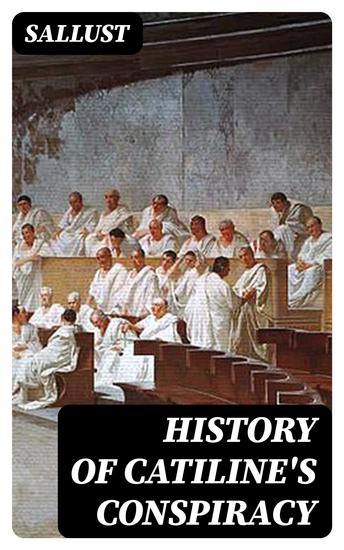
History of Catiline's Conspiracy - Enriched edition - cover

History of Catiline's Conspiracy - Enriched edition

Sallust

Translator William Rose

Publisher: DigiCat

  • 0
  • 0
  • 0

Summary

Sallust's "History of Catiline's Conspiracy" presents a gripping narrative that investigates the political turmoil of late Roman Republic, focusing on the failed coup led by Lucius Sergius Catilina in 63 BCE. Written in a concise and vivid prose style characteristic of Sallust, the text employs a moral viewpoint deeply influenced by his belief in the decay of Roman values and the moral responsibilities of citizenship. Through detailed accounts and sharp characterizations, Sallust examines themes of ambition, corruption, and the struggle for power, offering a lens into a pivotal moment of betrayal and disillusionment that resonates with contemporary political discourse. Sallust, a Roman historian and politician from the late Republic era, faced the surplus of internal conflict and corruption firsthand, serving in various political capacities before retreating into writing. This personal engagement with the tumultuous events of his time, coupled with his philosophical inclinations, informed his historiography, allowing him to critique the Republic's decline while exploring the psychological motives behind political actions. His earlier works, influenced by the tension between personal ethics and public duty, set the stage for this incisive analysis of Catiline's conspiracy. For readers interested in political history and its complexities, Sallust's "History of Catiline's Conspiracy" offers an essential exploration of ambition and moral decay, illuminating not only a significant event in Roman history but also timeless insights into the human condition. This classic work serves as a crucial reference for understanding the intricate dance of power and ethics in governance, making it a must-read for scholars and enthusiasts of historical narratives.

In this enriched edition, we have carefully created added value for your reading experience:
- A succinct Introduction situates the work's timeless appeal and themes.
- The Synopsis outlines the central plot, highlighting key developments without spoiling critical twists.
- A detailed Historical Context immerses you in the era's events and influences that shaped the writing.
- An Author Biography reveals milestones in the author's life, illuminating the personal insights behind the text.
- A thorough Analysis dissects symbols, motifs, and character arcs to unearth underlying meanings.
- Reflection questions prompt you to engage personally with the work's messages, connecting them to modern life.
- Hand‐picked Memorable Quotes shine a spotlight on moments of literary brilliance.
- Interactive footnotes clarify unusual references, historical allusions, and archaic phrases for an effortless, more informed read.
Available since: 08/10/2022.
Print length: 52 pages.

Other books that might interest you

  • How to Write a Novel - 49 Rules for Writing a Stupendously Awesome Novel That You Will Love Forever - cover

    How to Write a Novel - 49 Rules...

    Nathan Bransford

    • 0
    • 0
    • 0
    Author and former literary agent Nathan Bransford shares his secrets for creating killer plots, fleshing out your first ideas, crafting compelling characters, and staying sane in the process. Read the guide that New York Times bestselling author Ransom Riggs called "The best how-to-write-a-novel book I've read."
    Show book
  • America’s Westward Expansion Trails: The History and Legacy of the 19th Century’s Most Famous Routes to the West - cover

    America’s Westward Expansion...

    Editors Charles River

    • 0
    • 0
    • 0
    The Lewis and Clark Expedition, notwithstanding its merits as a feat of exploration, was also the first tentative claim on the vast interior and the western seaboard of North America by the United States. It set in motion the great movement west that began almost immediately with the first commercial overland expedition funded by John Jacob Astor’s Pacific Fur Company and would continue with the establishment of the Oregon Trail and California Trail.  
    The westward movement of Americans in the 19th century was one of the largest and most consequential migrations in history, and as it so happened, the paths were being formalized and coming into use right around the time gold was discovered in the lands that became California in January 1848. Located thousands of miles away from the country’s power centers on the East Coast at the time, the announcement came a month before the Mexican-American War had ended, and among the very few Americans that were near the region at the time, many of them were Army soldiers who were participating in the war and garrisoned there. San Francisco was still best known for being a Spanish military and missionary outpost during the colonial era, and only a few hundred called it home. Mexico’s independence, and its possession of those lands, had come only a generation earlier. 
    The most well-known is the Oregon Trail, which was not a single trail but a network of paths that began at one of four “jumping off” points. The eastern section of the Oregon Trail, which followed the Missouri River through Kansas, Nebraska, and Wyoming, was shared by people traveling along the California, Bozeman, and Mormon Trails. These trails branched off at various points, and the California Trail diverged from the Oregon Trail at Fort Hall in southern Idaho. From there, the Oregon Trail moved northward, along the Snake River, then through the Blue Mountains to Fort Walla Walla.
    Show book
  • Battle of Britain The: A Captivating Guide to One of the Most Critical Battles of World War II - cover

    Battle of Britain The: A...

    Captivating History

    • 0
    • 0
    • 0
    Did you know the Battle of Britain was the first major military campaign fought entirely in the air? 
    In the summer of 1940, Adolf Hitler and his henchman, Luftwaffe Commander-in-Chief Hermann Göring, began their attempt to clear the skies over England to invade Great Britain. Despite very long odds, the Royal Air Force stood its ground, prevented the German invasion, and helped turn the tide of WWII. 
    The valiant stand of the RAF fighter pilots (known today as “The Few” because of British Prime Minister Winston Churchill’s famous speech) not only saved England from Hitler but also motivated and inspired the people and leadership of the United States, which sent increasing amounts of weapons and supplies to the United Kingdom. 
    In Captivating History’s The Battle of Britain, you will learn about the following:The strategy and tactics of air warfare developed between WWI and WWIIHow the Germans secretly created the foundations of its WWII air force, the Luftwaffe, in the Soviet UnionHow young German men learned to fly even though they had no planesHow the British and Germans developed radar at almost the same time and how British radar was much more effective and better runThe women of the Women’s Auxiliary Air Force or WAAFsHow British and German fighters stacked up against each otherHow the Germans almost won the battleThe cost born by the British peopleSome of the most famous figures from the battle, such as Winston Churchill, Hermann Göring, Hugh Dowding, and many more 
    Scroll up and click the “add to cart” button to begin learning about the Battle of Britain!
    Show book
  • A Master Class In Krsna Bhakti - The Yoga Of Devotion - cover

    A Master Class In Krsna Bhakti -...

    Prana Govinda Das Spiritual...

    • 0
    • 0
    • 0
    "If you sell diamonds, you cannot expect to have many customers. But a diamond is a diamond even if there are no customers." A. C. Bhaktivedanta Swami Prabhupada 
     
    IF YOU ARE LOOKING FOR A DIAMOND - YOU HAVE COME TO THE RIGHT PLACE! Noted internationally known Self-help advocate and teacher of devotional yoga Prana Govinda Das was born in Liverpool, England in 1968 admittedly a pretty good year for all things bright and beautiful. He says, 'From as early as I can remember I had an unquenchable thirst for knowledge, and a desire to understand the true nature of man and this world we live in. I was also always seeking out people who could answer all the questions I had about life, the universe, and everything.' After studying film production in the early nineties Prana was able to fulfill his lifelong desire to travel to India. admittedly his first trip changed his life completely and forever. 'At that point,' He recalls, 'my thirst for material knowledge turned to a desire to understand the spiritual side of life. For the next six years, I returned frequently, where I studied many different paths of Hinduism, Buddhism, and other forms of yoga and meditation. However, even after learning and experiencing so much I was still left incomplete.' in 2001 during the young man's sixth trip to India, he traveled to Vrindavan, a holy town associated with Lord Krishna south of Delhi. It was there he met his spiritual guide, and mentor Srila Bhaktivedanta Narayana Goswami. Some twenty years on, Prana has been resident in his teacher's temples all over the world, particularly in India, Australia, America, and Europe. A wonderful audio adventure for everyone to enjoy!
    Show book
  • Social Contract The - Jacques Rosseau - cover

    Social Contract The - Jacques...

    Jean-Jacques Rosseau

    • 0
    • 0
    • 0
    The Social Contract  is a 1762 French-language book by the Genevan philosopher Jean-Jacques Rousseau. The book theorizes about the best way to establish a political community in the face of the problems of commercial society, which Rousseau had already identified in his Discourse on Inequality (1755). 
    The Social Contract helped inspire political reforms or revolutions in Europe, especially in France. The Social Contract argued against the idea that monarchs were divinely empowered to legislate. Rousseau asserts that only the people, who are sovereign, have that all-powerful right.
    Show book
  • A Rare Recording of Thomas Watson Explaining the Invention of the Telephone - cover

    A Rare Recording of Thomas...

    Thomas Watson

    • 0
    • 0
    • 0
    Born in Salem, Massachusetts, Thomas A. Watson (January 18, 1854 - December 13, 1934) was a bookkeeper and a carpenter before he found a job more to his liking in the Charles Williams machine shop in Boston. He was then hired by Alexander Graham Bell, who was a professor at Boston University. They were known for the invention of the telephone.
    Show book