Join us on a literary world trip!
Add this book to bookshelf
Grey
Write a new comment Default profile 50px
Grey
Subscribe to read the full book or read the first pages for free!
All characters reduced
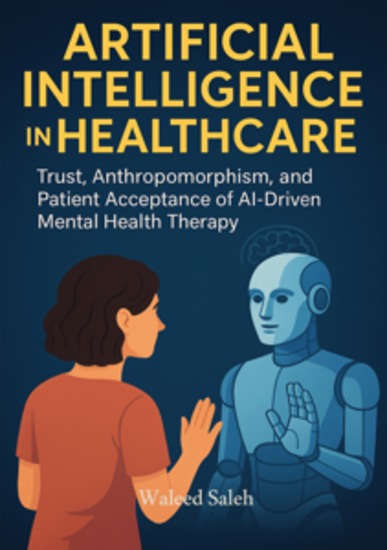
Artificial Intelligence in Healthcare - Trust Anthropomorphism and Patient Acceptance of AI-Driven Mental Health Therapy - cover

Artificial Intelligence in Healthcare - Trust Anthropomorphism and Patient Acceptance of AI-Driven Mental Health Therapy

Saleh Waleed

Publisher: Waleed Saleh

  • 0
  • 0
  • 0

Summary

Artificial Intelligence in Healthcare: Trust, Anthropomorphism, and Patient Acceptance of AI-Driven Mental Health Therapy is a groundbreaking and empirically driven exploration into how emerging AI technologies are reshaping mental healthcare. This expertly researched book examines the critical human factors—trust, self-disclosure, and the human-like design of AI avatars—that determine whether patients accept and benefit from AI-driven therapy systems.Drawing on data from over 800 participants and grounded in interdisciplinary theoretical frameworks, the book offers valuable insights into how anthropomorphic AI avatars can deliver therapeutic value while navigating the psychological, cultural, and ethical complexities of mental healthcare. With chapters covering everything from AI system design to real-world implementation challenges, this work provides healthcare providers, technologists, and policymakers with actionable recommendations for developing effective and ethical AI mental health solutions.Whether you are a researcher, practitioner, or digital health innovator, this book delivers a compelling vision for a future where AI and human compassion work together to make mental health support more accessible, trustworthy, and effective.
Available since: 06/19/2025.

Other books that might interest you

  • The Cherubim and the Flaming Sword - cover

    The Cherubim and the Flaming Sword

    Pastor Philip

    • 0
    • 0
    • 0
    When God drove Adam and Eve out of the Garden of Eden,   He placed a Cherubim and a Flaming Sword on the east side of the Garden of Eden to guard the way to the Tree of Life. The significance of the cherubim and the flaming sword still exists today. The song, 'Don't You Know' sung by Chey at the end of the sermon, gives the listener an opportunity to reflect on the sermon.
    Show book
  • Done - A rich portrait of visual sound for those going through personal heartfelt change and psychological self help - cover

    Done - A rich portrait of visual...

    Alex Kashevaroff, Bethany Dalton

    • 0
    • 0
    • 0
    "Done." is a self help tool, led by a psychologist to complete something in your life like a divorce, a project, or making decisions and moving forward to completion. 
    Alex Kash is a healing musician, vocalist, songwriter, performer, music publisher and member of the consciousness movement. 
    Bethany Dalton is a leader in the consciousness movement, who was educated at the California Institute of Integral studies, the Hakomi Institute, Portland State University and more.
    Show book
  • The Art of the Pharaohs - Sculptures Paintings and Jewelry - cover

    The Art of the Pharaohs -...

    Omar Khalil

    • 0
    • 0
    • 0
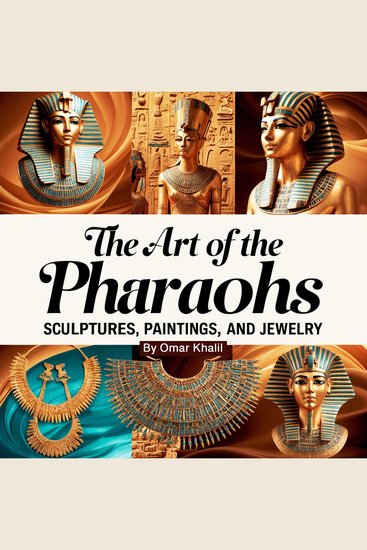
    Ancient Egyptian art is one of the most iconic and influential art forms in history. Spanning over three millennia, it provides a deep insight into the culture, religion, and beliefs of ancient Egyptian society. The art of Egypt is characterized by its symbolic use of colors, the strict adherence to formal rules of representation, and its focus on the afterlife. It was primarily created for religious, funerary, and commemorative purposes, serving as a medium to honor the gods and pharaohs, as well as to ensure a successful passage into the afterlife for the deceased. 
    The origins of Egyptian art can be traced back to the early dynastic periods, where it evolved in response to both religious needs and political structures. As the power of the pharaohs grew, so did the complexity and grandeur of Egyptian art. The early works were heavily influenced by the religious beliefs that governed life and death. Art was not seen as a form of personal expression but rather as a tool to serve divine and societal purposes. The rigid style and symbolic representations seen in Egyptian art reflect the culture's focus on order, permanence, and the divine, rather than individualism or naturalism. 
    Key materials used in Egyptian art included stone, wood, and metals, often adorned with vibrant pigments. The Egyptians were skilled in creating sculptures, jewelry, and paintings that survived for thousands of years due to their mastery of preservation techniques. The most recognizable aspects of Egyptian art include the distinctive posture and proportions in their sculptures, as well as the use of vibrant, symbolic colors in their paintings. These works were often intended for tombs, temples, and other sacred spaces, ensuring the continued favor of the gods and providing a connection to the divine realm.
    Show book
  • Jack and Rochelle - A Holocaust Story of Love and Resistance - cover

    Jack and Rochelle - A Holocaust...

    Jack Sutin, Rochelle Sutin

    • 0
    • 0
    • 0
    In this gripping memoir, Jack and Rochelle Sutin recount their experiences as Jewish resistance fighters during World War II, a story that ranges from extreme horror to poignant triumph. Told through their son Lawrence, the book brings alive the reality of months spent hidden in a dank underground bunker infested with lice and disease. Jack and Rochelle is more than just an account of stark survival, however. It is also the tale of an almost impossible love affair that has lasted over fifty years, and an eloquent reminder that history is made up of the often deeply moving details of individual lives.
    Show book
  • Inequality and Society - Prosperity and Poverty in Modern Society - cover

    Inequality and Society -...

    Fred Grandsen

    • 0
    • 0
    • 0
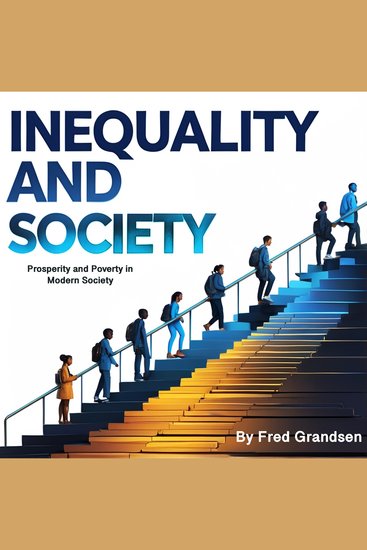
    Social inequality is a fundamental issue in societies around the world, shaping access to resources, opportunities, and quality of life. It refers to the uneven distribution of wealth, power, and privileges among individuals and groups, often determined by factors such as class, race, gender, and education. While some level of inequality has existed in every human society, modern economic and social structures have amplified disparities, making it a crucial area of study for sociologists, policymakers, and activists. 
    Throughout history, social inequality has taken various forms, from rigid caste systems to economic hierarchies based on capitalism. Industrialization and globalization have contributed to both the expansion of wealth and the widening of income gaps, leaving marginalized communities struggling for economic security and social recognition. The effects of inequality are not just economic; they extend into healthcare, education, political representation, and overall well-being. 
    One of the most significant consequences of inequality is the limitation it places on social mobility. In an ideal society, individuals would have the opportunity to improve their social and economic standing based on merit and effort. However, entrenched social hierarchies often make it difficult for those born into poverty or discrimination to break free from their circumstances. Access to education, employment opportunities, and healthcare remains largely determined by socioeconomic status, further reinforcing generational cycles of disadvantage.
    Show book
  • Summary of Good to Great - A Guide to The Book by Jim Collins from Boiled Down Basics - cover

    Summary of Good to Great - A...

    Kevin Brandt

    • 0
    • 0
    • 0
    This is a summary of the book Good to Great which is considered to be the most widely read of Jim Collins' work. This book takes a deep dive into the inner workings of companies that have achieved greatness. This summary takes a straightforward approach to helping you learn the most important points from Good to Great. 
    This Boiled Down Basics guide condenses the theories and key points of Good to Great, saving you time and money!
    Show book