Begleiten Sie uns auf eine literarische Weltreise!
Buch zum Bücherregal hinzufügen
Grey
Einen neuen Kommentar schreiben Default profile 50px
Grey
Jetzt das ganze Buch im Abo oder die ersten Seiten gratis lesen!
All characters reduced
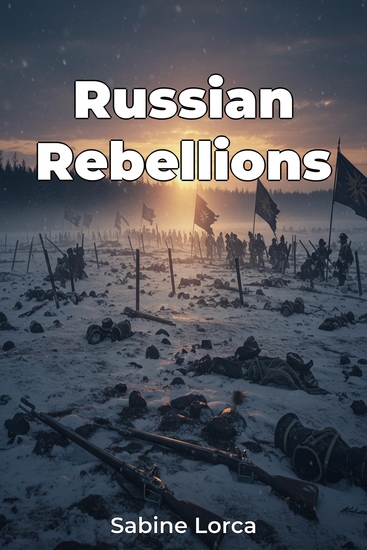
Russian Rebellions - cover

Russian Rebellions

Sabine Lorca

Übersetzer A AI

Verlag: Publifye

  • 0
  • 0
  • 0

Beschreibung

Russian Rebellions explores the persistent theme of violent uprisings throughout Russia's history, from peasant revolts to military mutinies. It examines how these rebellions reshaped Russian history, influencing national policies and leadership. The book highlights the socio-economic conditions, such as serfdom and social inequality, fueling popular discontent and the critical role of military insubordination in destabilizing autocratic rule. For instance, the Time of Troubles exemplified a period of profound instability that spurred significant social and political changes. The book progresses chronologically, analyzing specific rebellions like the Stenka Razin revolt and the Decembrist revolt, detailing their causes, key figures, and outcomes. By investigating both large-scale peasant wars and military mutinies, it reveals the complex interplay between popular grievances, leadership failures, and the state's repressive capabilities. Ultimately, Russian Rebellions synthesizes these case studies to identify recurring patterns, providing a comprehensive understanding of how rebellions have shaped Russian identity and political culture.
Verfügbar seit: 21.03.2025.
Drucklänge: 59 Seiten.

Weitere Bücher, die Sie mögen werden

  • Ordinary People Extraordinary Choices: Inside Poland’s Hidden Horrors - "Unlock the gripping tales of Ordinary People Extraordinary Choices with immersive audio lessons that captivate and inspire!" - cover

    Ordinary People Extraordinary...

    Alden Merrick

    • 0
    • 0
    • 0
    Ordinary People, Extraordinary Choices: Inside Poland’s Hidden Horrors 
    ⭐⭐ Simplified Guide & Explanations Included ⭐⭐   
    Are you eager to advance in your understanding and solidify your insights into the hidden horrors of Poland’s history?   
    Looking for a comprehensive resource that covers everything necessary to grasp the profound stories of resilience amidst adversity?   
    Your search ends here!   
    This guide serves as your ultimate companion for deepening your understanding, applying your insights, and engaging in meaningful explorations. With this, you're set for an enlightening journey.   
    Updated for the latest exploration of Poland’s hidden narratives.   
    Key features of this enriched guide:   
    - Profound insights into Poland’s hidden history   
    - Detailed explanations of resilience in adversity   
    - Effective strategies for understanding and engaging with the material   
    Our guide stands out with its thorough coverage, vital for a profound comprehension of the subject. Concepts aren’t just briefly touched upon; they are explored with depth and clarity.   
    Designed with clarity and straightforward language, our guide ensures seamless transitions between topics. Say farewell to complex jargon and embrace clear, precise, and informative content.   
    So, why wait? Click the BUY NOW button, secure your guide, and commence your journey into the extraordinary stories of resilience and human choice!  
    Zum Buch
  • The Night Trains - Moving Mozambican miners to and from the Witwatersrand Mines 1902–1955 - cover

    The Night Trains - Moving...

    Charles van Onselen

    • 0
    • 0
    • 0
     ON THE NIGHT TRAINS, THE LAST STOP WAS ALWAYS HELL. 
    The price exacted from across the African subcontinent for South Africa’s stalled 20th-century industrial revolution is, in human terms, still largely hidden from history. For half a century, up to the mid-1950s, privately operated trains travelled by night between Ressano Garcia, on the Mozambique border, and Booysens station, in Johannesburg. The night trains carried Mozambicans recruited to work in the mines of the booming Witwatersrand. The up-trains disgorged their human cargo into the maw of the great Rand mining machine, while the down-trains whisked away the time-expired miners – often ill, broken or insane, and preyed on by con men, petty criminals and corrupt officials. While mine labour was recruited from all over southern Africa, Mozambican migrants made up the largest component, and they paid the highest price. 
      
    Charles van Onselen clinically reconstructs the world of the night trains, which were run as a partnership between the mining houses and the railways. By tracing the up and down rail journeys undertaken by black migrants over half a century it is possible to discern how racial thinking, expressed logistically, reflected South Africa’s evolving systems of segregation and apartheid. Mirroring the brutal logic of industrial capitalism, this was a system of transport designed to maximise profit at the expense of the health, well-being and even the lives of those it conveyed. 
    The story of the night trains echoes today through songs such as ‘Stimela’ and ‘Shosholoza’. But the experience of the poverty-stricken Mozambicans who travelled on the trains has never been told. THE NIGHT TRAINS lays bare this hellish world.
    Zum Buch
  • Cryptography in World War I: The History of the Efforts to Make and Break Secret Codes during the Great War - cover

    Cryptography in World War I: The...

    Editors Charles River

    • 0
    • 0
    • 0
    World War I was the first major conflict in which new electronic means of transmitting and receiving messages became a major factor in political and military operations. The electric telegraph was developed in the first half of the 19th century, and by 1850, there were several telegraph companies around the world providing a service that allowed virtually instantaneous communication over long distances. This was a major breakthrough, but the telegraph depended on the availability of wires to transmit messages between stations, meaning that if these wires were broken or damaged, communications were cut off. 
    	Late in the 19th century, there was another new development, the telephone, though this too relied on wires to transmit and receive information. At the same time, there was a new invention that provided instant voice and Morse code communication over long distances that did not require wires. Initially called wireless, radio was quickly adopted by armies around the world as a way of providing rapid communication between military units. By the time World War I began in 1914, all the major nations involved had provided their forces with some form of radio equipment. 
    	Of course, this came with a fundamental problem: radio, telephone, and telegraph messages could be intercepted by the enemy, potentially giving them notice of impending operations. To protect these electronic messages from being read by the enemy, armies began to use codes and ciphers to disguise the meaning of messages. Teams were created to devise effective codes and ciphers, and these were quickly followed by other teams whose role was to attempt to break the codes and ciphers used by the other side. As a result, a secret war began, almost completely hidden from public view, as the belligerents devised complex ways of hiding the real meaning of their own messages while simultaneously attempting to understand those of the enemy. 
    Zum Buch
  • Break Free: Ignite Your Path to Lasting Freedom and Joy - "Discover 'Break Free': Engaging audio tools designed to lead you to enduring freedom and happiness!" - cover

    Break Free: Ignite Your Path to...

    Caelum Hawkes

    • 0
    • 0
    • 0
    Break Free: Ignite Your Path to Lasting Freedom and Joy 
    ⭐⭐ Simplified Guide & Explanations Included ⭐⭐ 
    Are you eager to elevate your personal growth and deepen your connections through shared experiences? 
    Searching for a thorough guide that encompasses all the essential elements to foster healing and connection? 
    Your quest ends here! 
    This guide acts as your ultimate companion for enhancing your understanding, honing your skills, and engaging in practical exercises. With this resource, you’re set up for genuine success. 
    Updated for the latest structure of personal development practices. 
    Key features of this enriched guide: 
    - In-depth insights on the journey towards healing and connection  
    - Comprehensive explanations of transformative practices 
    - Effective strategies for preparation and engagement 
    Our guide stands out due to its extensive coverage, crucial for achieving personal breakthroughs. Concepts are not merely touched upon; they are explored with care and depth. 
    Please note that this guide is an independent resource and is not associated with any official healing organizations. 
    Crafted with a clear layout and straightforward language, our guide ensures smooth transitions between topics. Say goodbye to complex terminology and embrace clear, precise, and technically sound content. 
    So, why delay? Click the BUY NOW button, secure your guide, and embark on your transformative journey towards lasting freedom and joy!
    Zum Buch
  • Blood and Treasure - The Economics of Conflict from the Vikings to the Modern Era - cover

    Blood and Treasure - The...

    Duncan Weldon

    • 0
    • 0
    • 0
    Wars are expensive, both in human terms and monetary ones. But while warfare might be costly it has also, at times, been an important driver of economic change and progress. Over the long span of history nothing has shaped human institutions—and thus the process of economic development—as much as war and violence. Wars made states and states made wars. As the costs of warfighting grew so did state structures, taxation systems and national markets for debt. And as warfare became ever more destructive the incentive for governments to resort to it changed too. 
     
    Blood and Treasure looks at the history and economics of warfare from the Viking Age to the war in Ukraine, examining how incentives and institutions have changed over the centuries. It surveys how warfare helped drive Europe's rise to global prominence, and it explains how the total wars of the twentieth century required a new type of strategy, one that took economics seriously. 
     
    Underpinning this riveting narrative is a focus on how and why the economics of conflict have changed over time. This is a story of how economics can help to explain the motivations of war, and how understanding the history of warfare can help explain modern economics.
    Zum Buch
  • Success among Nations - cover

    Success among Nations

    Emil Reich

    • 0
    • 0
    • 0
    Step into a sweeping, provocative tour of world history that asks a timeless question: why do some nations surge ahead while others stall or fall? In Success Among Nations, Emil Reich blends grand narrative with sharp psychological insight to trace the forces—economic, political, intellectual, and spiritual—that have shaped civilizations from ancient Egypt and Babylon to Greece, Rome, Renaissance Italy, modern France, Germany, Britain, Russia, and the United States. 
    This audiobook doesn’t just recount events; it dissects the human energies beneath them. Reich argues that prosperity and culture rarely rise together, that geography and city-states matter more than “race,” that alphabets and institutions can change the fate of continents, and that over-intellectualization can sap a people’s will just as surely as luxury can dull its edge. He juxtaposes Carthage’s commercial genius with Rome’s statecraft, Athens’s artistic brilliance with its political fragility, Venice’s maritime ascent with its eclipse after the Age of Discovery, and the middle-class engine of European modernity with Russia’s struggle for a true bourgeois core. Along the way, he explores how empires are won and lost, why religious movements with tiny beginnings reshape continents, and how character—national and personal—steers destiny. 
    Reich writes with bracing clarity and fearless opinion, drawing bold connections between past and present. You’ll meet conquerors and city builders, merchants and monks, reformers and revolutionaries—and see how canals, scripts, schools, armies, churches, and marketplaces forged the modern world. Whether examining the anatomy of British sea power, the organizational genius of the Jesuits, the civic soil that cultured Greek tragedy and science, or the restless dynamism of America, this is history as diagnosis and forecast.
    Zum Buch