Join us on a literary world trip!
Add this book to bookshelf
Grey
Write a new comment Default profile 50px
Grey
Subscribe to read the full book or read the first pages for free!
All characters reduced
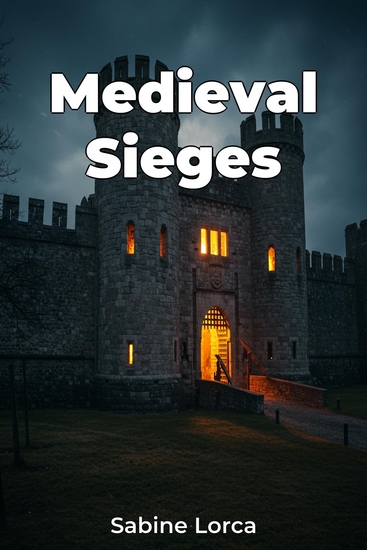
Medieval Sieges - cover

Medieval Sieges

Sabine Lorca

Translator A AI

Publisher: Publifye

  • 0
  • 0
  • 0

Summary

Medieval sieges, a critical aspect of military history, involved more than just brute force. From 500 to 1500 AD, siege warfare was a complex interplay of strategy, technology, and psychology. The success of a siege depended on logistical planning, engineering prowess, and exploiting vulnerabilities in the enemy's defenses. Starvation, disease, and psychological tactics were as crucial as battering rams and trebuchets in determining the outcome of these conflicts.

 
Medieval Sieges explores the multifaceted nature of these engagements. It delves into siege tactics and engineering, defensive innovations like concentric castles, and the grim realities of starvation and disease. Specific historical examples, such as the sieges of Constantinople, Acre, and Orleans, illustrate the interplay between offensive and defensive strategies.

 
The book progresses from fundamental principles to offensive and defensive technologies, psychological warfare, and long-term societal consequences. The book uncovers how sieges influenced military technology, power dynamics, and the social fabric of the era. It integrates military history with social and cultural history, providing a nuanced understanding of siege warfare, emphasizing the human dimensions of these prolonged and brutal conflicts.
Available since: 03/21/2025.
Print length: 67 pages.

Other books that might interest you

  • Breaking In - A First-Time Gay Tale - cover

    Breaking In - A First-Time Gay Tale

    Jane Fox

    • 0
    • 0
    • 0
    Kase, a slim, muscular young thief, just broke into the wrong place. When he discovers he's in a warehouse sex club run by a criminal named Ulrich, he wants to run. Ulrich knows just what to do with guys like him. But before Ulrich can do too much damage, Kase is rescued by one of Ulrich's men, Rabies, who is immediately attracted to Kase, and makes him a lucrative offer to join their club parties. Kase is afraid; he insists he's not into guys. And the violence in Ulrich's eyes terrifies him. But when Kase has to come up with quick cash or get thrown out of his home, will he give in to Rabies and go work for Ulrich at the club? Or will he, in the process, manage to steal Rabies' heart?
    Show book
  • We Wanted Workers - Unraveling the Immigration Narrative - cover

    We Wanted Workers - Unraveling...

    George J. Borjas

    • 0
    • 0
    • 0
    We are a nation of immigrants, and we have always been concerned about immigration. As early as 1645, the Massachusetts Bay Colony began to prohibit the entry of "paupers." Today, however, the notion that immigration is universally beneficial has become pervasive. To many modern economists, immigrants are a trove of much-needed workers who can fill predetermined slots along the proverbial assembly line. 


    But this view of immigration's impact is overly simplified, explains George J. Borjas, a Cuban American, Harvard labor economist. Immigrants are more than just workers—they're people who have lives outside of the factory gates and who may or may not fit the ideal of the country to which they've come to live and work. Like the rest of us, they're protected by social insurance programs, and the choices they make are affected by their social environments. 


    In We Wanted Workers, Borjas shows that, in the grand scheme, immigration has not affected the average American all that much. But it has created winners and losers. The losers tend to be nonmigrant workers who compete for the same jobs as immigrants. And somebody's lower wage is somebody else's higher profit, so those who employ immigrants benefit handsomely. In the end, immigration is mainly just another government redistribution program.
    Show book
  • Disability and Political Representation - cover

    Disability and Political...

    Elizabeth Evans, Stefanie Reher

    • 0
    • 0
    • 0
    Disability and Political Representation explores how disabled people experience the various stages and aspects of the representation process, drawing upon extensive empirical research and a variety of qualitative and quantitative data. It discusses why increasing the number of disabled politicians matters, not only as a matter of justice and equality but also to better represent the issues and interests of importance to disabled people. 


    Evans and Reher identify a variety of ableist barriers that prevent disabled people from fully participating in the political process, from disenfranchisement and inaccessible polling stations to prejudice within parties and a lack of financial support for candidates who require adjustments. The work shows that while the preferences of disabled citizens are currently under-represented in parliament, disabled representatives often draw on their lived experience to advocate for their interests. The concept of experiential representation is developed to help scholars and practitioners better navigate the concept of political representation, specifically as it relates to disability.
    Show book
  • History of Bulgaria - Its Culture Social Structure Religion Wars and Government - cover

    History of Bulgaria - Its...

    Kelly Mass

    • 0
    • 0
    • 0
    The history of Bulgaria is rich and complex, tracing its roots from the earliest settlements in the region to its emergence as a modern nation-state. The story of the Bulgarian people is intertwined with their origins, showcasing a diverse tapestry of cultures, languages, and traditions that have evolved over millennia. 
    Early Settlements and Civilization 
    Bulgaria's history dates back to around 5000 BC, when sophisticated societies flourished in the region. Archaeological discoveries indicate that these early inhabitants produced some of the world's first pottery, jewelry, and gold artifacts, demonstrating advanced craftsmanship and artistic expression. These early civilizations laid the groundwork for the rich cultural heritage that would follow. 
    Around 3000 BC, the Thracians, an ancient group known for their warrior culture and vibrant traditions, migrated to the Balkan Peninsula. The Thracians were renowned for their contributions to art and culture, as well as their complex social structures. By the late 6th century BC, parts of what is now Bulgaria, particularly in the eastern regions, came under the control of the Persian Achaemenid Empire, illustrating the geopolitical significance of the area at that time. 
    The Thracian Kingdom and Cultural Interactions 
    In the 470s BC, the Thracians established the formidable Odrysian Kingdom, which became a significant power in the Balkans. This kingdom lasted until 46 BC when it was ultimately conquered by the expanding Roman Empire. Throughout their history, various Thracian tribes experienced domination by neighboring civilizations, including the Ancient Macedonians, Hellenistic cultures, and Celts.
    Show book
  • Life in the Confederate Army - Observations and Experiences of a Foreigner in the South During the American Civil War - cover

    Life in the Confederate Army -...

    William Watson

    • 0
    • 0
    • 0
    Life in the Confederate Army is a firsthand account of a Confederate State Army solider William Watson. The book was written shortly after the war and it chronicles author's army life.Watsonjoined the local Rifle Volunteers, and when the Civil War broke out enlisted in the Confederate Army. As a sergeant in the 3rd Louisiana Infantry the author served in a number of military campaigns with the regiment. He was an eye witness and participant of Oak Hills, Pea Ridge and Beechgrove battles.
    Show book
  • Saving Michelangelo’s Dome - How Three Mathematicians and a Pope Sparked an Architectural Revolution - cover

    Saving Michelangelo’s Dome - How...

    Wayne Kalayjian

    • 0
    • 0
    • 0
    1742: the famous dome atop Saint Peter's Basilica, designed by Michelangelo, is fractured and threatened with collapse. The dome is the pride of Italy and the largest of its kind anywhere in the world. And no one knows how to fix it. 


    This engaging and colorful narrative tells the overlooked story of how Michelangelo's Dome was saved from disaster by three mathematicians and Pope Benedict XIV, who had asked them for help. It is a gripping story of decisive leadership, crisis management, and scientific innovation, and the resistance that was faced when sailing into the headwinds of conventional thought. 


    In Saving Michelangelo's Dome, Stanford-trained engineer Wayne Kalayjian illustrates how new ideas in science and mathematics established an entirely new way of looking at the world—as well as solving its complex problems. In the end, listeners will appreciate that in saving Michelangelo's Dome from collapse, these three mathematicians and one determined pope unknowingly invented the profession of engineering as we practice it today. With it, they transformed the architectural world and ushered in generations of future buildings and structures that, otherwise, would never have been built.
    Show book