Join us on a literary world trip!
Add this book to bookshelf
Grey
Write a new comment Default profile 50px
Grey
Subscribe to read the full book or read the first pages for free!
All characters reduced
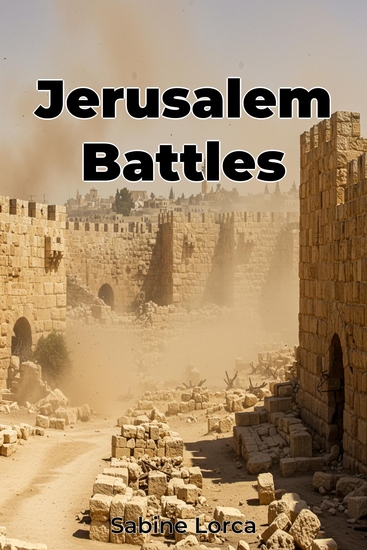
Jerusalem Battles - cover

Jerusalem Battles

Sabine Lorca

Translator A AI

Publisher: Publifye

  • 0
  • 0
  • 0

Summary

Jerusalem Battles explores the city's tumultuous history as a focal point of military, religious, and political conflict. Examining key battles from ancient sieges to modern warfare, the book reveals how Jerusalem's strategic location and profound religious significance have made it a perpetual battleground. One intriguing aspect is how theological interpretations and political motivations consistently influenced military decisions. 

 
The book chronologically dissects major battles, such as those during the Crusades, World War I, and the Arab-Israeli wars, analyzing military strategies, key figures, and the resulting demographic and political shifts. Primary source accounts, maps, and archaeological findings enrich the narrative, offering multifaceted perspectives on the human experience of war in Jerusalem.

 
The interdisciplinary approach, weaving together military history with religious studies and political science, highlights the complex forces that shaped Jerusalem's destiny. By connecting military events with theological and political undercurrents, Jerusalem Battles provides a unique understanding of Jerusalem's ongoing importance. The book progresses through different eras to demonstrate how urban warfare tactics have evolved in the context of this culturally unique city.
Available since: 03/20/2025.
Print length: 51 pages.

Other books that might interest you

  • Extreme Leadership - How Extreme Leaders achieve great results - cover

    Extreme Leadership - How Extreme...

    Charles Patton

    • 0
    • 0
    • 0
    Leadership is often talked about—but rarely understood. 
    Extreme Leadership cuts through the jargon and theory to show what real leadership looks like under pressure. With clarity, edge, and real-world insight, Charles Patton delivers a direct, no-nonsense guide for those who want to lead—and get results. 
    Leadership isn't about titles, org charts, or abstract models. It's about stepping up when it counts, seeing what others miss, and taking action when others hesitate. Drawing from bold examples and practical lessons, this book explores how extreme leaders think, respond, and succeed—even in chaotic, high-stakes environments. 
    Written as a supplement to graduate-level courses but accessible to anyone with a stake in leading or following, this book challenges the idea that leadership is soft, outdated, or optional. It's not. It's essential. 
    If you want the things great people have, you must do the things great leaders do. This book shows you how.
    Show book
  • Practices for Growing Up Mindful - Guided Meditations and Simple Exercises for Children Teens and Families - cover

    Practices for Growing Up Mindful...

    PsyD Christopher Willard

    • 0
    • 0
    • 0
    We do our best when we feel relaxed, capable, and confident. Teenagers and children are no different. Practices for Growing Up Mindful offers parents, educators, counselors, and caregivers a wealth of exercises and meditations to empower our kids to handle the stress and complexity of modern life in wise and healthy ways.With this audio companion to his book Growing Up Mindful, Dr. Christopher Willard brings you the tools he has found the most effective in his work with children and teens and as a leader in training educators, therapists, and other professionals. Organized to address the three core building blocks of mindfulness, here are 38 practices including:• Guided visualizations that tap the power of the imagination to strengthen our ability to pay attention on purpose• Body-based practices to cultivate present moment contact• Self-compassion practices for acceptance and non-judgment• Portable short practices to instill mindful moments into your day“Mindfulness practice encourages us to slow down, stop the rush, be instead of do, and experience instead of just think,” teaches Dr. Willard. Practices for Growing Up Mindful is your entryway to sharing the life-changing art of mindfulness.
    Show book
  • The Age of Revisionism - International Relations in Times of War Uncertainty and Insecurity - cover

    The Age of Revisionism -...

    Sergiy Korsunsky

    • 0
    • 0
    • 0
    Political revisionism is reshaping global relations in an era marked by rising powers, nuclear threats, AI, migration, and climate change. Drawing on 30 years of diplomatic experience, the author revisits key concepts in international relations to provide a new understanding of today’s complex and unstable world order.
    Show book
  • Tainos and Caribs The: The History of the Indigenous Natives Who Encountered Christopher Columbus in 1492 - cover

    Tainos and Caribs The: The...

    Editors Charles River

    • 0
    • 0
    • 0
    On October 12, 1492, one of the most important “first contacts” of the modern era was made when three ships of Spanish origin approached the island archipelago now known as the Bahamas, cautiously dropping anchor as the captain of the fleet gazed across to what he assumed was the coast of India. According to the popular version of the story, amazed at the sight of ships and men of such unfamiliar appearance, the native people of the island plunged into the clear waters of the western Atlantic, expertly swimming or aboard dugout canoes, and came out to greet the strangers. 
    	In all probability, the meeting was much more cautious and incremental, but the idea that these innocent people, raised in a tropical Eden, might embrace with such open enthusiasm their own destruction is picturesque, and no doubt appeals to contemporary perceptions. By whatever means one might choose to view it, this meeting of cultures certainly did mark the beginning of a bold new chapter in the history of Europe, and the beginning of the end of an ancient race of native people occupying a vast new continent.  
    	The entries into Christopher Columbus’ log as he recorded his first encounters with the indigenous people of the “Indies” are very telling. The island people arrived alongside his ships, offering humble gifts that Columbus described as “parrots and balls of cotton and spears and many other things, which they exchanged for the glass beads and hawks' bells.” These were the Taínos people, or the “Arawaks” as they would come to be known, and Columbus described them as “well built…with good bodies and handsome features.”  
    	This description, while deceptively simple, had a chilling implication, because Columbus was not taking note of these facts out of idle interest but in terms of how best to exploit them. As the natives offered up gifts aand by implication the freedom of their islands, Columbus remarked simply on their primitive appearance.
    Show book
  • Tao Te Ching - cover

    Tao Te Ching

    Lao Tzu

    • 0
    • 0
    • 0
    The Tao Te Ching is a Taoist philosophical treatise. Lao Tzu, a great Ancient Chinese philosopher and teacher, is considered to be the author of this book. We owe this book to an unnamed guardian who kept safe the far western borders of a country, Zhou in the fifth century BC. The legend says that exhausted from misunderstanding Teacher with a tired heart went on his last journey – to die in a dessert. The guardian recognized great Lao Tzu, called him by name and, nobody knows how, persuaded the wise man to tell a world about Dao and De. "When you said Dao, you said nothing", the teacher replied. And you were wrong: five thousand words, that contains this book, have been existing for two and a half thousand years...
    Show book
  • The Life of Numa - cover

    The Life of Numa

    Plutarch, Bernadotte Perrin

    • 0
    • 0
    • 0
    Numa Pompilius was chosen by the senate to become Rome’s second king. Plutarch recounts the transition between Romulus’ mysterious death and the strategic emergence of Numa as the next king. He paints Numa as a sly, shrewd leader who sought approval from the gods in order to gain the acceptance of the people. Rome was not built in a day, and “The Life of Numa” represents just the second stage of this great empire.  
    Show book