Join us on a literary world trip!
Add this book to bookshelf
Grey
Write a new comment Default profile 50px
Grey
Subscribe to read the full book or read the first pages for free!
All characters reduced
Firearms Evolution - cover

Firearms Evolution

Sabine Lorca

Translator A AI

Publisher: Publifye

  • 0
  • 0
  • 0

Summary

Firearms Evolution explores the profound impact of firearms on military history and global conflicts, tracing their development from rudimentary origins to modern weaponry. It examines how advancements in gun technology influenced military tactics, shifting strategies from massed formations to more agile approaches. The book highlights the interplay between technological innovation and strategic adaptation, revealing how firearms evolution has been a primary driver of changes in military tactics and a significant force in shaping the outcomes of global conflicts.

 
The book begins by tracing the origins of firearms in medieval China and their subsequent adoption in Europe. It progresses through key historical periods, such as the Industrial Revolution, to examine the development of rifling and cartridge ammunition. A dedicated section examines the impact of these technologies on major conflicts, from the Napoleonic Wars to the World Wars. This approach provides a detailed overview of key historical periods, military strategies, and technological principles relevant to understanding the development and influence of firearms.

 
What sets this book apart is its balanced approach, avoiding technological determinism while emphasizing the major role of firearms in shaping military history, and its incorporation of a global perspective. This makes Firearms Evolution valuable to military history enthusiasts, gun collectors, and anyone interested in the intersection of technology and conflict.
Available since: 03/29/2025.
Print length: 61 pages.

Other books that might interest you

  • The Economics of Renunciation - cover

    The Economics of Renunciation

    Augendra Bhukuth

    • 0
    • 0
    • 0
    What if the path to prosperity lay not in accumulation, but in renunciation?
    
    In The Economics of Renunciation, Augendra Bhukuth offers a bold reimagining of economic life through the lens of Vedic philosophy. Drawing on the Purusharthas—kama, artha, dharma, and moksha—this book explores how ancient Indian thought can illuminate contemporary debates on sustainability, inequality, and ethical development.
    
    Far from being a nostalgic return to tradition, Bhukuth's work engages critically with Western economic models, proposing a pluralist framework rooted in karma, dharma, and the cyclical nature of time. Through a nuanced analysis of the Varna system, the law of karma, and the principles of daan and seva, he argues for an economy that values selfless action, spiritual growth, and ecological balance.
    
    This is not just a book about economics—it is a philosophical inquiry into the conditions of human flourishing. Whether you are a scholar, practitioner, or seeker, The Economics of Renunciation invites you to rethink the foundations of value, responsibility, and collective well-being.
    
    A timely and transformative contribution, this work challenges us to imagine a future where renunciation is not retreat, but renewal.
    Show book
  • Sophist - A Deep Inquiry into Falsehood Language and Reality – Plato’s Study of the Nature of Being - cover

    Sophist - A Deep Inquiry into...

    Plato, Tim Zengerink

    • 0
    • 0
    • 0
    What if deception had a logic of its own? 
    In Sophist, Plato dares to tackle the concept of falsehood—not as error, but as something that seems to exist within language and thought. Through a dense but gripping dialogue between the Eleatic Stranger and Theaetetus, the discussion exposes the tricks of sophistry, the instability of language, and the paradox of how “what is not” can still be spoken of and understood. 
    This modernized audiobook delivers one of Plato’s most intellectually daring texts with clarity and precision. Perfect for thinkers, scholars, and seekers of truth. 
    What you’ll discover inside: 
    •	A bold philosophical exploration of non-being, falsehood, and the metaphysics of language 
    •	A deep critique of sophistry, appearance, and rhetorical manipulation 
    •	Plato’s method of division—used to isolate philosophical concepts with surgical accuracy 
    •	A readable, listener-friendly adaptation of one of Plato’s most abstract and influential works 
    If you want to unravel the logic behind illusion and sharpen your understanding of truth, Sophist is essential listening.
    Show book
  • The Art of Happiness - twelve steps into the light - cover

    The Art of Happiness - twelve...

    Dr Dimitrios Papadimitriadis

    • 0
    • 0
    • 0
    How can we create a life filled with happiness, meaning, and balance?  
    Drawing on his deep understanding of the human psyche and years of experience as a psychiatrist and psychotherapist, Dimitris Papadimitriadis takes us on a transformative journey of self-discovery. 
    With warmth and humanity, this book explores the power of thought, the importance of authenticity, the liberation of forgiveness, and other essential principles that lead to a truly fulfilling life. 
    A practical guide with twelve illuminating steps, enriched with real-life stories and grounded in scientific insight. Written in a clear, engaging style, it distills profound wisdom into a concise and accessible read—rich in substance yet refreshingly simple. 
    Happiness is not an unattainable dream—it is an art we can all learn to master.
    Show book
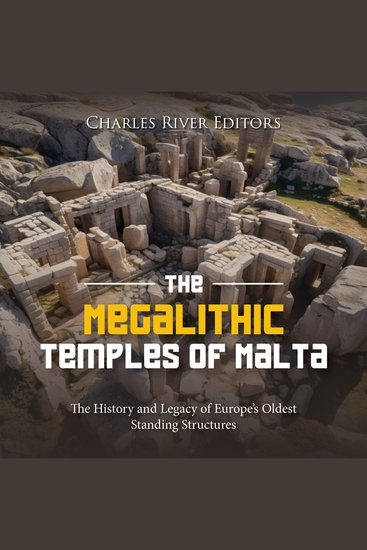
  • Megalithic Temples of Malta The: The History and Legacy of Europe’s Oldest Standing Structures - cover

    Megalithic Temples of Malta The:...

    Editors Charles River

    • 0
    • 0
    • 0
    Malta’s history goes back further than many know, which can be attested to by the numerous Neolithic and Bronze Age era megaliths that dot the island of Malta proper as well as the island of Gozo to the north. Naturally, when European archaeologists began unearthing the megaliths of Malta in the 19th century, they did not know what to think, which led to a plethora of theories, many of them quite fantastic. At least 23 of these temples were uncovered, but because the people who built them lacked the knowledge of writing, speculation over who built them and why remained well into the 20th century (Rountree 2003, 26). Some people theorized that the Malta megaliths were built by a race of giants, while others believed that it was the center of a “Mother Earth” cult that later spread through Neolithic Europe.  
    Early archaeologists were also perplexed about the physical origins of the Maltese megalith builders. Because Malta is such an isolated location, the builders had to have migrated there from elsewhere, but debates raged over the location. Equally confusing was when the megaliths were built. Although most legitimate historians believed from an early time that they were Neolithic structures, some argued that they were built much later and influenced by the Minoans and/or the Mycenaeans.  
    Even as some answers have arrived, scholars still debate the purpose of the megaliths. Although there is a near consensus that they served as religious temples, the deities that were worshiped as well as the rituals carried out in the structures remain a mystery and sources of further debate. As such, the ancient monuments remain enigmatic and serve as sources of pride for the modern Maltese people and awe-inspiring to all those who visit them.
    Show book
  • Carbon Democracy - Political Power in the Age of Oil - cover

    Carbon Democracy - Political...

    Timothy Mitchell

    • 0
    • 0
    • 0
    Oil is a curse, it is often said, that condemns the countries producing it to an existence defined by war, corruption, and enormous inequality. Carbon Democracy tells a more complex story, arguing that no nation escapes the political consequences of our collective dependence on oil. It shapes the body politic both in regions such as the Middle East, which rely upon revenues from oil production, and in the places that have the greatest demand for energy. 


    Coal was a source of energy so open to disruption that oligarchies in the West became vulnerable to mass demands for democracy. In the mid-twentieth century, however, the development of cheap and abundant energy from oil offered a means to reduce this vulnerability to democratic pressures. The abundance of oil made it possible to reorganize political life around the management of something now called "the economy". The politics of the West became dependent on an undemocratic Middle East. 


    In the twenty-first century, the oil-based forms of modern democratic politics have become unsustainable. Foreign intervention and military rule are faltering in the Middle East, while governments everywhere appear incapable of addressing the crises that threaten to end the age of carbon democracy—the disappearance of cheap energy and the carbon-fueled collapse of the ecological order.
    Show book
  • The Real Price of Ambition You're Already Paying - cover

    The Real Price of Ambition...

    Marcus Sterling

    • 0
    • 0
    • 0
    This audiobook is narrated by an AI Voice. Confront the hidden costs of ambition that success culture never mentions while driving you toward achievements that may destroy what matters most. This sobering audiobook examines the physical health consequences, relationship damage, psychological toll, and spiritual emptiness that ambitious pursuit often creates. Learn why driven people frequently achieve their goals only to discover the price was far higher than the reward, a realization that comes too late to undo the damage. The narrator presents research on executive burnout, successful people who regret their choices, and the hedonic treadmill that keeps ambitious individuals perpetually unsatisfied regardless of achievement. Discover how ambition becomes addiction, using the same neurological pathways as substances while society celebrates rather than treats the condition. Understand the opportunity costs of intense career focus, including missed childhood moments, neglected friendships, and postponed living that can never be recovered. This audiobook challenges cultural narratives glorifying hustle, grind, and relentless pursuit while offering alternative frameworks for meaningful success. Learn to recognize when ambition serves your genuine wellbeing versus when it operates as compensatory behavior masking deeper needs. Essential listening for driven professionals questioning whether their path leads where they truly want to go, and anyone seeking balance between achievement and fulfillment.
    Show book