Join us on a literary world trip!
Add this book to bookshelf
Grey
Write a new comment Default profile 50px
Grey
Subscribe to read the full book or read the first pages for free!
All characters reduced
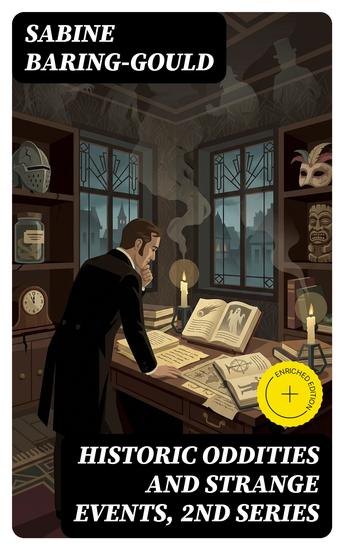
Historic Oddities and Strange Events 2nd Series - Enriched edition - cover

Historic Oddities and Strange Events 2nd Series - Enriched edition

Sabine Baring-Gould

Publisher: DigiCat

  • 0
  • 0
  • 0

Summary

In 'Historic Oddities and Strange Events, 2nd Series,' Sabine Baring-Gould embarks on an enthralling exploration of peculiar happenings and curious anecdotes from history. With meticulous detail and an engaging narrative style, Baring-Gould weaves together a tapestry of unusual events that challenge conventional historical narratives. The book showcases his keen interest in folklore, myth, and the supernatural, presenting readers with captivating stories that straddle the lines between fact and fiction, while also reflecting the Victorian fascination with the bizarre and the occult. Sabine Baring-Gould, a prolific writer and scholar, was deeply influenced by his educational background and a lifelong passion for folklore and local history. His travels across England and Europe enriched his understanding of regional tales and eccentricities, which he sought to preserve through his writings. Baring-Gould's vibrant career includes contributions to various genres, but his unique voice in documenting the strange occurrences of the past sets him apart in the literary canon, driving his desire to enlighten readers about the curiosities of humanity. For those intrigued by the strange and the unexplained, Baring-Gould's 'Historic Oddities and Strange Events, 2nd Series' is a compelling read that promises both entertainment and enlightenment. As you traverse the pages, you will encounter stories that provoke thought and evoke wonder, making it a must-have for history enthusiasts and lovers of the peculiar alike.

In this enriched edition, we have carefully created added value for your reading experience:
- A comprehensive Introduction outlines these selected works' unifying features, themes, or stylistic evolutions.
- A Historical Context section situates the works in their broader era—social currents, cultural trends, and key events that underpin their creation.
- A concise Synopsis (Selection) offers an accessible overview of the included texts, helping readers navigate plotlines and main ideas without revealing critical twists.
- A unified Analysis examines recurring motifs and stylistic hallmarks across the collection, tying the stories together while spotlighting the different work's strengths.
- Reflection questions inspire deeper contemplation of the author's overarching message, inviting readers to draw connections among different texts and relate them to modern contexts.
- Lastly, our hand‐picked Memorable Quotes distill pivotal lines and turning points, serving as touchstones for the collection's central themes.
Available since: 09/15/2022.
Print length: 258 pages.

Other books that might interest you

  • The Great Russian Famine of 1601-1603 - Causes and Consequences - cover

    The Great Russian Famine of...

    Sarah Willards

    • 0
    • 0
    • 0
    The Great Russian Famine of 1601-1603 was one of the most catastrophic events in Russian history, causing widespread death, social instability, and economic distress. This famine occurred during a period of political turmoil, just after the death of Tsar Ivan the Terrible and amid the struggle for the Russian throne. The famine’s impact was felt across Russia, particularly in the central and southern regions, and it highlighted both the fragility of the agrarian economy and the vulnerability of the Russian people to climatic and political disruptions. 
    The context of the famine is crucial to understanding its devastating effects. In the late 16th century, Russia was already experiencing significant strain, including the collapse of the feudal system, a declining central government, and the outbreak of the Time of Troubles, a series of civil wars and foreign invasions. The Russian agricultural system, heavily dependent on the success of yearly harvests, was not equipped to deal with the combination of extreme weather, crop failure, and a lack of effective governance. 
    The famine itself was primarily caused by a series of poor harvests, which were exacerbated by severe weather conditions, including droughts and unseasonably cold winters. The summer of 1601 saw a significant drought, which devastated crops, and the following winter brought freezing temperatures that further hindered the ability to cultivate food. As a result, grain production plummeted, and prices soared, making food increasingly inaccessible to the general population.
    Show book
  • How to Make People Do What You Want: Influence Human Behavior to Persuade People and Win Friends - cover

    How to Make People Do What You...

    Christopher Rothchester

    • 0
    • 0
    • 0
    Do you want to learn how to appeal to people, be happier, healthier, and free? How to Make People Do What You Want will get you started on that wonderful path. 
    Modern life distracts us from what's really important, causing us to forget who we really are. 
    None of us were born with fears, depression, or nervousness. Something in our lives along the line pushes us into a downward spiral, careening into problems left and right. The solutions to these problems may be staring us straight in the face, but unless we try, we'll never figure it out and reach our full potential. For some, dealing with people can be very stressful, but it doesn't have to be! 
    The hangups and baggage that weigh us down need to be set aside, we need to become free. Many kind, caring, and intelligent people repel potential friends, employers, and even future spouses because they're not socially perceptive, they don't understand how to attract friends, and they don't understand what impression their words, actions, and behaviors may give to others. 
    This skill is vital to learn because not one of us is an island, we can try to live by ourselves, but we make life so much more rich, easy, joyous, simple, and relaxed when we work together with friends to reach a common goal. 
    Life doesn't have to be so difficult, the repetitive, boring, stressful, and unpleasant life you probably live is not a necessity—it's up to you, it's your choice. Choose wisely. Doing and learning new things will inherently require us to make changes, big changes, and this will feel uncomfortable. Our "comfort zones" lock us into a cage, a self-made prison that limits us and keeps us away from the unknown. Adventure and pure joy start when we step out of our comfort zones, we embrace the great unknown, and we follow our deepest dreams. 
    You won't want to do this alone.
    Show book
  • The Art of Trust Building - Transform Lives Teams and Organizations - cover

    The Art of Trust Building -...

    PhD Michelle Reina, PhD Dennis...

    • 0
    • 0
    • 0
    Master the essential actions that create lasting trust in any relationship, from the world's leading experts in workplace trust.Trust is essential to all relationships, but knowing how to build and maintain it remains elusive. Drawing from three decades of research and consulting, trust experts Dennis and Michelle Reina provide a comprehensive roadmap for creating lasting trust in any relationship.Through actionable frameworks, tools, and stories, listeners will learn essential behaviors that build trust in character, communication, and capability; how to foster an environment of openness where people feel heard and valued; ways to rebuild trust after breaches or betrayals; techniques for strengthening self-trust as the foundation for trusting others; and the role of gratitude in nurturing reciprocal trust. 
     
    With the groundbreaking Reina Individual Trust Scale Assessment and concrete strategies for implementation, this essential guide equips listeners to forge powerful bonds of trust that endure through uncertainty and change.
    Show book
  • Narrative of the Life of Frederick Douglass an American Slave (Hero Classics) - cover

    Narrative of the Life of...

    Frederick Douglass

    • 0
    • 0
    • 0
    Part of the Hero Classics series 
    “Where justice is denied, where poverty is enforced, where ignorance prevails, and where any one class is made to feel that society is an organized conspiracy to oppress, rob and degrade them, neither persons nor property will be safe.” 
    Douglass cultivated himself to such an extent that the listeners of his lectures doubted if his narratives were true. His autobiography is both a compelling tale of a slave and a contribution to the public discourse on slavery. His language is poetic and precise honed in its simplicity as if something artificially put together but immensely natural at the same time. Opening this book is opening the door into Douglass's consciousness and tracking his inner journey of finding himself in the world: a story of his childhood and youth – a long and laborious path to freedom. Douglass talks about the explicit punishments and tortures that slaves were exposed to. Despite the suffering, he emphasises the power of self-education and continuous resistance that pushes one to fight their predicament. The publication of this book was such an unprecedented event that the author had to leave the US for Europe for about two years. The fact that Douglass's experience and meditations were issued in print gave him a wider audience, not restricting dissemination of his beliefs to those who could physically come to his public speeches. 
    The Hero Classics series:MeditationsThe ProphetA Room of One’s OwnIncidents in the Life of a Slave GirlThe Art of WarThe Life of Charlotte BronteThe RepublicThe PrinceNarrative of the Life of Frederick Douglass, an American SlaveUtopia
    Show book
  • Your Highly Sensitive Child - Helping your child flourish in an overwhelming world - cover

    Your Highly Sensitive Child -...

    Aoife Durcan

    • 0
    • 0
    • 0
    Highly sensitive, spirited, empathic, shy, strong-willed … these are common descriptions of children who simply feel the world on a deeper level.
    As a parent it can be difficult to know how to respond to these deep emotions. You may feel that traditional parenting approaches don't work but you're worried that your child won't learn how to survive in the 'real world'.
    Now leading psychologist Dr Aoife Durcan offers expert advice on how to:
    
    - Support your child in navigating big emotions, including meltdowns, with compassion and understanding.
    - Feel confident managing challenges like separation anxiety, school pressures and social interactions.
    - Help your child be less hard on themselves when things don't go well.These practical, research-backed tools will empower you to feel comfortable about your parenting style and, most importantly, help your child to thrive in a world that can sometimes feel like too much.
    'This book is a parenting life raft' CAROLINE FORAN
    'Feels like having your hand held as you deepen your understanding of the world through the eyes of a sensitive person' JOANNA FORTUNE
    'This book allows parents to support their sensitive child without trying to harden them or coerce them into some form of robust resilience' COLMAN NOCTOR
    'As both a psychologist and a mum, this book is a must-read that leaves you feeling equipped, empowered, understood and trusting in your own path as a parent' ALLISON KEATING
    Show book
  • Drawing Fire - Investigating the Accusations of Apartheid in Israel - cover

    Drawing Fire - Investigating the...

    Benjamin Pogrund

    • 0
    • 0
    • 0
    Benjamin Pogrund, who spent 26 years as a journalist in South Africa investigating apartheid and who has been living in Israel for the past 15 years, investigates the accusation that Israel is practicing apartheid and the motives of those who make it. His study is founded on a belief in Israel, combined with frank criticism, to provide a balanced view of Israel’s strengths and problems.  To understand Israel today, one must first look at the past and so the book first outlines key foundational events to explain current attitudes. It then explores the contradictions found in the region, including discrimination against Israeli Arabs and among Jews, before concluding that it is wrong to affix the apartheid label to Israel inside the Green Line of 1948/1967. It also deconstructs the criticisms of Israel and the boycott movement before arguing for two states, Israeli and Palestinian, as the only way forward for Jews and Arabs.  This detailed and balanced study offers a unique comparison between South Africa a
    Show book