Join us on a literary world trip!
Add this book to bookshelf
Grey
Write a new comment Default profile 50px
Grey
Subscribe to read the full book or read the first pages for free!
All characters reduced
Language I Am - The Path to Language Success - cover

Language I Am - The Path to Language Success

S. C. W. Coleman-Roush

Publisher: BookRix

  • 0
  • 0
  • 0

Summary

     Hello, my name is Stephen and I am a linguist. Some say that we are born into our vocation while others say that it is something developed over time. In the case of language acquisition, both are true. We are all inherently language learners being a highly adaptable and intuitive social species. Language will and always has taken on new and exciting forms that continuously change and adapt to new environments. Some languages die, while others flourish and change into something new. Each language has its own rhythm, its own method of thought, and its own fundamental values. In a sense, Language is everything, language is life. 
     I have studied languages ever since I was in homeschool before 5th grade. My mother taught me to read, write, and speak Latin, Greek, and Hebrew. I read Beowulf in old English as a child. While I can remember almost nothing of these languages, the dedication instilled in me has carried on. I studied at the Defense Language Institute in Monterey, CA. I learned and collaborated among thousands of people in my field. I learned that everyone is an individual and we all are interested by different languages. Not everyone, however, is interested in what is commonly thought of as language. The oral, visual, and auditory skills of communication are possessed by all but a passion of few. If your language is in a vocation such as science, medicine, or something else then you are probably not interested in the textbook definition of language studies. Instead, such people focus on a different sort of language acquisition and study. If you see other languages, foreign to you, as a novelty then this book is not for you. I will not be sharing my knowledge of language acquisition in areas of vocations, often referred to as jargon, but will instead be imparting my skill in the auditory, visual, and spoken word. Please take my words with a grain of salt. Do not believe everything you’re told but instead study for yourself. Give into your creative individuality and search out your own answers. All advice is free, but time is finite. I hope that you enjoy this book.
Available since: 12/21/2023.
Print length: 49 pages.

Other books that might interest you

  • Kickstart Your American Accent - Step-by-Step Accent Training for American English - cover

    Kickstart Your American Accent -...

    American English Tutoring

    • 0
    • 0
    • 0
    You're frustrated with not being understood. You're tired of shying away from conversations and presentations that hinder your career progress and social connections.  
    Kickstart Your American Accent has the “mysterious secrets” that non-native speakers seek on their journey to speaking clear, fluent American English. These are secrets even native speakers often overlook!  
    This audiobook offers top-notch, in-depth instruction paired with the easiest-to-follow practice activities ever! We’re talking step-by-step guidance here…because a little extra help never hurt anyone!Structured Learning: Focuses on listening and “feeling” your mouth positions first, ensuring you can confidently correct yourself when speaking.Comprehensive Practice: Includes exhaustive exercises that start at the simplest sound level and gradually progress to syllables, words, phrases, sentences, reading, and ultimately, conversation practice, so you don’t get stuck.Clear Instructions: Provides easy-to-understand guidance without all the confusing jargon. 
    Make today the day you choose to have clear, articulate American pronunciation!
    Show book
  • The Sayings of Lao-Tzu - An accessible narrative prose translation of the Dao De Jing - cover

    The Sayings of Lao-Tzu - An...

    Lao Tzu, Lionel Giles (translator)

    • 0
    • 0
    • 0
    A prose translation of the Tao that focuses on bringing out the subtlety and depth of the classic Way.Translations of the famous Way and Virtue (Dao De Jing/Tao Te Ching) focus on the poetics and depth of the original. In contrast, Giles’ translation focuses on telling stories with the text, drawing out the nuances in a way that is more familiar to Western audiences from philosophical and religious texts.“Few can help being struck by the similarity of tone between the sayings of Lao Tzu and the Gospel enunciated six centuries later by the Prince of Peace. There are two famous utterances in particular which secure to Lao Tzu the glory of having anticipated the lofty morality of the Sermon on the Mount. The cavilers who would rank the Golden Rule of Confucius below that of Christ will find it hard to get over the fact that Lao Tzu said, "Requite injury with kindness," and "To the not-good I would be good in order to make them good." It was a hundred and fifty years later that Plato reached the same conclusion in the first book of the Republic.It is interesting to observe certain points of contact between Lao Tzu and the early Greek philosophers. He may be compared both with Parmenides, who disparaged sense-knowledge and taught the existence of the One as opposed to the Many, and with Heraclitus, whose theory of the identity of contraries recalls some of our Sage's paradoxes. But it is when we come to Plato that the most striking parallels occur. It has not escaped notice that something like the Platonic doctrine of ideas is discoverable in the "forms" which Lao Tzu conceives as residing in Tao. But, so far as I know, no one has yet pointed out what a close likeness Tao itself bears to that curious abstraction which Plato calls the Idea of the Good.”
    Show book
  • Thirty-Two Words for Field - Lost Words of the Irish Landscape - cover

    Thirty-Two Words for Field -...

    Manchán Magan

    • 0
    • 0
    • 0
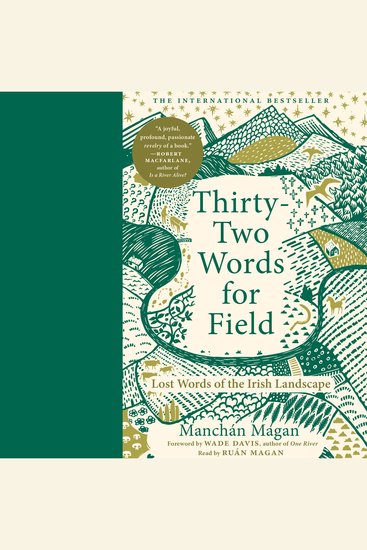
    The Irish language has thirty-two words for field. Among them are: Geamhar – a field of corn-grass • Tuar – a field for cattle at night • Reidhlean – a field for games or dancing • Cathairin – a field with a fairy-dwelling in it. 
     
    The richness of the Irish language is closely tied to the natural landscape and offers a more magical way of seeing the world.  
     
    Most people associate Britain and Ireland with the English language, a vast, sprawling linguistic tree with roots in Latin, French, and German. But the inhabitants of these islands originally spoke another tongue. Look closely enough and English contains traces of the Celtic soil from which it sprung, found in words like bog, loch, cairn, and crag. Today, this heritage can be found nowhere more powerfully than in modern-day Gaelic.  
     
    In Thirty-Two Words for Field, Manchán explores how Gaelic, a three-thousand-year-old lexicon, has imbued the natural world with meaning and magic, evoking a time-honored way of life, from its thirty-two separate words for a field to terms like bróis (whiskey for a horseman at a wedding), iarmhaireacht (the loneliness you feel when you are the only person awake at dawn), and bladhmann (steam rising from a fermented haystack or idle boasting).  
     
    Manchán urges readers to consider the sublime beauty and profound oddness of this ancient tongue that has been spoken in close connection to the land for thousands of years. Told through stories collected from his own life and travels, Thirty-Two Words for Field is an enthralling celebration of Irish words and a testament to the indelible relationship between landscape, culture, and language.
    Show book
  • The Greatest Invention - A History of the World in Nine Mysterious Scripts - cover

    The Greatest Invention - A...

    Silvia Ferrara

    • 0
    • 0
    • 0
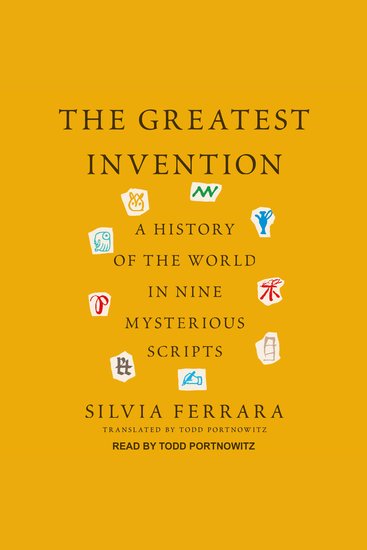
    The L where a tabletop meets the legs, the T between double doors, the D of an armchair's oval backrest—all around us is an alphabet in things. But how did these shapes make it onto the page, never mind form complex structures such as this sentence? In The Greatest Invention, Silvia Ferrara takes a profound look at how—and how many times—human beings have managed to produce the miracle of written language, traveling back and forth in time and all across the globe to Mesopotamia, Crete, China, Egypt, Central America, Easter Island, and beyond. 


    With Ferrara as our guide, we examine the enigmas of undeciphered scripts, including famous cases like the Phaistos Disk and the Voynich Manuscript; we touch the knotted, colored strings of the Inca quipu; we study the turtle shells and ox scapulae that bear the earliest Chinese inscriptions; we watch in awe as Sequoyah single-handedly invents a script for the Cherokee language; and we venture to the cutting edge of decipherment, in which high-powered laser scanners bring tears to an engineer's eye. 


    A code-cracking tour around the globe, The Greatest Invention chronicles a previously uncharted journey, one filled with past flashes of brilliance, present-day scientific research, and a faint, fleeting glimpse of writing's future.
    Show book
  • Publish Yourself - Create & Sell Your Own E-Books - cover

    Publish Yourself - Create & Sell...

    J.M. Snyder

    • 0
    • 0
    • 0
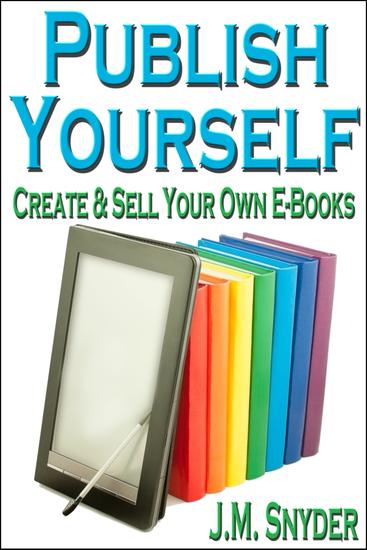
    If you've ever wanted to retain more of your royalties or try publishing e-books but didn't know where to start, this book is for you!
    
    
    Recently e-books have exploded onto the publishing scene, making it easier than ever for writers to break into the market. But many people who read e-books aren't familiar with how to create them. What formats should you offer? Where do you sell them? What do you use for a cover? And, most important, how do you go from a Word document to an EPUB, MOBI, or PDF file?
    
    
    Best-selling, multi-published author J.M. Snyder has written this no-nonsense, hands-on guide. She takes the mystery out of e-publishing while making the process of creating an e-book simple, cheap, and easy.
    
    
    Using Microsoft Word (or an equivalent word processing program) along with inexpensive or free software readily available online, you will learn how to create the nine most common e-book formats. You will be walked through cover art design, interior book layout, and e-book creation, as well as given many of the tips J.M. has learned along the way. Also included is a brief guide to online bookstores where you can sell your finished e-book.
    
    
    Let J.M. Snyder help you discover how easy it is to publish yourself!
    Show book
  • Japanese Made Easy - Beginner - Volume 2 of 3 - cover

    Japanese Made Easy - Beginner -...

    Lingo Wave

    • 0
    • 0
    • 0
    We broke our new series on learning Japanese down into different learning stages. Start with the "Lower Beginner" books followed by the "Beginner" and "Upper Beginner" books. Next, progress to the "Intermediate" series, then test and reinforce your knowledge with the "Conversations" series. 
    This audiobook is divided into units.While it provides different learning patterns and accommodates various needs, this audiobook focuses on helping you improve your ability to understand, speak, and memorise Japanese.  
    In Unit 1 you will hear Japanese decoded with each syllable spoken very slowly and clearly with repetition. Immediately before each sentence is spoken, you will hear the translation, so you will always understand what is being said. 
    Unit 2 focuses solely on increasing your listening ability, which will improve your abilities to engage in dialogue with a native Japanese speaker. This chapter requires you to listen very carefully to nuances in the language. 
    By Unit 3 you will already notice progress in your abilities to speak and understand Japanese. The spoken translation is followed by two repetitions in Japanese at a completely natural speed. While you are learning to process naturally spoken Japanese, Units 3 and 4 will help you memorise new vocabulary and full sentences. 
    In Unit 5 you can test yourself on how much you have learned. If you are having difficulties, we suggest you revisit the listening, speaking, or memorisation section of Units 1, 2 3 or 4, according to what you need more help with. 
    Topics covered in this book: 
    1. Asking about family 
    2. Asking about relationship status 
    3. Expressing frequency 
    4. Talking about spare time activities and hobbies 
    5. Using quantifiers/determiners 
    6. Talking about preference 
    7. Talking about abilities 
    8. Talking about location of places 
    9. Describing appearance 
    10. Talking about personality 
    ...
    Show book