Join us on a literary world trip!
Add this book to bookshelf
Grey
Write a new comment Default profile 50px
Grey
Subscribe to read the full book or read the first pages for free!
All characters reduced
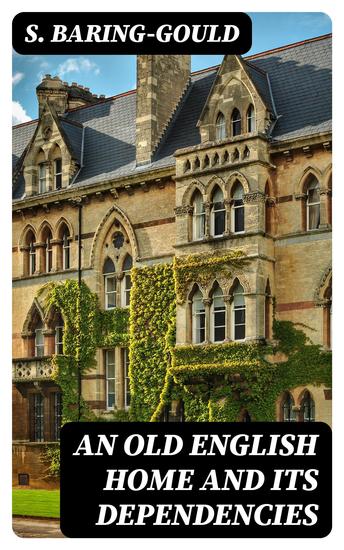
An Old English Home and Its Dependencies - cover

An Old English Home and Its Dependencies

S. Baring-Gould

Publisher: DigiCat

  • 0
  • 0
  • 0

Summary

In "An Old English Home and Its Dependencies," S. Baring-Gould offers an evocative exploration of the intricacies of English domestic life as it existed in the 19th century. Through meticulous descriptions and rich narrative detail, Baring-Gould captures the architecture and ambiance of traditional English homes, meticulously addressing their socio-cultural importance. His literary style merges romanticism with realism, utilizing vivid imagery and a reflective tone that creates a palpable sense of nostalgia, while also engaging with contemporary issues of social class and the evolution of domestic spaces in Victorian England. S. Baring-Gould (1834-1924) was a multifaceted figure—an author, antiquarian, and folklorist whose diverse interests undoubtedly shaped his literary pursuits. His deep appreciation for English history and culture is reflected throughout this work, as he draws on his extensive research and personal observations. Growing up in a family steeped in tradition, he was keenly aware of the shifting landscapes within English society, which propelled him to document and preserve the narratives tied to domesticity and familial structures during a time of rapid change. I highly recommend "An Old English Home and Its Dependencies" to readers interested in historical literature, architecture, and social history. Baring-Gould's rich prose and insightful observations provide not only a glimpse into the past but also prompt reflection on the values and complexities inherent in our own homes today.
Available since: 09/15/2022.
Print length: 1471 pages.


Other books that might interest you

  • History of France - Significant Events and Prominent Individuals in France’s History (4 in 1) - cover

    History of France - Significant...

    Kelly Mass

    • 0
    • 0
    • 0
    This book consists of four titles, which are: 
    Franco-Prussian War - The Franco-Prussian War, also known as the Franco-German War or, in France, the War of 1870, was a pivotal conflict between the Second French Empire and the North German Confederation, which was led by the Kingdom of Prussia. This war lasted from 19 July 1870 to 28 January 1871, and its consequences would shape European geopolitics for decades. The primary cause of the war stemmed from France's desire to reaffirm its dominance in continental Europe, which had been seriously challenged after Prussia's decisive victory over Austria in the Austro-Prussian War of 1866. This defeat shifted the balance of power in Europe, making France anxious about its standing. 
    Jean-Jacques Rousseau - Jean-Jacques Rousseau, born in 1712 in Geneva, Switzerland, was a philosopher, author, and composer whose work had a profound impact on the intellectual and political landscape of the 18th century. He is best known for his political philosophy, which laid the groundwork for many of the principles that influenced the Enlightenment and later shaped the French Revolution.  
    The Basques - The Basques are an ethnic group indigenous to Southwestern Europe, distinguished by their unique genetic heritage, ancient language (Euskara), and distinct cultural practices. Their homeland, known as the Basque Country (Euskal Herria), spans both sides of the Pyrenees, covering areas in north-central Spain and southwestern France, and lies along the Bay of Biscay. 
    The Seven Years' War - The Seven Years' War (1756–1763) marked a global struggle for supremacy between two major powers of the time: Great Britain and France. This conflict unfolded across continents and influenced various colonial and European theaters, laying the groundwork for modern geopolitics.
    Show book
  • Third Book of John The - The World English Bible Book 64 (Unabridged) - cover

    Third Book of John The - The...

    Various Authors

    • 0
    • 0
    • 0
    The Third Book of John is the third-to-last book of the New Testament and the Christian Bible as a whole, and attributed to John the Evangelist, traditionally thought to be the author of the Gospel of John and the other two epistles of John. The Third Epistle of John is a personal letter sent by "the elder" to a man named Gaius, recommending to him a group of Christians led by Demetrius, which had come to preach the gospel in the area where Gaius lived. The purpose of the letter is to encourage and strengthen Gaius, and to warn him against Diotrephes, who refuses to cooperate with the author of the letter.
    Show book
  • The Illumination Code - 7 Keys to Unlock Your Quantum Intelligence - cover

    The Illumination Code - 7 Keys...

    Kim Chestney, Peter Smith

    • 0
    • 0
    • 0
    "Kim Chestney's codes bring you closer to the comprehension of a reality that was wholly hidden prior to the quantum discoveries." —Ervin László, author of Science and the Akashic Field 


    Intuition—the extraordinary ability to access information from the quantum realms—is fast becoming humanity's most advanced form of knowledge acquisition. The Illumination Code presents seven keys to unlock your inner dimension so you can access expanded states of awareness that exist beyond the limits of the rational mind. Kim Chestney reveals the deeply personal nature of the universe while offering a new way to know the unknowable and experience the seemingly impossible. As you venture inward on this step-by-step journey, you will gain profound insights and discover the true power of your own inner wisdom.
    Show book
  • The Shortest History of Democracy - 4000 Years of Self-Government-A Retelling for Our Times - cover

    The Shortest History of...

    John Keane

    • 0
    • 0
    • 0
    From The Shortest History series comes the complete history of democracy, its champions, and its detractors—from the assemblies of ancient Mesopotamia to present perils 


    This tumultuous global story begins with democracy's radical core idea: We can collaborate, as equals, to determine our own lives and futures. John Keane traces how this concept emerged and evolved, from the earliest "assembly democracies" to European-style electoral democracy to our present system of "monitory democracy." Today, governments answer not only to voters on Election Day, but to intense public scrutiny (monitoring) every day. Keane calls this media- and communication-driven system "the most complex and vibrant form of democracy yet"—but it is not invulnerable. 


    We live in an age of political and environmental crisis, when despots in China, Russia, Saudi Arabia, and elsewhere reject the promises of power-sharing. At this urgent moment, Keane's book mounts a new defense of a precious global ideal.
    Show book
  • Marriage Tudor Style - Love Hate & Scandal - cover

    Marriage Tudor Style - Love Hate...

    Sylvia Barbara Soberton

    • 0
    • 0
    • 0
    Step into the world of scandalous Tudor-era marriages in this delicious book from Sylvia Barbara Soberton . . . 


    The newly-wed Anne Hastings faced her husband's wrath when her affair with William Compton was made public. Mary Tudor married to satisfy her brother's political need to ally with France, but when her decrepit royal husband died, she married the dashing Charles Brandon for love. William Parr, humiliated by his wife's extramarital affair, sought a divorce to marry the woman he loved. 


    Trapped in loveless marriages, women like Anne Parr and Anne Grey eloped with their lovers, risking their reputations and livelihoods to find personal happiness. 


    Courtiers like Mary Boleyn, Margaret Douglas, Edward Seymour, and Robert Dudley faced royal wrath when marrying for love. Some returned to royal favor, but others languished in prison, dying without obtaining a pardon. 


    Teeming with unforgettable stories, scandals and courtiers who followed their hearts over their duties, this book is a must-listen for anyone who loves a blend of intrigue, romance, and historical splendor set against the backdrop of the Tudor court.
    Show book
  • Pain as a Portal - A Philosophy to Explore Your Potential - cover

    Pain as a Portal - A Philosophy...

    April Simone

    • 0
    • 0
    • 0
    Discover how Mettāmorphosis-an essential new philosophy-offers a pathway to alleviate suffering and connects you with your own inherent wisdom to make sense of it all. 
    The book is divided into three parts: 
        * Part One explores The PAIN Process model, introducing the philosophy behind it and a step-by-step guide to frame, process and morph your pain into gifts. 
        * Part Two includes case studies to provide clear examples of how this model has been applied in real-life scenarios. 
        * Part Three offers deeply personal and vulnerable narratives from April Simone's own life, serving as sustenance of hope for your mind and heart. 
    Pain as a Portal is a transmission that serves as a guide, travelling alongside you on your journey to uncover the many gifts your pain has to offer.
    Show book