Join us on a literary world trip!
Add this book to bookshelf
Grey
Write a new comment Default profile 50px
Grey
Subscribe to read the full book or read the first pages for free!
All characters reduced
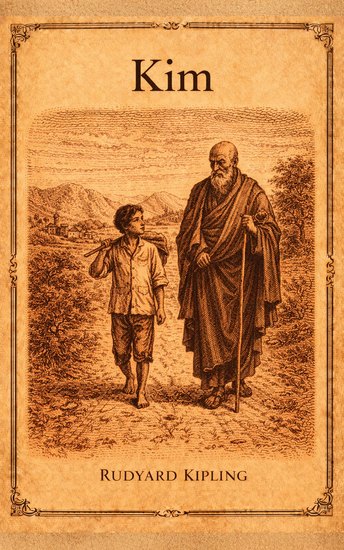
Kim - cover

Kim

Rudyard Kipling

Publisher: CLXBX

  • 0
  • 0
  • 0

Summary

Set against the vibrant and complex backdrop of British-ruled India, Kim by Rudyard Kipling is a rich and captivating tale of adventure, identity, and espionage. Blending coming-of-age storytelling with political intrigue, this classic novel transports readers into a world of shifting loyalties and cultural crossroads.

The story follows Kimball O'Hara—known simply as Kim—an orphaned boy growing up on the bustling streets of Lahore. Clever, resourceful, and deeply connected to the diverse cultures around him, Kim moves effortlessly between worlds. His life changes when he befriends a wandering Tibetan lama on a spiritual quest. As Kim accompanies the holy man across the subcontinent, he is drawn into the "Great Game," the shadowy rivalry between empires vying for influence in Central Asia.

Torn between his Irish heritage and his Indian upbringing, Kim becomes both disciple and spy, navigating a landscape filled with soldiers, holy men, merchants, and secret agents. His journey is one of discovery—of purpose, loyalty, and self-understanding—set against sweeping landscapes and vividly drawn characters.

Kipling's portrayal of India is layered and atmospheric, capturing its color, complexity, and contradictions. Through Kim's eyes, readers experience bustling cities, remote mountain passes, and the intricate interplay of faith, politics, and empire. The novel explores themes of belonging, identity, and the tension between spiritual seeking and worldly ambition.

At once an adventure story and a nuanced portrait of colonial society, Kim remains one of Kipling's most celebrated works. Its compelling narrative, memorable characters, and exploration of cultural identity continue to resonate with readers, offering both excitement and thoughtful reflection.
Available since: 02/14/2026.
Print length: 362 pages.

Other books that might interest you

  • Tales Of Shakespeare - cover

    Tales Of Shakespeare

    Charles Lamb, Mary Lamb

    • 0
    • 0
    • 0
    The following Tales are meant to be submitted to the young reader as an introduction to the study of Shakespeare, for which purpose his words are used whenever it seemed possible to bring them in; and in whatever has been added to give them the regular form of a connected story, diligent care has been taken to select such words as might least interrupt the effect of the beautiful English tongue in which he wrote: therefore, words introduced into our language since his time have been as far as possible avoided
    Show book
  • The Devil Light - Former soldier and journalist that became a revered author and screenwriter - cover

    The Devil Light - Former soldier...

    Edgar Wallace

    • 0
    • 0
    • 0
    Richard Horatio Edgar Wallace was born on the 1st April 1875 in Greenwich, London.  Leaving school at 12 because of truancy, by the age of fifteen he had experience; selling newspapers, as a worker in a rubber factory, as a shoe shop assistant, as a milk delivery boy and as a ship’s cook.  
     
    By 1894 he was engaged but broke it off to join the Infantry being posted to South Africa. He also changed his name to Edgar Wallace which he took from Lew Wallace, the author of Ben-Hur.  
     
    In Cape Town in 1898 he met Rudyard Kipling and was inspired to begin writing. His first collection of ballads, The Mission that Failed! was enough of a success that in 1899 he paid his way out of the armed forces in order to turn to writing full time.  
     
    By 1904 he had completed his first thriller, The Four Just Men. Since nobody would publish it he resorted to setting up his own publishing company which he called Tallis Press. 
      
    In 1911 his Congolese stories were published in a collection called Sanders of the River, which became a bestseller. He also started his own racing papers, Bibury’s and R. E. Walton’s Weekly, eventually buying his own racehorses and losing thousands gambling.  A life of exceptionally high income was also mirrored with exceptionally large spending and debts.  
     
    Wallace now began to take his career as a fiction writer more seriously, signing with Hodder and Stoughton in 1921. He was marketed as the ‘King of Thrillers’ and they gave him the trademark image of a trilby, a cigarette holder and a yellow Rolls Royce. He was truly prolific, capable not only of producing a 70,000 word novel in three days but of doing three novels in a row in such a manner. It was estimated that by 1928 one in four books being read was written by Wallace, for alongside his famous thrillers he wrote variously in other genres, including science fiction, non-fiction accounts of WWI which amounted to ten volumes and screen plays. Eventually he would reach the remarkable total of 170 novels, 18 stage plays and 957 short stories. 
     
    Wallace became chairman of the Press Club which to this day holds an annual Edgar Wallace Award, rewarding ‘excellence in writing’.  
     
    Diagnosed with diabetes his health deteriorated and he soon entered a coma and died of his condition and double pneumonia on the 7th of February 1932 in North Maple Drive, Beverly Hills. He was buried near his home in England at Chalklands, Bourne End, in Buckinghamshire.
    Show book
  • A Pair of Blue Eyes - cover

    A Pair of Blue Eyes

    Thomas Hardy

    • 0
    • 0
    • 0
    Immerse yourself in the evocative world of "A Pair of Blue Eyes" by Thomas Hardy, a tale of love, social class, and inner conflict. Follow the beautiful and naive Elfride Swancourt as she becomes entangled in a romantic triangle with the ambitious architect Stephen Smith and the intellectual but troubled Henry Knight. Set against the rugged Cornish landscape, this poignant novel explores the pressures of societal expectations and the complexities of human emotions. Hardy's rich narrative and vivid characters create an enduring story of passion, heartbreak, and self-discovery.
    Show book
  • Man Overboard - A horror tale set on a ship full of mystery and twists along the way - cover

    Man Overboard - A horror tale...

    F. Marion Crawford

    • 0
    • 0
    • 0
    Francis Marion Crawford, an only child, was born on 2nd August 1854 at Bagni di Lucca, Italy. He was a nephew to Julia Ward Howe, the American poet and writer of ‘The Battle Hymn of the Republic’.  
     
    Crawford was educated at St Paul's School, Concord, New Hampshire and then on to Cambridge University, the University of Heidelberg and the University of Rome.  
     
    In 1879 he went to India, to study Sanskrit and then to edit The Indian Herald. In 1881 he returned to America to continue his Sanskrit studies at Harvard University. 
     
    His family became increasingly concerned about his employment prospects.  After an attempt at a singing career as a baritone was ruled out, he was encouraged to write.  
     
    In December 1882 his first novel, ‘Mr Isaacs’, was published and was an immediate hit as was his second novel ‘Dr Claudius’ in 1883.  
     
    In October 1884 he married Elizabeth Berdan and encouraged by his excellent start to a literary career they returned to Sant Agnello, Italy to make a permanent home, buying the Villa Renzi that then became Villa Crawford.  
     
    In the late 1890s, Crawford began work on his historical works which would later include ‘Corleone’, in 1897, the first major treatment of the Mafia in literature.  
     
    Crawford is also exceedingly popular and anthologized as a short story writer of bizarre and creepy tales.   
     
    In 1908 came his classic ‘The Screaming Skull’. Without doubt its unsettling nature is heightened as the reader/listener is drawn into to the story by its narrator.  Everything is explained and plausible until, of course, it isn’t. 
     
    Francis Marion Crawford died at Sorrento on Good Friday 1909 at Villa Crawford of a heart attack.  
     
    In ‘Man Overboard’ Crawford uncovers the story of identical twins.  When one falls overboard it unravels a sequence of events that take years to complete, all with a growing sense of uneasiness that further misery awaits
    Show book
  • The Art of War and The Invisible Man - cover

    The Art of War and The Invisible...

    H. G. Wells, Sun Tzu

    • 0
    • 0
    • 0
    Audiobook Two-Pack: The Art of War & The Invisible Man (Storm Edition) 
    Unlock strategy and suspense in one immersive bundle. 
     
    This exclusive digital collection pairs two timeless classics in a uniquely atmospheric listening experience: 
     
    The Art of War by Sun Tzu Narrated with crisp clarity and meditative pacing, this ancient Chinese treatise on military strategy and leadership remains essential for thinkers, leaders, and tacticians. Whether you're navigating boardrooms or battlefields, Sun Tzu’s wisdom offers timeless guidance on discipline, deception, and decisive action. 
     
    The Invisible Man by H.G. Wells — Storm Edition Experience Wells’ chilling tale of science gone awry with a haunting twist: ambient thunderstorms underscore the descent into madness. As the mysterious Griffin grapples with isolation and power, the rumble of distant thunder and pattering rain heighten every moment of suspense and dread.
    Show book
  • The Doom That Came To Sarnath - cover

    The Doom That Came To Sarnath

    H. P. Lovecraft

    • 0
    • 0
    • 0
    🎬 Experience the atmospheric visual edition of this tale by searching "Jonathan Dunne Horror" on YouTube. 
    Title: The Doom That Came to Sarnath 
    Series Name: Timeless Terrors 
    Series Entry: 133 
    Author: H. P. Lovecraft 
    Narrator: Jonathan Dunne 
    Original Publication: 1920 
    Public Domain: Yes 
    YouTube Channel: Jonathan Dunne Horror Stories & Audiobooks (search on YouTube) 
    Description: 
    The Doom That Came to Sarnath by H. P. Lovecraft is a chilling mythic chronicle of pride, cruelty, and inevitable cosmic retribution. Written in Lovecraft’s richly archaic style, the tale unfolds like a forbidden legend whispered down through forgotten ages. 
    In the land of Mnar, beside a still and mist-shrouded lake, the proud city of Sarnath rose in splendor after conquering the ancient, alien city of Ib. The beings of Ib—strange, green, and mute—were utterly destroyed, their memory mocked and their idol carried away as a trophy. For centuries, Sarnath prospered, its alabaster walls gleaming and its feasts growing ever more decadent. 
    Yet on the eve of a grand celebration marking the thousandth year of Ib’s fall, unease begins to creep across the revelers’ hearts. The stolen idol inspires dread. Whispers echo through torchlit halls. And as the appointed hour approaches, an ancient doom—long foretold—draws near from the dark waters of the lake. 
    Lovecraft crafts a tale not of sudden violence, but of mounting inevitability: a civilization blind to its own arrogance, haunted by forces older than mankind. Rich with dreamlike imagery and mythic cadence, The Doom That Came to Sarnath stands as an early and powerful expression of cosmic horror—where time is vast, memory is long, and vengeance may sleep for centuries before it wakes. 
    Narrated by Amazon bestselling horror author Jonathan Dunne, this performance captures the story’s solemn grandeur, creeping dread, and apocalyptic finality—a legend of forgotten gods, drowned cities, and the terrible price of pride.
    Show book