Join us on a literary world trip!
Add this book to bookshelf
Grey
Write a new comment Default profile 50px
Grey
Subscribe to read the full book or read the first pages for free!
All characters reduced
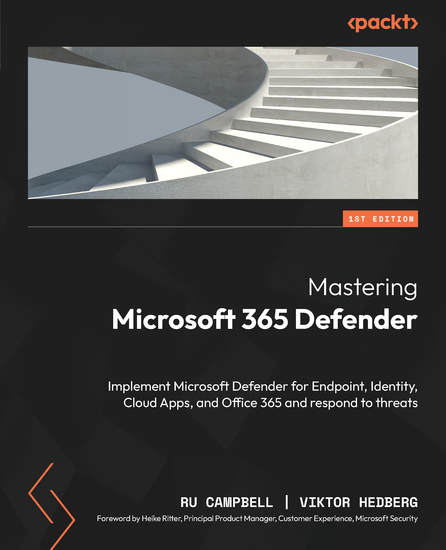
Mastering Microsoft 365 Defender - Implement Microsoft Defender for Endpoint Identity Cloud Apps and Office 365 and respond to threats - cover

Mastering Microsoft 365 Defender - Implement Microsoft Defender for Endpoint Identity Cloud Apps and Office 365 and respond to threats

Ru Campbell, Viktor Hedberg

Publisher: Packt Publishing

  • 0
  • 0
  • 0

Summary

This book will help you get up and running with Microsoft 365 Defender and help you use the whole suite effectively.You’ll start with a quick overview of cybersecurity risks that modern organizations face, such as ransomware and APT attacks, how Microsoft is making massive investments in security today, and gain an understanding of how to deploy Microsoft Defender for Endpoint by diving deep into configurations and their architecture.As you progress, you’ll learn how to configure Microsoft Defender Antivirus, and onboard and manage macOS, Android, and Linux MDE devices for effective solutions. You’ll also learn how to deploy Microsoft Defender for Identity and explore its different deployment methods that can protect your hybrid identity platform, as well as how to configure Microsoft Defender for Office 365 and Cloud Apps, and manage KQL queries for advanced hunting with ease. Toward the end, you’ll find out how M365D can be integrated with Sentinel and how to use APIs for incident response.By the end of this book, you will have a deep understanding of Microsoft 365 Defender, and how to protect and respond to security threats.
Available since: 07/28/2023.
Print length: 572 pages.

Other books that might interest you

  • The Shocking Truth about Renewable Energy - cover

    The Shocking Truth about...

    Zoey Fraisers

    • 0
    • 0
    • 0
    For decades, renewable energy has been marketed as the ultimate solution to climate change, pollution, and our reliance on fossil fuels. Solar panels and wind turbines fill the landscape, promising a cleaner, greener future. Governments, corporations, and activists push the narrative that renewables are not only necessary but inevitable. Billions of dollars have been poured into the transition, with incentives and subsidies encouraging the mass adoption of so-called “clean energy.” On the surface, this movement appears to be a global success.  
      
    Yet, beneath the optimistic rhetoric lies a far more complex and inconvenient truth. While renewable energy offers undeniable benefits, it also comes with significant drawbacks that are rarely discussed. Solar farms consume vast amounts of land, wind turbines disrupt ecosystems, and hydropower alters entire river systems, sometimes with devastating consequences. The environmental cost of producing, maintaining, and disposing of renewable energy infrastructure is frequently overlooked. Furthermore, the idea that renewables alone can sustain modern society is built on a foundation of wishful thinking rather than reality.  
      
    One of the biggest challenges facing renewables is reliability. The sun doesn’t always shine, and the wind doesn’t always blow. Unlike fossil fuels, which provide a constant and controllable energy supply, renewables fluctuate unpredictably. This intermittency creates enormous challenges for electrical grids, often requiring backup from coal, natural gas, or nuclear power. Energy storage technology, such as batteries, is still far from capable of bridging this gap at the scale necessary. The result is an energy system that is fragile, expensive, and, in some cases, even more dependent on fossil fuels than before. 
    Show book
  • CompTIA A+ All-in-One Mega Study Guide - Master 220-1101 & 220-1102 Exams with 250+ Practice Questions In-Depth Answers & Complete Certification Prep for IT Success - cover

    CompTIA A+ All-in-One Mega Study...

    Josh Russell

    • 0
    • 0
    • 0
    Master the CompTIA A+ Exams and Launch Your IT Career with Confidence! 
    Are you ready to crush the CompTIA A+ Core 1 & 2 exams (220-1101 & 220-1102) and fast-track your tech career? Whether you're a first-time test taker or brushing up for certification renewal, the CompTIA A+ All-in-One Mega Study Guide is your complete, fun-to-follow, and field-tested toolkit for success. 
    📚 What You'll Get Inside:✅ 250+ Realistic Practice Questions with detailed, step-by-step answers to boost your confidence and exam readiness🧠 Clear explanations of core IT concepts—hardware, networking, security, operating systems, troubleshooting, and more!🛠️ Expert tips & proven strategies for tackling tricky exam questions like a pro🎯 Covers everything you need to master CompTIA A+ 220-1101 & 220-1102 exams—no fluff, just what matters 
    💡 Why This Guide Stands Out:📈 Optimized for high scores and quick learning—you’ll go from novice to certified with fewer headaches💬 Written in a friendly, engaging tone so you actually enjoy studying🔑 Packed with real-world examples and troubleshooting scenarios to help you retain knowledge longer🎓 Perfect for self-paced learners, bootcamp students, and IT career switchersIf you're aiming for that entry-level help desk role, chasing your dream IT job, or collecting certifications like trophies—this guide will get you there. It's not just a book—it’s your tech career launchpad
    Show book
  • Planting Our World - cover

    Planting Our World

    Stefano Mancuso

    • 0
    • 0
    • 0
    It all begins and ends with plants. From the chance to live on this planet to the pleasure of listening to the sound of a violin—every story begins with a plant. 


    We animals account for a paltry 0.3% of the planet's biomass while plants add up to 85%. It is obvious that every story on this planet has a plant as its protagonist. Our world is a green world; Earth is the planet of plants. And when, with just a little training, we are able to look at the world without seeing it solely as humanity's playground, we cannot help but notice the ubiquity of plants. They are everywhere and their stories are inevitably wound up with ours. Not to see this plan, or even worse, to ignore its existence, is one of the most serious threats to the survival of our species. 


    Neurobiologist Stefano Mancuso is back with a book to tell us about the greenprint of our world. He does it through unforgettable stories starring plants; stories combining an inimitable narrative style and remarkable scientific rigor. From the story of the red spruce that gave Stradivarius the wood for his fourteen violins, to the Kauri tree stump, kept alive for decades by the interconnected root system of nearby trees. From the story of the slipperiness of the banana skin to the plant that solved the "crime of the century," the Lindbergh kidnapping, by way of wooden ladder rungs.
    Show book
  • Computational Methods for Physicists - Using Numerical Techniques in Physics - cover

    Computational Methods for...

    Mark Hedges

    • 0
    • 0
    • 0
    Computational physics is a crucial branch of modern physics that utilizes numerical techniques and algorithms to solve complex physical problems. With the increasing complexity of theoretical models and the limitations of analytical solutions, computational methods have become an indispensable tool for physicists. From simulating quantum systems to modeling astrophysical phenomena, computation allows researchers to explore scenarios that are otherwise impractical or impossible to study experimentally. 
    One of the primary motivations for using computational techniques in physics is the ability to handle problems involving nonlinear equations, chaotic systems, or large datasets. Many physical equations, such as the Navier-Stokes equations in fluid dynamics or Schrödinger’s equation in quantum mechanics, lack closed-form analytical solutions. In such cases, numerical methods provide approximate but highly accurate solutions. Computational techniques also play a crucial role in experimental physics, where data analysis and simulations help interpret results and refine theoretical models. 
    Historically, computational physics emerged as a distinct discipline in the mid-20th century, with the advent of digital computers. Early physicists used numerical methods for simple problems, such as solving ordinary differential equations, but as computing power increased, so did the scope of applications. Today, computational physics is integrated with other scientific disciplines, including materials science, climate modeling, and biophysics, demonstrating its wide-ranging impact.
    Show book
  • The Rhythm of Everything - A Journey Through Nature Science and Faith - cover

    The Rhythm of Everything - A...

    Bonnie Truax

    • 0
    • 0
    • 0
    Is survival of the fittest enough? Or do we wish to thrive through connection? Discover how nature’s rhythms reveal a life of abundance, purpose, and deeper meaning. 
    Patterns are embedded in everything—from the delicate spirals of sunflowers to the vast cycles of ocean currents and weather systems. But what do these rhythms tell us about the world, and can they reveal something deeper about our origins, purpose, and connection to the universe? 
    In The Rhythm of Everything, Bonnie Truax blends scientific discovery, personal travel stories, and reflections on faith to explore the interwoven patterns of life. Drawing from her adventures across every continent, she reveals how nature’s design mirrors a greater truth—one that speaks to both the scientific mind and the seeking soul. 
    This book will appeal to readers who:Enjoy science writing that explores patterns, symmetry, and the natural order.Seek a bridge between faith and reason in the study of life’s origins.Love immersive storytelling that brings global landscapes and ecosystems to life. 
    A compelling read for those who ponder the intersection of logic and belief, The Rhythm of Everything invites you to rediscover the wonder of the world—and your place within it.
    Show book
  • The World is Blue - How Our Fate and The Ocean’s Are One - cover

    The World is Blue - How Our Fate...

    Sylvia A. Earle, Bill McKibben

    • 0
    • 0
    • 0
    A Silent Spring for our era, this eloquent, urgent, fascinating book reveals how just fifty years of swift and dangerous oceanic change threatens the very existence of life on Earth. Legendary marine scientist Sylvia Earle portrays a planet teetering on the brink of irreversible environmental crisis. 


    In recent decades we've learned more about the ocean than in all previous human history combined. But, even as our knowledge has exploded, so too has our power to upset the delicate balance of this complex organism. Modern overexploitation has driven many species to the verge of extinction. Since the mid-twentieth century about half our coral reefs have died or suffered sharp decline; hundreds of oxygen-deprived "dead zones" blight our coastal waters; and toxic pollutants afflict every level of the food chain. 


    Fortunately, there is reason for hope, but what we do—or fail to do—in the next ten years may well resonate for the next ten thousand. The ultimate goal, Earle argues passionately and persuasively, is to find responsible, renewable strategies that safeguard the natural systems that sustain us. The first step is to understand and act upon the wise message of this accessible, insightful, and compelling book.
    Show book