Join us on a literary world trip!
Add this book to bookshelf
Grey
Write a new comment Default profile 50px
Grey
Subscribe to read the full book or read the first pages for free!
All characters reduced
Divine Archetypes - cover

Divine Archetypes

Rohan Singh

Translator A AI

Publisher: Publifye

  • 0
  • 0
  • 0

Summary

Divine Archetypes explores the recurring patterns of divine figures and narratives across cultures, delving into the universal human experiences reflected in mythology and religious beliefs. It categorizes and compares archetypes like sky gods, earth mothers, tricksters, and culture heroes to illuminate the shared threads of human spirituality. The book argues that these archetypes aren't coincidental but represent fundamental psychological and social needs expressed through religion. The study draws from history, religion, archaeology, and anthropology to highlight common themes in how societies make sense of the world. For example, the prevalence of "trickster" figures, often defying social norms, suggests a universal need to question authority and explore boundaries. The book progresses systematically, identifying and categorizing archetypes, analyzing their psychological and social functions, and examining their evolution over time. This approach challenges localized interpretations of religion, emphasizing the underlying unity of human spiritual experience and offering a new perspective on cultural studies.
Available since: 05/06/2025.
Print length: 61 pages.

Other books that might interest you

  • All This Healing is Killing Me - A Memoir - cover

    All This Healing is Killing Me -...

    Gabrielle Pelicci

    • 0
    • 0
    • 0
    At age 20, Gabrielle Pelicci returned from her modeling career in NYC to her hometown of Scranton, PA where her mother suddenly passed away. At her mother’s funeral, Gabrielle had a spiritual experience that left her reeling and set her on a heroine’s journey to learn about both the scientific and mystical explanations of human consciousness. Gabrielle studied a dozen healing practices, from alternative medicine to yoga, including travel immersions in Europe, Asia, and Africa. Over the next 10 years, her complex PTSD symptoms persisted. Little by little, Gabrielle’s childhood experiences of domestic violence, and her parents’ mental illnesses and addictions are revealed. At age 30, still grieving the loss of her mother and disgusted with the fact that she can’t overcome her anxiety and depression, Gabrielle attempted to take her own life. Luckily, she survived and continued her journey of healing and trauma recovery, earning a Ph.D. and becoming a professor of Holistic Medicine, with a dissertation on Women Healers. 
    In this deeply personal and vulnerable account, Gabrielle reveals how childhood trauma impacts our physical and mental health — as well as our adult relationships. She explores how you are only as sick as your secrets and telling your story is the medicine that can save your life.  All This Healing is Killing Me is a brave narrative that reckons with the hold of the past over the present, the mind over the body and celebrates one woman’s ability to write herself a happy ending.
    Show book
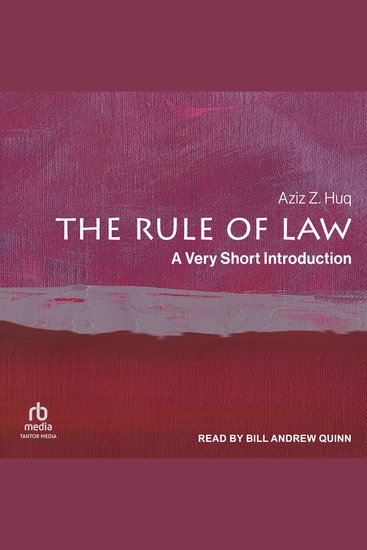
  • The Rule of Law - A Very Short Introduction - cover

    The Rule of Law - A Very Short...

    Aziz Z. Huq

    • 0
    • 0
    • 0
    Politicians, judges, and citizens commonly use the phrase "rule of law" to describe some good that flows from a legal system. But what precisely is that good? Even in Aristotle's time, there was no agreement on either its nature, and on whether it counted as an unqualified good. Even now, a core rule-of-law aspiration is that law can constrain how power is flexed. But how or when? Disagreement persists as to whether the rule of law is a matter of how law is used or why it is deployed. In consequence, the World Bank, the leaders of Singapore's one-party state, and the Communist Party in China can all offer their own spins on the concept. 


    By charting these disagreements and showing the overlap and the conflicts between different understandings of the concept, Aziz Z. Huq shows how the rule of law can still be used as an important tool for framing and evaluating the goals and functions of a legal system. He traces the idea's historical origins from ancient Greece to the constitutional theorist Albert Venn Dicey to the economist and political philosopher Friedrich Hayek. And he explores how that value is coming under pressure from terrorist threats, macroeconomic crisis, pandemics, autocratic populism, and climate change.
    Show book
  • Plaything - cover

    Plaything

    Mike Monsoon

    • 0
    • 0
    • 0
    "You're my toy now!" Plaything - a new tale of dominance from the filthy imagination of Mike Monsoon.  
    When Billy wakes up in the dark he is scared and confused. Restrained, cold and naked with no idea how he got there. When his captor reveals himself, it's only the start of an ordeal that will challenge Billy to his sexual and physical limits. And there is the little matter that he keeps coming back to...how will he explain all of this to his husband? 
    This menacing tale delves deep into those desires that you daren't share. 
    Show book
  • Art History Decoded From Cave to the Aegean World - Great Art Explained in a Clear Easy Way to Help Students and Art Lovers Read Understand and Appreciate Famous Masterpieces - cover

    Art History Decoded From Cave to...

    Roberto Russo

    • 0
    • 0
    • 0
    Ancient images can feel distant—formal, silent, as if speaking an unknown language. And yet, they were designed to communicate with absolute clarity. 
    Why is the pharaoh always larger? Why do figures appear flat, shown in strict profile? Why do certain symbols repeat with such insistence? Why do temples, tombs, and palaces take the shapes they do? 
    These aren't accidents. They're choices—visual strategies born from what these cultures valued most: power, order, memory, the divine. 
    This book turns ancient art into a readable language. 
    You'll learn simple, practical tools to "read" any artwork—by noticing patterns like hierarchy, repetition, color, and framing, and by connecting those choices to the stories they were meant to tell. Each work becomes a narrative: of kings who needed to appear eternal, of gods who demanded visibility, of societies that encoded their entire worldview into stone and pigment. 
    The journey is chronological, from prehistoric caves to the Bronze Age worlds of Egypt, Mesopotamia, Crete, and Mycenae. Every chapter focuses on key works and monuments, training your eye through clear explanations and a repeatable method. 
    By the end of this volume, you won't have memorized dates and names. You'll have acquired a method—a way of looking that transforms any image, ancient or modern, into a text you can read. 
    This skill matters more than ever. In a world flooded with images—from social media to advertising and news—learning ancient visual codes sharpens how we decode what we see today.
    Show book
  • Between Two Rivers - The Story of Mesopotamia - cover

    Between Two Rivers - The Story...

    Priyank Agrawal

    • 0
    • 0
    • 0
    This audiobook is narrated by an AI Voice.  
    Between Two Rivers: The Story of Mesopotamia takes readers on a captivating journey through the ancient land nestled between the Tigris and Euphrates, where civilization first took root. This book explores the rise and fall of Mesopotamian societies, from the dawn of urban life in Sumer to the grandeur of Babylon and the mighty Assyrian Empire. Richly detailed and meticulously researched, it delves into the innovations that shaped human history, including the invention of writing, the development of law, groundbreaking scientific advancements, and the creation of some of the world’s most enduring myths and literature. 
    Through vivid storytelling, the book brings to life the achievements and struggles of Mesopotamia’s inhabitants—farmers, priests, kings, and scribes—whose lives and legacies have had a profound and lasting impact on the course of civilization. From the monumental Ziggurats of Ur to the majestic Ishtar Gate of Babylon, the book showcases the architectural and cultural marvels that defined this ancient world. 
    Mesopotamia’s complex pantheon of gods, the great epics of Gilgamesh, and the foundational legal code of Hammurabi offer a glimpse into the minds and beliefs of one of humanity’s most innovative cultures. The book also explores Mesopotamia’s legacy, demonstrating how its contributions to law, literature, science, and governance have influenced subsequent civilizations and continue to shape modern culture. 
    Between Two Rivers is a comprehensive and accessible exploration of the ancient world that highlights the enduring significance of Mesopotamia—an eternal land that bridged the past with the present and laid the groundwork for much of what we know as modern civilization. Whether you are a history enthusiast, student, or general reader, this book offers an in-depth and thought-provoking look at the origins of human society in the heart of the ancient world.
    Show book
  • The Rising Kingdom - cover

    The Rising Kingdom

    Santiago Machain

    • 0
    • 0
    • 0
    The Rising Kingdom chronicles the pivotal era in Norumbega's history as it transforms from a fledgling settlement into a unified and resilient nation. Through the arrival of new European settlers, the forging of alliances, and the challenges of war and diplomacy, Norumbega's people confront questions of identity, governance, and coexistence. The narrative follows the city's leaders, artisans, and everyday citizens as they navigate the complexities of cultural integration, defend their homes during the Siege of Vinland, and ultimately craft the Treaty of the River—a landmark agreement that lays the foundation for peace and shared prosperity. As old traditions blend with new influences, Norumbega emerges as a beacon of hope, innovation, and unity in a changing world.
    Show book