Join us on a literary world trip!
Add this book to bookshelf
Grey
Write a new comment Default profile 50px
Grey
Subscribe to read the full book or read the first pages for free!
All characters reduced
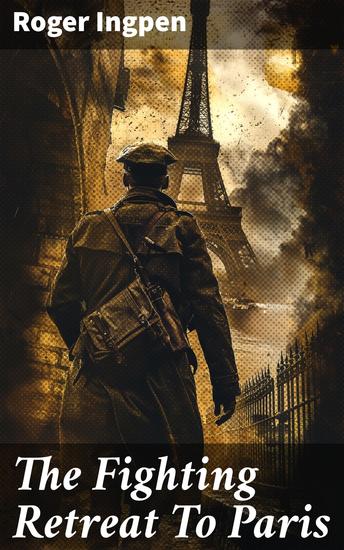
The Fighting Retreat To Paris - A Harrowing Tale of Desperation Heroism and Sacrifice in War-Torn Europe - cover

The Fighting Retreat To Paris - A Harrowing Tale of Desperation Heroism and Sacrifice in War-Torn Europe

Roger Ingpen

Publisher: Good Press

  • 0
  • 0
  • 0

Summary

In "The Fighting Retreat To Paris," Roger Ingpen masterfully narrates the tumultuous events of the First World War, focusing on the harrowing retreats of the French army in 1914. Through his precise yet evocative prose, Ingpen captures the chaos and emotional turmoil faced by soldiers as they navigate the realities of warfare, interweaving personal stories with larger historical events. The book adopts a gripping narrative style that blends journalism with literary craftsmanship, allowing readers to experience the unsettling atmosphere of battle while retaining a keen awareness of the broader geopolitical context. Roger Ingpen, an astute observer of human experience and a chronicler of historical events, draws from his own military background to craft this compelling account. His deep understanding of the implications of war and the psychological landscape it breeds stems from a life spent witnessing the fragility of civilization. Ingpen's experiences, coupled with his commitment to historical accuracy, lend a profound authenticity to this work, which serves as both a tribute and a critique of wartime endeavors. This book is essential for readers interested in military history, literature, or the psychological impact of war. Ingpen'Äôs ability to combine personal narratives with thrilling historical accounts offers a unique perspective that resonates with both scholars and casual readers alike, making "The Fighting Retreat To Paris" a significant contribution to the understanding of World War I.
Available since: 10/30/2023.
Print length: 99 pages.

Other books that might interest you

  • Tituba - The Intentional Witch Of Salem - cover

    Tituba - The Intentional Witch...

    Dave Tamanini

    • 0
    • 0
    • 0
    A unique Salem 1692 witchcraft story 
    Tituba, the first woman accused of witchcraft in colonial Salem 
    Enslaved Tituba has been faithful to a promise to her mama in Africa. 
    When Tituba's only son dies trying to escape slavery, her life changes forever. 
    The villagers see witches and demons sent by the Devil everywhere but they are wrong. It is Tituba-conjuring spectral images that spark the infamous witch hunts of 1692. 
    As neighbors accuse neighbors of witchcraft, hysterical trials follow. Tituba gloats in her power. But when hangings begin, her conscience arises. 
    Can she confront her secret crime?
    Show book
  • The Whispering Tongues - Sussex Regency Romance Book 3 - cover

    The Whispering Tongues - Sussex...

    Beth Andrews

    • 0
    • 0
    • 0
    Another exquisite regency murder mystery from your new favourite author, Beth Andrews. 
     
    Anthea Halliwell’s once-bright future is cruelly taken from her the moment she is accused of stealing a necklace dripping with rubies and diamonds and attempting to sell it. 
     
    Her beloved Captain Crispin breaks off their engagement at the first hint of scandal and marries her friend instead. Then to make matters worse, her father gambles away their fortune. 
     
    Heartbroken and penniless, Anthea is forced to beg handsome Gideon Rodrigo for help. But she never expects him to propose. 
     
    It may be a marriage of convenience for Anthea, but Gideon will do anything to clear his wife’s name. 
     
    Gideon enlists the help of John and Lydia Savidge, who have their own reputation for solving crimes. 
     
    While tongues wag and suspicions mount, John and Lydia suspect more than theft and slander are at play. 
     
    And someone is killing to keep their secrets hidden . . .
    Show book
  • Fire in the Mountains - cover

    Fire in the Mountains

    Rachel Wesson

    • 0
    • 0
    • 0
    When the railroad comes to town, some fights are worth everything. 
     
    Thomas Hayes has spent four years building a life in Shamrock Ridge—a successful blacksmith shop, a respected place in the community, and a promising marriage to mail-order bride Fiona Long. But when railroad developers arrive with generous buyout offers and veiled threats, Thomas's carefully constructed world begins to crumble. 
     
    As neighbors turn away and the community fractures under pressure, Thomas considers the one thing he swore he'd never do again: run. But Fiona didn't abandon everything in New York to watch her husband surrender to shame. She's learned what it means to fight for what matters, and she won't let fear win—not in their marriage, and not in their town. 
     
    With friends rallying and enemies closing in, Thomas must choose between the safety of surrender and the courage to stand for what's right. Because sometimes the only way to prove you're not a coward is to face the fight that terrifies you most. 
     
    A story of love, loyalty, and the price of doing what's right when everything is at stake.
    Show book
  • The Way of All Flesh - cover

    The Way of All Flesh

    Samuel Butler

    • 0
    • 0
    • 0
    "The Way of All Flesh" is a semi-autobiographical novel by Samuel Butler, published posthumously in 1903. The narrative critiques Victorian society, particularly its hypocrisy surrounding family, religion, and education, through the lens of the Pontifex family across four generations 
    The story begins with John Pontifex, a carpenter whose ambitions lead him to become a wealthy but morally questionable businessman. His obsession with social status sets the stage for the struggles faced by his descendants, particularly his son George and grandson Theobald. 
    The central character, Ernest Pontifex, emerges as the great-grandson of John. Raised in a repressive environment by his domineering parents, Theobald and Christina, Ernest grapples with the expectations placed upon him to follow a path in the clergy. Despite initial enthusiasm for religious life, he becomes disillusioned during his time at Cambridge and later as a curate. His attempts to reform the Church lead to personal crises, including a misguided sexual advance that results in imprisonment.
    Show book
  • Mór Jókai - A Short Story Collection - Celebrated author and national icon who was a leader in the 19th Century Hungarian Revolution - cover

    Mór Jókai - A Short Story...

    Mór Jókai

    • 0
    • 0
    • 0
    Móric Jókay de Ásva was born on the 18th February 1825 in Komárom, then in the Kingdom of Hungary but now part of Slovakia.  
     
    Due to his timid and delicate constitution he was educated at home until the age of 10 and then sent away to complete his studies at the Calvinist college at Pápa. 
     
    At 12 his father died, and he was pushed to honour him by replicating his career as a lawyer.  He studied hard and completed the curriculum at Kecskemét and Pest.  He won his first case as a newly graduated lawyer. 
     
    But he found a career in law to be dull and, encouraged by the positive reaction to his first play, he moved to Pest in 1845.  There he published, first in a newspaper, and then as a novel ‘Hétköznapok’ (‘Working Days’).  It was acclaimed as a masterpiece.  To add to his promise he was appointed as the editor of Életképek, the leading Hungarian journal. 
     
    In 1848 he married the actress, Róza Laborfalvi.  That same year Europe was awash with revolutions and Jókai, a moderate Liberal, enthusiastically supported the nationalist cause and its decision to depose the Habsburg dynasty.  The attempt failed. 
     
    He was now classed as a political suspect and threw himself into his literary career, writing dozens of novels, many of them masterpieces, stories, essays and the like.  In total he wrote several hundred volumes, many of them in the local Magyar language which helped arrest its declining relevance in society.  
     
    By 1867 the political temperature had cooled, and he entered parliament as well as becoming the editor a government journal he had founded.   His skills were much admired and helped the government navigate through several difficult matters.   
     
    His wife died in 1886 but although grief-stricken he continued to work and to write.  
     
    In 1897 the king appointed him a member of the upper house.  Two years later he caused a minor scandal by marrying the young 20-year-old actress, Bella Nagy.  At the time he was 74. 
     
    Mór Jókai died in Budapest on the 5th May 1904.  He was 79.
    Show book
  • The Short Stories of Jack London - Turn of the century social activist and heralded American author - cover

    The Short Stories of Jack London...

    Jack London

    • 0
    • 0
    • 0
    John Griffith Chaney was born on January 12th, 1876 in San Francisco.   
     
    His father, William Chaney, was living with Flora Wellman when she became pregnant.  Chaney insisted she have an abortion.  Flora's response was to turn a gun on herself.  Although her wounds were not severe the trauma made her temporarily deranged. 
     
    In late 1876 his mother married John London and the young child was brought to live with them as they moved around the Bay area, eventually settling in Oakland where now, calling himself Jack, he completed grade school. 
     
    Jack worked hard at several jobs, sometimes 12-18 hours a day, but his dream was university.  He studied hard and borrowed the money to enrol in the summer of 1896 at the University of California in Berkeley. 
     
    In 1897, at 21, Jack searched out newspaper accounts of his mother's suicide attempt and for the name of his biological father. He wrote to Chaney, then living in Chicago, who claimed he could not be Jack’s father because he was impotent and casually asserted that London's mother had relations with other men.  Jack, devastated by the response, quit Berkeley and went to the Klondike. Other accounts suggest that his dire finances presented Jack with the excuse he needed to leave. 
     
    In the Klondike Jack began to gather material for his writing but also accumulated many health problems, including scurvy, which together with hip and leg problems he would carry for the rest of his life. 
     
    During the late 1890's Jack was regularly publishing short stories and by the turn of the century full blown novels. 
     
    By 1904 Jack had married, fathered two children and was now in the process of divorcing.  A stint as a reporter on the Russo-Japanese war of 1904 was equal amounts trouble and experience. But that experience was always put to good use in a continuing and remarkable output of work. 
     
    In 1905 he married Charmian Kittredge who at last was a soul and companion who brought him some semblance of peace despite his advancing alcoholism and his incurable wanderlust. 
     
    Twelve years later Jack had amassed both wealth and a literary reputation through such classics as ‘The Call of the Wild’, ‘White Fang’ and many others. He had a reputation as a social activist and was a tireless friend of the workers.   
     
    Jack London died suffering from dysentery, late-stage alcoholism and uremia, aged only 40, on November 22nd 1916 at his property in Glen Elen in California. 
    01 - Jack London - A Short Story Collection - An Introduction 
    02 - To Build a Fire by Jack London 
    03 - A Wicked Woman by Jack London 
    04 - The Unparallelled Invasion by Jack London 
    05 - A Thousand Deaths by Jack London
    Show book