Join us on a literary world trip!
Add this book to bookshelf
Grey
Write a new comment Default profile 50px
Grey
Subscribe to read the full book or read the first pages for free!
All characters reduced
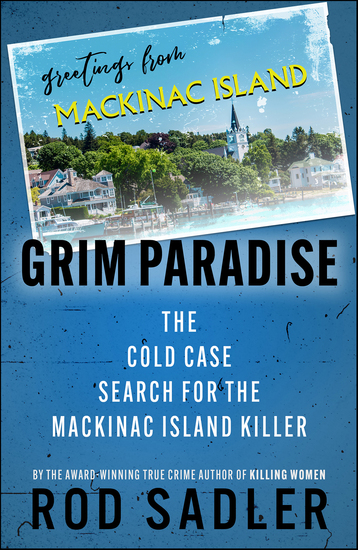
Grim Paradise - The Cold Case Search for the Mackinac Island Killer - cover

Grim Paradise - The Cold Case Search for the Mackinac Island Killer

Rod Sadler

Publisher: WildBlue Press

  • 0
  • 0
  • 0

Summary

The true crime story of a 1960 murder that rocked a tranquil Michigan vacation spot and the search for justice that followed. 
 
When widow Frances Lacey was murdered in July 1960 on Mackinac Island, only a few meager clues were found by police, and the case soon turned cold. But more than sixty years later, will those same clues finally solve the mystery?  
 
On July 24, 1960, the quaint charm and serenity of Mackinac, nestled between Michigan’s Upper and Lower Peninsulas, was shattered by Lacey’s brutal death. Despite a massive manhunt and thousands of pages of police reports, her killer was never caught.  
 
Now, in Grim Paradise, true crime author Rod Sadler (Killing Women) delves into the secrets of one of Michigan's most perplexing murder cases. Offering an in-depth and suspenseful account of the long-standing mystery, he poses the question: Could advancements in DNA technology lead to the identity of the Mackinac Island murderer as it did in the case of the Golden State Killer?
Available since: 08/22/2023.
Print length: 340 pages.

Other books that might interest you

  • Middle East in World War I The: The History and Legacy of the Biggest Campaigns in the Great War’s Forgotten Theater - cover

    Middle East in World War I The:...

    Editors Charles River

    • 0
    • 0
    • 0
    World War I, also known in its time as the “Great War” or the “War to End all Wars”, was an unprecedented holocaust in terms of its sheer scale. Fought by men who hailed from all corners of the globe, it saw millions of soldiers do battle in brutal assaults of attrition which dragged on for months with little to no respite. Tens of millions of artillery shells and untold hundreds of millions of rifle and machine gun bullets were fired in a conflict that demonstrated man’s capacity to kill each other on a heretofore unprecedented scale, and as always, such a war brought about technological innovation at a rate that made the boom of the Industrial Revolution seem stagnant.  
    	Most books and documentaries about the First World War focus on the carnage of the Western Front, where Germany faced off against France, the British Empire, and their allies in a grueling slugfest that wasted millions of lives. The shattered landscape of the trenches has become symbolic of the war as a whole, and it is this experience that everyone associates with World War I, but that front was not the only experience. There was the more mobile Eastern Front, as well as mountain warfare in the Alps and scattered fighting in Africa and the Far East. 
    	Then there was the Middle Eastern Front, fought across the Levant and Mesopotamia, which captured the imagination of the European public. There, the British and their allies fought the Ottoman Turkish Empire under harsh desert conditions hundreds of miles from home, struggling for possession of places most people only knew from the Bible and the Koran.
    Show book
  • Conquistadors: The Lives and Legacies of Hernán Cortés and Francisco Pizarro - cover

    Conquistadors: The Lives and...

    Editors Charles River

    • 0
    • 0
    • 0
    During the Age of Exploration, some of the most famous and infamous individuals were Spain’s best known conquistadors. Naturally, as the best known conquistador, Hernán Cortés is also the most controversial. Like Christopher Columbus before him, Cortés was lionized for his successes for centuries without questioning his tactics or motives, while indigenous views of the man have been overwhelmingly negative for the consequences his conquests had on the Aztecs and other natives in the region. Just about the only thing everyone agrees upon is that Cortés had a profound impact on the history of North America. Of course, the lionization and demonization of Cortés often take place without fully analyzing the man himself, especially because there are almost no contemporaneous sources that explain what his thinking and motivation was. If anything, Cortés seemed to have been less concerned with posterity or the effects of the Spanish conquest on the natives than he was on relations with the Mother Country itself.  
    	If Columbus and Cortés were the pioneers of Spain’s new global empire, Pizarro consolidated its immense power and riches, and his successes inspired a further generation to expand Spain’s dominions to unheard of dimensions. Furthermore, he participated in the forging of a new culture: like Cortés, he took an indigenous mistress with whom he had two mixed-race children, and yet the woman has none of the lasting fame of Cortés’s Doña Marina. With all of this in mind, it is again remarkable that Pizarro remains one of the less well-known and less written about of the explorers of his age. On the other hand, there are certain factors that may account for the conqueror of Peru’s relative lack of lasting glory. Cortés’s reputation was built on being the first to overthrow a great empire, so Pizarro’s similar feat, even if it bore even greater fruit in the long run, would always be overshadowed by his predecessor’s precedent. 
    Show book
  • How to Rewire Your Brain: 7 Easy Steps to Master Neuroplasticity Mind Hacking Think Habits & Practical Neuroscience - cover

    How to Rewire Your Brain: 7 Easy...

    Troye Bates

    • 0
    • 0
    • 0
    How can you rewire your brain? Is there anything you can do to change the current trajectory of your life?  
      
    Find the answers of how to get a grasp of your thoughts and gain an understanding of the impact it has on who you are and the choices you make.  
      
    Learn how to achieve the motivation needed to rewire your brain. Reach that level of consciousness to be able to identify and be aware of your thoughts in just 7 steps! 
      
    YOU WILL LEARN: 
    ·     What neuroplasticity entails. 
    ·     How to practice your subconscious mind power. 
    ·     How to alter your conscious mind. 
    ·     How to change your outlook with mind hacking. 
    ·     How you find joy in life with practical neuroscience. 
    ·     How you practice meditation. 
    ·     7 Easy steps to rewire your brain completely. 
      
    You don’t have to make major modifications, but you will learn how to transform how you think which will transform your life. 
      
    Practice will truly bring positive progression. Changing your mind will change you, start today!
    Show book
  • HIGHLY SENSITIVE PERSON - How to Use Emotional Intelligence Skills Without Being Abused - A Complete Guide to Understand and Master Emotions and Empathy to Improve Self Esteem and Social Skills - cover

    HIGHLY SENSITIVE PERSON - How to...

    Andrew Lopez

    • 0
    • 0
    • 0
    Embrace Your Sensitivity: Unlock the Power of Emotional Intelligence with "HIGHLY SENSITIVE PERSON" Audiobook 
    Are you tired of feeling overwhelmed by your emotions? Do you long to harness your sensitivity as a strength rather than a burden? Look no further – "HIGHLY SENSITIVE PERSON" is the transformative audiobook you've been searching for. 
    Dive into a comprehensive guide that will empower you to navigate the intricacies of emotional intelligence with confidence. Unravel the mysteries of your own emotions and learn how to harness the power of empathy to enhance your self-esteem and social skills. This audiobook is a beacon of light for those seeking to thrive as highly sensitive individuals in a world that often fails to understand their unique gifts. 
    Through this captivating auditory experience, you'll embark on a journey of self-discovery and growth. Learn practical strategies to cultivate emotional resilience, set healthy boundaries, and protect yourself from emotional abuse. Discover the delicate balance between sensitivity and strength, as you unlock the keys to understanding and mastering your emotions. 
    Let this audiobook be your steadfast companion, guiding you toward a profound transformation. Embrace your sensitivity as a superpower, and harness the profound wisdom of emotional intelligence to forge meaningful connections and lead a life of authentic fulfillment. 
    Unlock the secrets to emotional intelligence, break free from the cycle of abuse, and step into your true power as a highly sensitive person. Get ready to embark on a life-changing journey with "HIGHLY SENSITIVE PERSON" audiobook – your passport to a vibrant and empowered existence.
    Show book
  • The Revolution Betrayed - What Is the Soviet Union and Where Is It Going? - cover

    The Revolution Betrayed - What...

    Leon Trotsky

    • 0
    • 0
    • 0
    It is June 1936. Leon Trotsky (1879-1940) has finally been granted a visa for asylum in Norway, having been banned first from living in Paris, and then the whole of France. With him comes the draft of The Revolution Betrayed: What Is the Soviet Union and Where Is It Going?, which is completed and sent to the publishers on the 4th of August. The book, published by Faber in 1937, is considered to be Trotsky’s major work on Stalinism. Trotsky’s passion for the spirit of the Revolution he co-founded, his disgust and sadness at how the people of Russia have been betrayed by Stalin and his acolytes, shows us the bleak lives of 170 million Russians under the absolute control of ‘the Ten Thousand’ of the bureaucracy.  
     
    Trotsky reminds us of the high concepts of the 1917 October Revolution, (Marx’s 'From each according to his ability, to each according to his needs') with the sharing of the nation’s resources for the benefit of all. Prominent among such forward thinking was the commitment to lift women out of the trap of housework and childbirth by communal refectories and creches in the workplace. He praises the positive economic advances of the USSR since the death of Lenin - the growth in areas such as industrial and electrical output. But he notes the continued and inevitable low productivity (much lower than the capitalist West, he acknowledges) that is the result of lack of incentive for the Soviet worker. This, he argues, will never allow the country to lift itself up to full potential, despite Stalin’s ever-changing Five-Year Plans. 
     
    Indeed, it is this zig-zagging of panicked policy and bovine directionlessness that frustrates Trotsky so much. It is bad enough that Stalin and his self-serving cohorts have formed a Thermidorian regime of brutal repression and conservative nest-feathering. But even worse, their economic adventurism is carrying ‘the nation to the edge of disaster’.  
     
    Trotsky brings us a clear picture of the miserable existence of the vast majority of Russians, barely surviving on bad rations, endemic corruption and fear, and the promise of a tomorrow that will never come. He laments the lack of a proletarian uprising in the West that might encourage Russians to change their own off-course regime. He notes the rise of Hitler and Mussolini, and seems, even in 1936, to see war as inevitable. He predicts the toppling of Stalinism but would have wept at how many decades it took and how many millions of lives would be wasted by stupidity and war.  
     
    Only 10 days after Trotsky sent this book to the publishers, Stalin announced the first of the Moscow show trials that began the Great Purge. Trotsky and his wife were badly treated and muzzled by the Norwegians to prevent his protesting at Stalin’s actions, and they moved to Mexico City in early 1937. There they lived, terrorized by Stalin’s determination to assassinate his old rival, until Trotsky’s death following a blow from an ice pick on 20th August 1940. The Revolution Betrayed, with its vivid translation by Max Eastman, is presented with clarity and commitment by Jonathan Booth.
    Show book
  • No Self No God No Clue - David Hume and the Joy of Destroying Everything - cover

    No Self No God No Clue - David...

    Sophia Blackwell

    • 0
    • 0
    • 0
    ohn Locke: Enlightenment philosopher, father of liberalism, inventor of “natural rights,” and accidental spiritual patron of land developers, libertarians, and your uncle who won’t shut up about property taxes. 
    In this gloriously sarcastic takedown of one of Western philosophy’s most over-quoted minds, Sophia Blackwell (Kant You Not, No Self, No God, No Clue) guides you through Locke’s greatest hits—including: 
    The blank slate theory, which basically says you’re born dumb and the world makes you worse 
    His ideas on identity, which collapse the second you forget your phone password 
    His version of consent, which mostly consists of “You didn’t leave, so I assume you’re fine with it.” 
    And of course, property rights—where mixing your labor with the earth somehow makes it yours, and stealing land becomes morally correct as long as you bring a shovel 
    Locke’s political philosophy inspired democracies, revolutions, and every 400-comment Reddit thread titled “Taxation is theft.” 
    This is not a respectful biography. 
    This is a roast. A eulogy. A survival guide for understanding how Locke gave us: 
    Liberalism 
    Landlords 
    Legal headaches 
    And a political system that thinks fencing off a patch of dirt = moral superiority 
    Perfect for: 
    Recovering philosophy students 
    Political skeptics 
    Enlightenment haters 
    Property law survivors 
    And anyone who wants to laugh while questioning whether government is just a giant metaphor for a really passive-aggressive roommate agreement 
    You don’t need to read Two Treatises of Government. 
    You just need to know Locke said, “I think I own that,” and people believed him.
    Show book