Join us on a literary world trip!
Add this book to bookshelf
Grey
Write a new comment Default profile 50px
Grey
Subscribe to read the full book or read the first pages for free!
All characters reduced
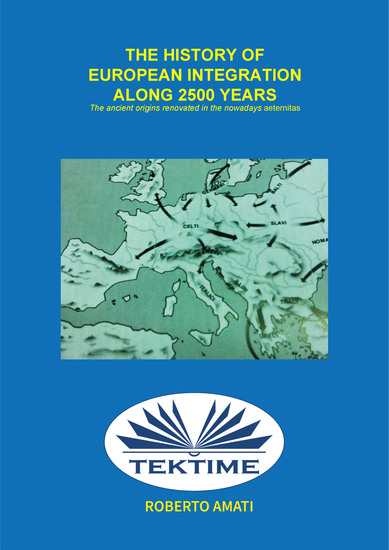
History of European Integration in 2500 Years - Ancient Origins Are Renewed In The Present Aeternitas - cover

History of European Integration in 2500 Years - Ancient Origins Are Renewed In The Present Aeternitas

Roberto Amati

Translator Alessandra Cervetti

Publisher: Tektime

  • 0
  • 0
  • 0

Summary

The history of European integration did not begin in the aftermath of the 20th century AD: only the epilogue of a very long political, religious and socio-cultural formation process that started with the great adventure of Alexander the Great and his impromptu universal empire. In the centuries that followed, Europe became a land of immigration of peoples of Asian origin and Indo-European matrix, who found themselves on a continent that had emerged from the ice and occupied their own 'living space'. People still essentially present today who recognise themselves in Europe as an entity that retains its own characteristic identity in political, religious and historical-cultural terms. This book tells the story of the forces and ideas that enabled different 'gentes' to integrate and live together through facts, characters, thoughts, faiths, royal dynasties and power struggles.
The text is conceived with a plural thematic structure that aims to reflect the various European 'souls' and offer each specific interpretation. The Introduction sets out principles, concepts, questions, but also the philosophical/cultural paths along which the overall European culture was formed, even if not entirely homogeneous and for long periods dramatically conflicting, highlighting the turning milestones of the common continental thought thanks to an oriental and classical philosophical discourse. Part One, on the other hand, recounts the history of European events, personalities and evolutionary lines, with a Greek historical approach, relating them to the action and function of the Empire (especially the Christian one), which over the centuries 'attracted' the various peoples settled in Europe and trained them in a model of civilisation and socio-political organisation still visible today in every corner of the continent: the formation of the European states and nations now included in the EU is thus the product of the 'budding' of the Empire over two thousand years. Part Two examines the evolution of European legal and political thought using the method of Roman jurist treatises, following the development of the function of auctoritas, from its first configuration in the ancient Res Publica of Rome through the medieval, renaissance and modern eras to demonstrate the continuity of its conceptual reworking in every political and legal form of power established at every latitude of Europe, up to the so-called 'modern states' of today's democratic and constitutional republics. Part Three is a synthesis of the history of Christianity, from the events of the first 'communities' formed in the imperial age and then spread to the whole of Europe thanks to the evangelical action of the missionary monks and the policy of Christianization of the peoples of Europe conducted by the Empire and the institutional Church, under the sign of the biblical eschatological vision of 'salvation for all believers in Christ' which has an evident Jewish matrix and draws strength from the unique figure in human history of Jesus of Nazareth. The story also deals with the events that have marked the history of the Christian Church in every era, from the original conceptual controversies to imperial dogmatism, from the confrontation between the different 'churches' that arose in Europe in the Middle Ages to the struggles between Papacy and Empire, up to the Protest and Reformation that shaped the state of Christian religiosity today. Part Four is a cryptic narrative that seeks to 'unveil' (and thus end the evolutionary process underway) European history by its cultural roots, its founding myths and the journey of the 'European people', inspired by a Celtic metaphysical approach: only by delving into the various 'mysteries' collected in Eastern Greek cosmogony, in ancient Greco-Roman mythology, in the biblical letter and again in the most famous medieval legends narrated by the Chanson de geste, can one reconstruct the whole of European history and understand its unity of orig
Available since: 02/03/2022.
Other books that might interest you

  • Queens - History and Biography of Mary Tudor Marie Antoinette Eleanor of Aquitaine Victoria and Anne Boleyn - cover

    Queens - History and Biography...

    Kelly Mass

    • 0
    • 0
    • 0
    This book contains the stories and biographies of several queens from history: 
    Bloody Mary - Mary I, typically called Mary Tudor and called "Bloody Mary" by her Protestant challengers, ruled as Queen of England and Ireland from July 1553 till November 17th, 1558. She is well recalled for her solid attempts to reverse the English Reformation, which started throughout her dad's reign, Henry VIII's reign. 
    Marie Antoinette - Before the Reign of Terror, Marie Antoinette was the last queen of France. She was the penultimate kid and youngest daughter of Empress Maria Theresa and Emperor Francis I, and was born an archduchess of Austria. At the age of 14, she wed Louis-Auguste, the beneficiary evident to the French throne, and ended up being dauphine of France in May 1770. Her partner, Louis XVI, took the throne on May 10, 1774, and she ended up being queen. 
    Eleanor of Aquitaine - Eleanor of Aquitaine is a controversial figure in history. Many have referred to her in a different light. Some with some opinions, others with others. Today, you will learn more about those and get as many facts straight as possible. 
    Queen Victoria - From June twentieth, 1837, to her death in the year 1901, Victoria ruled as Queen of the UK of Great Britain and Ireland. Her rule of 63 years and 7 months, called the Victorian period, was the longest of any British emperor before her. It was a period of considerable commercial, social, technical, and army development in the U.K., and also a period of great British Empire growth. 
    Anne Boleyn - As King Henry VIII's 2nd marriage partner, Anne Boleyn ruled as Queen of England from 1533 till 1536. Her marriage and execution by beheading for treason and other criminal offenses made her an essential player in the political and religious chaos that identified the start of the English Reformation. 
    Show book
  • Young Lions - cover

    Young Lions

    Andrew Mackay

    • 0
    • 0
    • 0
    This is the story of two teenage British boys in a Britain occupied by the Germans, which is what might have happened if the Nazis had successfully carried out their plans to invade Britain under Operation Sea Lion in the 1940s. Alan Mitchell and Sam Roberts study at St. John's Academy in the fictional Cambridgeshire market town of Hereward. Their Home Guard unit is defeated and the Schutzstaffel (S.S.) massacres the prisoners but the boys escape and return to German occupied Hereward.
    Show book
  • CO-PARENTING WITH A NARCISSIST - Divorcing a Narcissistic Ex and Moving on from an Addictive Partner Finding a Way to Heal From Emotional Trauma While Yet Being a Good Mother (2022 Guide for Newbies) - cover

    CO-PARENTING WITH A NARCISSIST -...

    Una Guzman

    • 0
    • 0
    • 0
    Being in a relationship with a narcissist may be pretty traumatic.  
    Unbeknownst to the narcissist may be aware of their goals and may be manipulating them. It is challenging to be a part of and cope with.  
    This is why it is beneficial to understand better what it is like to be in a relationship with a narcissist. Try to get your body tuned up. 
    What does your body say about the current situation?  
    Look out for a technique to take care of yourself and ease your worry before it affects your health. Your body is telling you that something is wrong with you. Tell it that you will be paying greater attention in the future. 
    This book discusses:The Narcissist and MarriageDivorce from a NarcissistAdapting to Parental Separation and Child DevelopmentGuidelines for Responding to Children's Divorce QuestionsAlienation from one's parentsManipulative Narcissistic TacticsHow to Co-Parent with a NarcissistHow to Support Your Children During a DivorceThe Importance of Routines in ParentingEmotional Abuse RecoveryHow to Give Your Child the Best AdviceReturning to Love 
      
    ...And Much More! 
    Remember that you must first love yourself before you can be receptive to receiving love. 
    Do you want to learn more about this book?  
    Now is the time to click the "purchase now" button! 
     
    Show book
  • Tainos and Caribs The: The History of the Indigenous Natives Who Encountered Christopher Columbus in 1492 - cover

    Tainos and Caribs The: The...

    Editors Charles River

    • 0
    • 0
    • 0
    On October 12, 1492, one of the most important “first contacts” of the modern era was made when three ships of Spanish origin approached the island archipelago now known as the Bahamas, cautiously dropping anchor as the captain of the fleet gazed across to what he assumed was the coast of India. According to the popular version of the story, amazed at the sight of ships and men of such unfamiliar appearance, the native people of the island plunged into the clear waters of the western Atlantic, expertly swimming or aboard dugout canoes, and came out to greet the strangers. 
    	In all probability, the meeting was much more cautious and incremental, but the idea that these innocent people, raised in a tropical Eden, might embrace with such open enthusiasm their own destruction is picturesque, and no doubt appeals to contemporary perceptions. By whatever means one might choose to view it, this meeting of cultures certainly did mark the beginning of a bold new chapter in the history of Europe, and the beginning of the end of an ancient race of native people occupying a vast new continent.  
    	The entries into Christopher Columbus’ log as he recorded his first encounters with the indigenous people of the “Indies” are very telling. The island people arrived alongside his ships, offering humble gifts that Columbus described as “parrots and balls of cotton and spears and many other things, which they exchanged for the glass beads and hawks' bells.” These were the Taínos people, or the “Arawaks” as they would come to be known, and Columbus described them as “well built…with good bodies and handsome features.”  
    	This description, while deceptively simple, had a chilling implication, because Columbus was not taking note of these facts out of idle interest but in terms of how best to exploit them. As the natives offered up gifts aand by implication the freedom of their islands, Columbus remarked simply on their primitive appearance.
    Show book
  • The Courage to Continue - A Family's Legacy of Resilience and Global Enterprise - cover

    The Courage to Continue - A...

    Itzhak Fisher

    • 0
    • 0
    • 0
    In this compelling memoir, Itzhak Fisher pays tribute to the values of perseverance and family loyalty, inspired by his parents’ and in-laws’ generosity and courage as they rebuilt their lives after surviving the Holocaust.
    Show book
  • Africa on the Precipice - The Blueprint to Steer the Continent and Diaspora to Redemption - cover

    Africa on the Precipice - The...

    Nnamdi Chiekwu

    • 0
    • 0
    • 0
    Africa on the Precipice (ATP) provides commentary on global geopolitics, economics, and world history, using African interests as a lens to give a different perspective on world events. The book specifically explores how and why Africa has not fared well in the ‘battle of civilizations’ (or global geopolitics) from the 15th century until present times. ATP also presents a bold blueprint to make African countries dominant on the international stage through an ideology originated by the author called ‘Afro-Hegemonism’.  
    ATP sounds the alarm for African countries that they must undergo transformational socioeconomic restructuring by 2030. The consequence of not doing so, will see Africans continue to be a global underclass in a geopolitical landscape that is quickly evolving. Moreover, the ultimate price for not embracing revolutionary change now, could see Africans permanently lose their sovereignty, treasure, and freedom in the 21st century.
    Show book