Join us on a literary world trip!
Add this book to bookshelf
Grey
Write a new comment Default profile 50px
Grey
Subscribe to read the full book or read the first pages for free!
All characters reduced
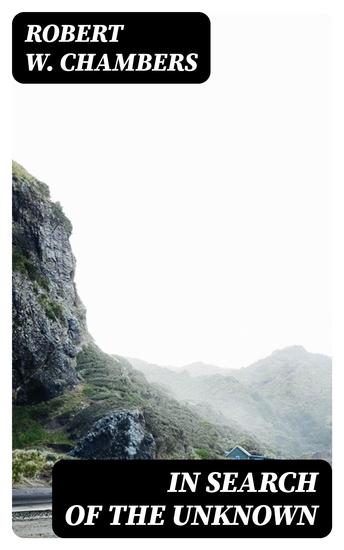
In Search of the Unknown - cover

In Search of the Unknown

Robert W. Chambers

Publisher: DigiCat

  • 0
  • 0
  • 0

Summary

Robert W. Chambers' "In Search of the Unknown" is a captivating exploration of the boundaries between reality and the supernatural, delving into the realms of mystery and existential inquiry. Written during the late 19th century, a period marked by the tension between scientific progress and the intrigue of the unexplained, Chambers employs a lush, yet concise literary style. The narrative weaves together elements of gothic horror and philosophical pondering, resulting in a text that challenges the reader's perceptions while evoking an atmosphere thick with suspense and arcane knowledge. The intertwined stories reveal profound reflections on human nature and the elusiveness of understanding the unknown. As a prominent figure in early 20th-century American literature, Chambers was deeply influenced by the cultural milieu of his time, particularly the fascination with mysticism and the occult. His background as a painter and his interest in symbolist art informed his writing, enabling him to create vivid, evocative imagery that lingers in the reader's mind. Chambers' engagement with the psychological dimensions of his characters illuminates his understanding of the fears and uncertainties that drive humanity toward the mystical. "In Search of the Unknown" is a must-read for anyone intrigued by the interplay of the known and the mysterious. It invites readers to embark on a thrilling intellectual journey, beckoning those who dare to confront the shadows that lie beyond the familiar. This profound work remains relevant today, offering insights into the perennial human quest for meaning and connection with the inexplicable.
Available since: 09/16/2022.
Print length: 178 pages.

Other books that might interest you

  • Dead America - The Texas Panhandle - Pt 6 - cover

    Dead America - The Texas...

    Derek Slaton

    • 0
    • 0
    • 0
    With the battle in full swing, great risks are taken on both sides in an attempt to achieve victory. 
    Dead America - The Second Month series follows survivors from coast to coast as they deal with the threats posed by both the living and the undead.
    Show book
  • Transition of Juan Romero The (The Work of H P Lovecraft Episode 7) - cover

    Transition of Juan Romero The...

    H. P. Lovecraft

    • 0
    • 0
    • 0
    The story involves a mine that uncovers a very deep chasm, too deep for any sounding lines to hit bottom. The night after the discovery of the abyss the narrator and one of the mine's workers, a Mexican called Juan Romero, venture together inside the mine, drawn against their will by a mysterious rhythmical throbbing in the ground. Romero reaches the abyss first and is swallowed by it. The narrator peers over the edge, sees something – "but God, I dare not tell you what I saw!" and loses consciousness. The next morning, the narrator and the deceased Romero are both found in their bunks. Other miners swear that neither of them left their cabin that night. The chasm has vanished as well.
    Show book
  • The Lurking Fear - cover

    The Lurking Fear

    H.P. Lovecraft

    • 0
    • 0
    • 0
    Something is killing the hill folk in the Catskills, and our intrepid narrator is determined to find out what it is. What he finds is much, much more than he bargained for.
    Show book
  • The Pit and the Pendulum - cover

    The Pit and the Pendulum

    Edgar Allan Poe

    • 0
    • 0
    • 0
    "I was sick—sick unto death with that long agony"
    
    Imprisoned in a nightmarish dungeon by the Spanish Inquisition, a man awakens in darkness, knowing he is about to face a series of terrifying tortures designed to break his body, mind and spirit. Chained beneath the slowly descending blade of a pendulum, with the walls closing in and the yawning mouth of a deadly pit in the centre of the floor, he is forced to confront fear, madness, and the unknown.
    
    Edgar Allan Poe's classic short story is a masterclass in psychological terror, creating an atmosphere of fear and suspense not through the use of supernatural monsters, but through isolation, anticipation and the diabolical ingenuity of man. One of the author's most enduring tales, it has been adapted multiple times for film, television and radio, with notable adaptations including the 1961 film starring Vincent Price and the animated 2013 film Extraordinary Tales.
    Edgar Allan Poe (1809–1849) was an American writer, poet, editor and literary critic known for his dark, atmospheric tales and haunting poetry. Widely regarded as one of the most influential figures in American literature, Poe helped shape the horror and science-fiction genres and is widely credited with inventing detective fiction in his 1841 short story, Murders in the Rue Morgue. Despite a life marked by personal tragedy and financial hardship, Poe produced a number of enduring classics such as The Raven, The Tell-Tale Heart, and The Fall of the House of Usher, and since his somewhat mysterious death, he and his writings have had a wide-ranging influence in popular culture. In 1946, the Mystery Writers of America established the annual Edgar award, which honour the best in mystery fiction, non-fiction, and film.
    Show book
  • Plunge Hill: A Case Study and The Castle - The Eden Book Society Book 3 and 4 - cover

    Plunge Hill: A Case Study and...

    J. M. McVulpin, Chuck Valentine

    • 0
    • 0
    • 0
    Collecting the next two books in the Eden Book Society series: Plunge Hill and The Castle. 
     
    Plunge Hill: In 1972, during the chaotic days of miners strikes and the three-day week, Bridget Brix Shipley moves to Plunge Hill to start her new job as a medical secretary at the local hospital. As she writes to Maurice, her younger brother, sick at home (who never replies), it becomes clear that not all is well at Plunge Hill. There are frequent power cuts and she has to work by candlelight. While shed hoped this might inspire some blitz spirit and solidarity between her, the other secretaries and the medical staff, shes increasingly isolated and seemingly ignored by her co-workers.
    Show book
  • Dracula The Lost Manuscript - cover

    Dracula The Lost Manuscript

    Bram Stoker

    • 0
    • 0
    • 0
    Dracula, a Gothic novel by Bram Stoker, published in 1897, is derived from old vampire legends and is the basis for an entire genre of literature and film. Dracula, the archetypal vampire, is depicted in the novel as having been the origin of the many werewolf legends. The willowy count is believed to have been inspired by the 15th-century Vlad the Impaler, and by Sir Henry Irving, an actor for whom Stoker was a personal assistant. One of Dracula's most iconic powers is his ability to turn others into vampires by biting them and thus infecting them with the vampiric disease. Stoker's novel takes the form of an epistolary tale, in which Count Dracula's characteristics, powers are narrated by multiple narrators. Count Dracula is an undead, centuries-old vampire, and Transylvanian nobleman descended from Attila the Hun. He inhabits a decaying castle in the Carpathian Mountains near the Borgo Pass. Dracula is devilishly handsome and charismatic, with a veneer of dark aristocratic charm. Likewise, he possesses supernatural abilities gained through his intimate dealings with the Devil. Dracula does not cast a shadow or reflect in mirrors. He can defy gravity and possesses superhuman agility, able to climb vertical surfaces upside down. In the novel he also has great hypnotic, telepathic and illusionary powers. This is the rare, long lost original 1897 manuscript - published here for the first time. 
     
    Produced by Macc Kay 
    Production executive Avalon Giuliano 
    ICON Intern Eden Garret Giuliano 
    ©2022 Eden Garret Giuliano (P) 2022 Eden Garret Giuliano
    Show book