

Join us on a literary world trip!
Add this book to bookshelf
Grey
Write a new comment Default profile 50px
Grey
Subscribe to read the full book or read the first pages for free!
All characters reduced
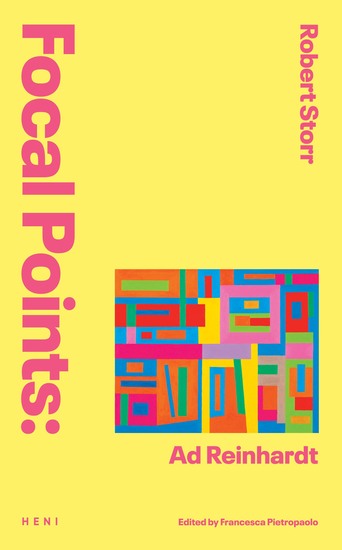
Ad Reinhardt - cover

Ad Reinhardt

Robert Storr

Publisher: HENI Publishing

  • 0
  • 0
  • 0

Summary

How can we interpret the work of contemporary artists? Focal Points is a new book series of essays, articles and reviews by acclaimed curator and critic Robert Storr. Expertly edited by art historian and curator Francesca Pietropaolo, and richly illustrated, it lends Storr’s illuminating insights into an artist’s practice and way of thinking across recent decades. Brilliantly scholarly, accessible and engaging, Focal Points offers fresh interpretations of the varied territory of modern and contemporary art. This second volume considers the work of American abstract painter Ad Reinhardt (1913–1967). Active in New York for over three decades, Reinhardt was part of the group of artists who became known as Abstract Expressionists, and he made work that would prove influential to the younger generation of Minimal and Conceptual artists. He believed in a philosophy of what he called ‘art-as-art’ and used his writing and satirical cartoons to advocate for abstract art. As he famously wrote in 1962: ‘Art is art-as-art and everything else is everything else.’ In this volume, Storr discusses Reinhardt’s painting, his comics, and his slide lecture series or ‘non-happenings, ’ as the artist called them.
Available since: 05/22/2025.

Other books that might interest you

  • Everything She Touched - The Life of Ruth Asawa - cover

    Everything She Touched - The...

    Marilyn Chase

    • 0
    • 0
    • 0
    This is the story of a woman who wielded imagination and hope in the face of intolerance and who transformed everything she touched into art. In this compelling biography, author Marilyn Chase brings Ruth Asawa's story to vivid life. She draws on Asawa's extensive archives and weaves together many voices to offer a complex and fascinating portrait of the artist. 


    Born in California in 1926, Ruth Asawa grew from a farmer's daughter to a celebrated sculptor. She survived adolescence in the World War II Japanese-American internment camps and attended the groundbreaking art school at Black Mountain College. Asawa then went on to develop her signature hanging-wire sculptures, create iconic urban installations, revolutionize arts education in her adopted hometown of San Francisco, fight through lupus, and defy convention to nurture a multiracial family. 


    ● Documents Asawa's transformative touch—most notably by turning wire—the material of the internment camp fences—into sculptures 


    ● Author Marilyn Chase mined Asawa's letters, diaries, sketches, and photos and conducted interviews with those who knew her to tell this inspiring story.
    Show book
  • 100 20th-Century Buildings - cover

    100 20th-Century Buildings

    Society Twentieth Century

    • 0
    • 0
    • 0
    A stylish celebration of some of the greatest buildings in Britain, from the 20th century and beyond, by the country's leading organisation for the protection of 20th century architecture.
    This fascinating book showcases 100 standout buildings from 1914 onwards, representing the broad variety of 20th century British architecture. The structures celebrated in this book include the Royal Festival Hall, the Hepworth Gallery, Preston Bus Station, Battersea Power Station, the Barbican Estate, the Aquatics Centre and many more.  
    The glorious photography in 100 20th Century Buildings is accompanied by insightful text from a range of expert architectural writers and enthusiasts including Alan Powers, Owen Hatherley and Rowan Moore, along with several longer essays on different aspects of the 20th-century built environment: the late Gavin Stamp on the inter-war decades, the much missed Elain Harwood on post-war architecture and Timothy Brittain-Catlin on postmodernism.
    From factories to art galleries, churches to health centres, office blocks to individual private dwellings, this book provides a captivating overview of the 20th century built environment.
    Show book
  • Edo Period - Tokugawa Rule Isolation and the Samurai Code - cover

    Edo Period - Tokugawa Rule...

    Rolf Hedger

    • 0
    • 0
    • 0
    The Edo period in Japan began with the dramatic rise of Tokugawa Ieyasu and the establishment of the Tokugawa Shogunate, which would bring over two centuries of relative peace and stability to the country. This transformation was not immediate but was set into motion by the pivotal Battle of Sekigahara in 1600. Ieyasu, a powerful daimyo and skilled strategist, emerged victorious in this decisive conflict, defeating rival factions and securing his dominance over the fractured Japanese landscape. This battle marked the end of the Warring States period, a time of nearly constant civil war, and laid the foundation for a new era of centralized feudal rule. 
    In 1603, Ieyasu was granted the title of shogun by the emperor, officially establishing the Tokugawa Shogunate. Although the emperor remained a symbolic figurehead, true political power rested with the shogun. Ieyasu’s government was based in Edo, a small fishing village that quickly developed into a sprawling political and economic center—modern-day Tokyo. From here, the Tokugawa clan implemented a system of governance that emphasized strict control, social hierarchy, and regional oversight. The shogunate devised a complex administrative structure that allowed it to maintain authority over hundreds of semi-autonomous domains ruled by daimyo, while ensuring loyalty through a combination of military strength, economic policy, and social regulation. 
    One of the key strategies used by Tokugawa Ieyasu to solidify his power was the creation of the han system. Under this arrangement, each daimyo governed a specific territory but was subject to strict oversight from the shogunate. The policy of sankin-kotai, or alternate attendance, required daimyo to spend alternating years in Edo, effectively draining their resources and keeping them under close surveillance. Their families were often kept in Edo as virtual hostages, ensuring obedience and discouraging rebellion.
    Show book
  • Radiohead's OK Computer - cover

    Radiohead's OK Computer

    Dai Griffiths

    • 0
    • 0
    • 0
    Seemingly granted ‘classic album’ status within days of its release in 1997, OK Computer transformed Radiohead from a highly promising rock act into The Most Important Band in the World – a label the band has been burdened by (and has fooled around with) ever since. Through close musical analysis of each song, Dai Griffiths explores the themes and ideas that have made this album resonate so deeply with its audience, and argues that OK Computer is one of the most successfully realized CD albums so far created.
    Show book
  • Man Bites Dog - Hot Dog Culture in America - cover

    Man Bites Dog - Hot Dog Culture...

    Bruce Kraig, Patty Carroll

    • 0
    • 0
    • 0
    Whether you call them franks, wieners, or red hots, hot dogs are as American as apple pie, but how did these little links become icons of American culture? Man Bites Dog explores the transformation of hot dogs from unassuming street fare to paradigms of regional expression, social mobility, and democracy. World-renowned hot dog scholar Bruce Kraig investigates the history, people, décor, and venues that make up hot dog culture and what it says about our country.  These humble sausages cross ethnic and regional boundaries and have provided the means for plucky entrepreneurs to pull themselves up by their bootstraps. Hot dogs, and the ways we enjoy them, are part of the American dream. Man Bites Dog celebrates the power of the hot dog through a historical survey and profiles of notable hot dog purveyors. Loaded with stunning color photos by Patty Carroll, descriptions of neighborhood venues and flashy pushcarts from New York to Los Angeles, and recipes for cooking up hot dog heaven at home, this book is the u
    Show book
  • Cardi B's Invasion of Privacy - cover

    Cardi B's Invasion of Privacy

    Ma'Chell M. Duma

    • 0
    • 0
    • 0
    The apex of critical praise and commercial success is a metric achieved by a select few. In 2020, Cardi B became synonymous with “record breaking” as her debut album Invasion of Privacy went five times platinum and became the longest charting record by a female rapper in history. From streaming and charting to views, likes, retweets, and shares, Cardi dominates. Cardi B’s ascension to stardom is pure 21st century: from welfare kid to unapologetic stripper; reality TV persona, to social media maven, to a household name delivering one of the consummately executed albums in rap history, it’s easy to imagine future critics noting popular music as before and after the rise of Cardi B.This in-depth look at Invasion of Privacy explores the sexual politics of hip hop through a track-by-track breakdown of the album. It addresses questions like: How does the wage gap impact pop music? Has Cardi destigmatized sex work for artists? What would hip hop look like as a matriarchy? Each chapter explores the musicality and social constructs that shape the album and a new movement in femme rap.
    Show book
