Join us on a literary world trip!
Add this book to bookshelf
Grey
Write a new comment Default profile 50px
Grey
Subscribe to read the full book or read the first pages for free!
All characters reduced
The Steiner Technique - cover

The Steiner Technique

Robert Steiner

Publisher: Babelcube

  • 0
  • 0
  • 0

Summary

There are many different singing techniques, but one technique above all allows you to sing anything and everything without ever damaging your voice: the belcanto technique. 


Appropriately modified, adapted and consolidated over the years by Robert Steiner, this technique, which has now taken on very different connotations from that used in opera, allows the student to sing musicals, pop, rock, jazz, blues, soul, metal or any other non-opera music genre, without ruining or straining the voice. 


The use of this technique by actors or dubbers also avoids unnecessary fatigue on the instrument, without ruining or compromising vocal performance. 


Anyone, professional or not, can now learn to use their voice well, thanks to the Steiner Technique.
Available since: 12/10/2021.
Other books that might interest you

  • Run It Like a Business - Strategies for Arts Organizations to In­crease Audiences Remain Relevant and Multiply Money--Without Losing the Art - cover

    Run It Like a Business -...

    Aubrey Bergauer

    • 0
    • 0
    • 0
    In the US alone, the arts are a $763 billion sector whose 100,000+ organizations serve almost every community in the nation. There's no reason arts organizations should struggle to make ends meet. Running your arts organization like a business is your path forward to: 


    ● Grow audiences and keep them coming back again 


    ● Make our organizations more inclusive 


    ● Get younger attendees in the seats and on the donor rolls 


    ● Continue to create the art we love—without the stress of figuring out how to afford it 


    Just because arts organizations are non-profits doesn't mean they shouldn't make money; it means the money they make goes back to fund the mission—whether that's music, visual arts, theatre, dance, or one of many other mediums that enrich our lives. 


    The for-profit world knows how to achieve success across customer engagement, user experience, company culture, the subscription economy, technology and media, new revenue streams, and brand relevance. Run It Like a Business provides a powerful, proven framework to help all arts organizations revitalize their economic engines and ultimately serve the arts and its patrons.
    Show book
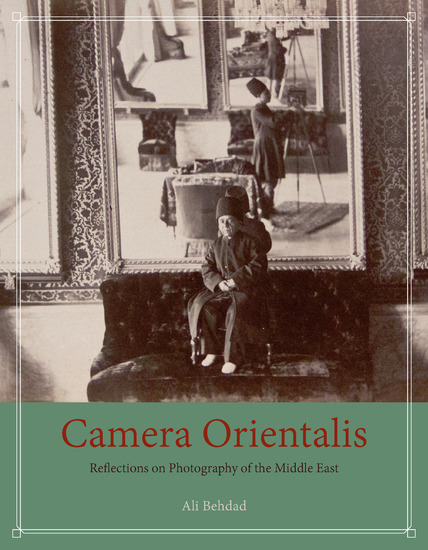
  • Camera Orientalis - Reflections on Photography of the Middle East - cover

    Camera Orientalis - Reflections...

    Ali Behdad

    • 0
    • 0
    • 0
    In the decades after its invention in 1839, photography was inextricably linked to the Middle East. Introduced as a crucial tool for Egyptologists and Orientalists who needed to document their archaeological findings, the photograph was easier and faster to produce in intense Middle Eastern light—making the region one of the original sites for the practice of photography. A pioneering study of this intertwined history, Camera Orientalis traces the Middle East’s influences on photography’s evolution, as well as photography’s effect on Europe’s view of “the Orient.” Considering a range of Western and Middle Eastern archival material from the late nineteenth and early twentieth centuries, Ali Behdad offers a rich account of how photography transformed Europe’s distinctly Orientalist vision into what seemed objective fact, a transformation that proved central to the project of European colonialism. At the same time, Orientalism was useful for photographers from both regions, as it gave them a set of conventions by which to frame exotic Middle Eastern cultures for Western audiences. Behdad also shows how Middle Eastern audiences embraced photography as a way to foreground status and patriarchal values while also exoticizing other social classes. An important examination of previously overlooked European and Middle Eastern photographers and studios, Camera Orientalis demonstrates that, far from being a one-sided European development, Orientalist photography was the product of rich cultural contact between the East and the West.  
    Show book
  • Greatest Radio Shows Volume 3 - Ten Classic Shows from the Golden Era of Radio - cover

    Greatest Radio Shows Volume 3 -...

    Various Various

    • 0
    • 0
    • 0
    OASIS AUDIO CLASSIC RADIO SHOWCASE SERIES   Oasis Audio has gone into the vaults and dusted off the very earliest form of audio book, old time radio shows, for our listeners. Introduced episode by episode by Jim Engel, old time radio authority and board member of the Museum of Broadcast Communications in Chicago, this series of classic radio shows is sure to have something for everyone. Celebrity casts and top-notch writers made the 1920s through the early 1950s, the golden era of radio. The series features seven exciting themes with 100 episodes in each. That is 700 classic radio programs in all.   Greatest Radio Shows   New to Old-time Radio? Join Oasis Audio for 100 radio shows from across all genres. Thrill to detective stories and mysteries, Dig your spurs in for some dusty trail western adventures, laugh until you cry with the kings and queens of radio comedy, sit on the edge of your seat for the greatest radio dramas. Be filled with nostalgia as you enjoy this unique collection of 100 of the all-time best radio shows. Volume 3 The Cavalcade of America 1945_10_08 Spy on the KilocylesThe CBS Radio Workshop 1956_05_11 The Enormous RadioThe Charlie McCarthy Show 1943_04_11 Guest Martha RayeThe Chase 1952_10_19 ManhuntThe Cisco Kid 1954_01_26 The Claim JumpersCloak and Dagger 1950_05_07 File Number 2218Crime Classics 1953_09_30 The Bloody Bloody Banks of Fall RiverThe Damon Runyon Theatre 1950_09_26 The Lemon Drop KidDangerous Assignment 1950_12_30 When a Friend Is Not a FriendDimension X 1951_06_17 A Pebble in the Sky
    Show book
  • This is Not New - Art Culture and the Promise of Change - cover

    This is Not New - Art Culture...

    David Balzer

    • 0
    • 0
    • 0
    Praise for Curationism: "Balzer writes with zest, skepticism, and sly humor" —Sheila Heti, author of Pure Colour 


    What does it mean to call something "new"? Why is Western art and culture, even after postmodernism, still so obsessed with the concept? What are the consequences of relying on culture to bring about social change? 


    In this provocative book, David Balzer argues that Western culture was never designed to produce truly new or original artifacts. Rather, we move from fixation to fixation, trend to trend—a cycle of creation and destruction with deep origins in Judeo-Christianity and the paganism that preceded it. The culture industry promises its own form of change while preserving existing systems of power exactly as they are. 


    From the New Jerusalem to the New Left, from Vannevar Bush to Kate Bush, This is Not New asks difficult questions about the role of culture not in making change, but in delaying—even preventing—it.
    Show book
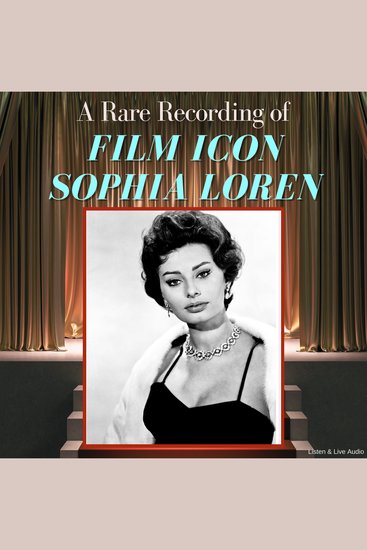
  • A Rare Recording of Film Icon Sophia Loren - cover

    A Rare Recording of Film Icon...

    Sophia Loren

    • 0
    • 0
    • 0
    Sofia Costanza Brigida Villani Scicolone (born on September 20, 1934), known professionally as Sophia Loren, was an Italian actress considered one of the last major stars from the Golden Age of Hollywood cinema. Her career spanned over 70 years, highlighted by her performance in the 1960 film, Two Women, which earned her a Best Actress Oscar. Loren has also received five special Golden Globes, a BAFTA Award, a Grammy Award, and an Honorary Academy Award for lifetime achievements. The following is a recording from 1958 when Loren was 23-years-old.
    Show book
  • Lucas - His Hollywood Legacy - cover

    Lucas - His Hollywood Legacy

    Richard Ravalli

    • 0
    • 0
    • 0
    George Lucas is an innovative and talented director, producer, screenwriter, and filmmaker whose prolific career spans decades. While he is best known as the creative mind behind the Star Wars franchise, Lucas first gained notoriety with his 1973 film American Graffiti, which received five Academy Award nominations. When Star Wars was released, the groundbreaking motion picture won six Academy Awards, became the highest grossing film at the time, and started a cultural revolution that continues to inspire generations of fans. Three decades and countless successes later, Lucas announced semiretirement in 2012 and sold his successful production company, Lucasfilm, to Disney. His achievements have earned him the Academy's Irving G. Thalberg Award, the American Film Institute's Life Achievement Award, induction into the Science Fiction Hall of Fame and the California Hall of Fame, and a National Medal of Arts presented by President Barack Obama. Lucas: His Hollywood Legacy is the first collection to bring a sustained scholarly perspective to the iconic filmmaker and his legacy beyond the Star Wars films. Edited by Richard Ravalli, this volume analyzes Lucas's overall contribution and importance to the film industry, diving deep into his use and development of modern special effects technologies, the history of his Skywalker Ranch production facilities, and more.
    Show book