Join us on a literary world trip!
Add this book to bookshelf
Grey
Write a new comment Default profile 50px
Grey
Subscribe to read the full book or read the first pages for free!
All characters reduced
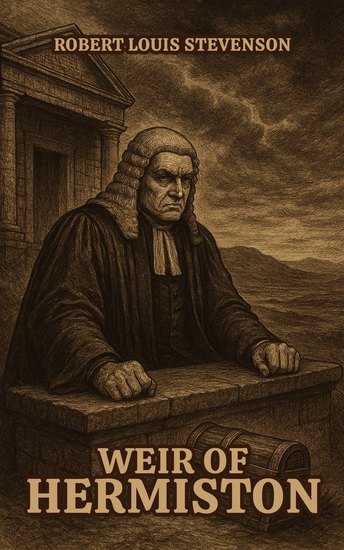
Weir of Hermiston - cover

Weir of Hermiston

Robert Louis Stevenson

Publisher: CLXBX

  • 0
  • 0
  • 0

Summary

First published posthumously in 1896, Weir of Hermiston is widely regarded as one of Robert Louis Stevenson's most powerful and mature novels, a dark and compelling exploration of authority, justice, and human conflict.

Set in early 19th-century Scotland, the novel centers on the intense and tragic relationship between Archie Weir and his father, Adam Weir, the formidable Lord Hermiston. As a harsh and unyielding judge, Lord Hermiston embodies the rigid moral and legal authority of his time, ruling from the bench with uncompromising severity. Archie, sensitive and idealistic, struggles to reconcile his sense of justice and compassion with his father's cold absolutism.

Seeking refuge from this oppressive relationship, Archie retreats to the countryside, where he becomes entangled in a passionate and dangerous romance that draws him into a web of jealousy, betrayal, and violence. As personal loyalties clash with moral duty, the novel builds toward an inevitable and haunting tragedy.

Stevenson's prose in Weir of Hermiston is rich, atmospheric, and psychologically profound. Through vividly drawn characters and a stark Scottish landscape, he examines the destructive consequences of inflexible authority and the emotional cost of moral rigidity. Although left unfinished at Stevenson's death, the novel remains remarkably complete in its emotional power and thematic depth.

Weir of Hermiston stands as a masterwork of classic literature—somber, intense, and deeply human. It is an essential read for those who appreciate literary fiction that confronts the complexities of justice, family, and the darker corners of the human heart.
Available since: 02/09/2026.
Print length: 148 pages.

Other books that might interest you

  • Feuille d'Album - cover

    Feuille d'Album

    Katherine Mansfield

    • 0
    • 0
    • 0
    "Feuille d'Album" is a 1917 short story by Katherine Mansfield. It was first published in the New Age on 20 September 1917, under the title of An Album Leaf. A revised version later appeared in Bliss and Other Stories.
    Ian French is a young artist who lives alone in Paris. He is very reserved and rarely talks to anyone. He is particularly shy around women and rejects their advances. One day he sees a girl his own age on the balcony of the building opposite his and becomes infatuated with her.
    Show book
  • The History of Rasselas - cover

    The History of Rasselas

    Samuel Johnson

    • 0
    • 0
    • 0
    Above all, Samuel Johnson’s Rasselas (1759) is concerned with the nature of happiness. Rasselas and his companions remove themselves from the pleasure of the ‘happy valley’ so that they can make their ‘choice of life’. In the course of their travels they come across scholars, astronomers, shepherds, hermits and poets, explore their way of life. Rasselas finds that complete happiness is elusive and, in the words of his mentor Imlac, ‘while you are making the choice of life, you neglect to live’.In his treatment of this popular tale from the Orient, Johnson deploys his customary wit and perspicacity. Popular in its own day, Rasselas is a journey of the mind and soul, raising important questions concerning the human condition, which remain pertinent today.
    Show book
  • In the Fourth Dimension - From their pens to your ears genius in every story - cover

    In the Fourth Dimension - From...

    Clotilde Graves

    • 0
    • 0
    • 0
    Clotilde Augusta Inez Mary Graves was born on the 3rd June 1863 at Buttevant Castle, Co. Cork, to parents with military backgrounds. 
    At age nine, the family moved to Southsea in England for yet another military posting.  Her father’s postings gave her valuable experiences that would be put to good use in later years in some of her literary works. 
    She was educated at a Catholic convent in Lourdes before returning to London in 1884 to study art in Bloomsbury.  She worked part-time at the British Museum and the Royal Female School of Art and generated further income by drawing little pen-and-ink grotesques for the comic papers.  
    A few years later a chance meeting found her writing extra lyrics for a pantomime version of Puss in Boots.  She followed up with several financially successful plays, both in London and New York, and gained a measure of notoriety in one with the comparison of marriage and prostitution.   
    Despite her dramatic success she published her first novel in 1911 under the pseudonym of Richard Dehan which she continued to use for later works.  As well as novels and plays she published collections of short stories which glow with talent and invention. 
    She was an unusual figure in London society, wearing her hair short, taking on a masculine manner and cut of clothing, and smoking cigarettes in public when such traits were considered eccentric at best.  Add to this her admired collection of Chinese and Japanese trophies, her enthusiasm for fly-fishing and her riding of a tricycle and you have a perfect image of this fascinating writer. 
    Clotilde Graves died at the convent of Our Lady of Lourdes at Hatch End in Middlesex, on the 3rd December 1932.  She was 69.
    Show book
  • The Strange Case of Dr Jekyll and Mr Hyde and Prince Otto - cover

    The Strange Case of Dr Jekyll...

    Robert Louis Stevenson

    • 0
    • 0
    • 0
    On their weekly walk, an eminently sensible, trustworthy lawyer named Mr. Utterson listens as his friend Enfield tells a gruesome tale of assault. The tale describes a sinister figure named Mr. Hyde who tramples a young girl, disappears into a door on the street, and reemerges to pay off her relatives with a check signed by a respectable gentleman. Since both Utterson and Enfield disapprove of gossip, they agree to speak no further of the matter. It happens, however, that one of Utterson’s clients and close friends, Dr. Jekyll, has written a will transferring all of his property to this same Mr. Hyde. Soon, Utterson begins having dreams in which a faceless figure stalks through a nightmarish version of London. 
     
    Puzzled, the lawyer visits Jekyll and their mutual friend Dr. Lanyon to try to learn more. Lanyon reports that he no longer sees much of Jekyll since they had a dispute over the course of Jekyll’s research, which Lanyon calls “unscientific balderdash.” Curious, Utterson stakes out a building that Hyde visits—which, it turns out, is a laboratory attached to the back of Jekyll’s home. Encountering Hyde, Utterson is amazed by how undefinably ugly the man seems as if deformed, though Utterson cannot say exactly how. Much to Utterson’s surprise, Hyde willingly offers Utterson his address. Jekyll tells Utterson not to concern himself with the matter of Hyde. 
     
    A year passes uneventfully. Then, one night, a servant girl witnesses Hyde brutally beat to death an old man named Sir Danvers Carew, a member of Parliament and a client of Utterson. The police contact Utterson, and Utterson suspects Hyde as the murderer. He leads the officers to Hyde’s apartment, feeling a sense of foreboding amid the eerie weather—the morning is dark and wreathed in fog. When they arrive at the apartment, the murderer has vanished, and police searches prove futile. 
    Show book
  • The Lost World - cover

    The Lost World

    Arthur Conan Doyle

    • 0
    • 0
    • 0
    "The Lost World" is a novel written by Sir Arthur Conan Doyle, the British author best known for creating the iconic detective Sherlock Holmes. Published in 1912, this adventure novel stands apart from Doyle's more famous detective fiction and is known for its exploration of the unknown and its contribution to the "lost world" literary genre. 
     
    The story is centered around the character of Professor Challenger, an eccentric and larger-than-life scientist who, like Sherlock Holmes, became one of Conan Doyle's memorable literary creations. Professor Challenger claims to have discovered evidence of prehistoric life in the Amazon rainforest and invites a group of individuals, including the narrator Edward Malone, to join him on an expedition to verify his findings. 
     
    The group embarks on a perilous journey into the uncharted and remote plateau in South America, where they encounter a world seemingly frozen in time. Dinosaurs and other prehistoric creatures roam the plateau, and the explorers must navigate not only the dangers of the natural world but also the challenges of their own personalities and relationships. 
     
    "The Lost World" is a pioneering work in the "lost world" subgenre of adventure fiction, which involves the discovery of isolated and prehistoric environments that time forgot. It predates other famous works in this genre, such as Edgar Rice Burroughs' "The Land That Time Forgot" and Sir Arthur Conan Doyle's contemporary H.G. Wells' "The Time Machine." 
     
    The novel combines elements of science fiction, adventure, and exploration with themes of human curiosity, bravery, and the clash between the modern world and the primeval past. It also touches on the ethical implications of encountering and documenting creatures thought to be extinct.
    Show book
  • Call of the Wild - cover

    Call of the Wild

    Jack London

    • 0
    • 0
    • 0
    The Call of the Wild is a novel by American writer Jack London. The plot concerns a previously domesticated and even somewhat pampered dog named Buck, whose primordial instincts return after a series of events finds him serving as a sled dog in the treacherous, frigid Yukon during the days of the 19th century Klondike Gold Rushes. Published in 1903, The Call of the Wild is one of London's most-read books, and it is generally considered one of his best.    Because the protagonist is a dog, it is sometimes classified as a juvenile novel, suitable for children, but it is dark in tone and contains numerous scenes of cruelty and violence. London followed the book in 1906 with White Fang, a companion novel with many similar plot elements and themes as The Call of the Wild, although following a mirror image plot in which a wild wolf becomes civilized by a mining expert from San Francisco named Weedon Scott.
    Show book