Join us on a literary world trip!
Add this book to bookshelf
Grey
Write a new comment Default profile 50px
Grey
Subscribe to read the full book or read the first pages for free!
All characters reduced
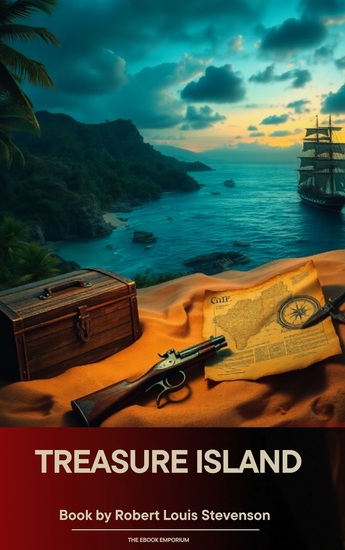
Treasure Island - cover

Treasure Island

Robert Louis Stevenson

Publisher: The Ebook Emporium

  • 0
  • 0
  • 0

Summary

Set sail on one of the greatest adventure stories ever written.

First published in 1883, Treasure Island by Robert Louis Stevenson is the timeless tale that defined the pirate genre. Following young Jim Hawkins on a dangerous voyage across the seas, the novel brings readers face to face with hidden treasure, shifting loyalties, and unforgettable characters.

At the heart of the story is the legendary Long John Silver—charming, clever, and dangerously unpredictable—whose presence turns a simple treasure hunt into a thrilling test of courage and trust.

This classic novel combines action, mystery, and moral growth, making it beloved by readers of all ages for generations.

Inside this eBook, you'll experience:

A fast-paced adventure filled with pirates and buried treasure

Rich storytelling that shaped modern adventure fiction

Themes of bravery, loyalty, and coming of age

One of literature's most iconic villains

Read in schools and enjoyed worldwide, Treasure Island remains an essential classic for anyone who loves adventure, classic literature, or unforgettable storytelling.

Begin the journey that has thrilled readers for over a century. Buy now and rediscover a true literary treasure.
Available since: 01/21/2026.
Print length: 228 pages.

Other books that might interest you

  • Twas The Night Before Christmas - Stories For Everyone - cover

    Twas The Night Before Christmas...

    Clement Clarke Moore

    • 0
    • 0
    • 0
    Twas the Night Before Christmas has been called "arguably the best-known verses ever written by an American" and is largely responsible for some of the conceptions of Santa Claus from the mid-nineteenth century to today. It has had a massive effect on the history of Christmas gift-giving. Before the poem gained wide popularity, American ideas had varied considerably about Saint Nicholas and other Christmastide visitors. A Visit from St. Nicholas eventually was set to music and has been recorded by many artists.
    Show book
  • Sanditon - cover

    Sanditon

    Jane Austen

    • 0
    • 0
    • 0
    Jane Austen's final, unfinished novel centres on Charlotte Heywood as she arrives in an up-and-coming seaside town. As she meets a host of characters, from her hosts' family to visitors from the West Indies, Austen's final novel gives us a concise insight into the deception, snobbery, and unexpected romances that occur in the world of her characters.
    Show book
  • The Cambridge Modern History Collection - cover

    The Cambridge Modern History...

    J. B. Bury, Mandell Creighton,...

    • 0
    • 0
    • 0
    Witness the Grand Narrative of Human Civilization.
    
    Conceived by the legendary historian Lord Acton, The Cambridge Modern History stands as a monumental achievement in the field of historiography. This collection provides a rigorous, objective, and deeply detailed analysis of the forces that shaped our contemporary world. Rather than focusing on a single nation, this series offers a "universal history," tracing the interconnected threads of politics, religion, science, and war across continents.
    
    Inside this prestigious collection, you will explore:
    
    The Dawn of the Modern Age: A deep dive into the Renaissance, the Reformation, and the Age of Discovery, documenting the moment humanity broke away from the medieval world.
    
    The Age of Revolution: Comprehensive coverage of the intellectual and violent upheavals that birthed modern democracy, including the Enlightenment and the restructuring of the European map.
    
    The Rise of Global Powers: Detailed accounts of the expansion of empires, the growth of nationalism, and the industrial advancements that shifted the global balance of power.
    
    Collaborative Brilliance: Each section is authored by a specialist in their field, ensuring that every chapter reflects the highest standard of academic precision and insight available to the era.
    
    This collection is not just a reference work; it is an immersive intellectual experience. It remains an essential cornerstone for historians, political scientists, and anyone seeking to understand the complex machinery of global change.
    
    Own the record of our collective past. Buy "The Cambridge Modern History Collection" today and explore the foundation of the modern world.
    Show book
  • In the Steppe - From their pens to your ears genius in every story - cover

    In the Steppe - From their pens...

    Maxim Gorky

    • 0
    • 0
    • 0
    Alexei Maximovich Peshkov was born on 28th March 1868, in Nizhny Novgorod, Russia. 
    Better known as Maxim Gorky he was orphaned at 11 and ran away from home at 12.  At 19 he had already attempted suicide and thereafter travelled, by foot, across the Russian Empire for 5 years. 
    His first book ‘Essays & Stories’ in 1898 was a sensation and so began a long career as an author of short stories, novels and plays.  Gorky saw writing as a moral and political act that would help to change the unjust world around him.  He was an ardent early advocate of the emerging Marxist movement and publicly opposed the Tsarist regime leading several times to his arrest.  
    In 1904 he began his own theatre but the censor banned every play and Gorky was forced to abandon the project. 
    But Gorky was a financially successful author, editor, and playwright and gave monies to political parties as well as for civil rights and social reform.  The brutal shooting of workers, which set in motion the Revolution of 1905, pushed Gorky more decisively toward radical solutions.  
    In 1906 he went to the United States to raise funds for the Bolsheviks. Those experiences including a scandal over travelling with his lover and not his wife deepened his contempt for the ‘bourgeois soul.’ 
    Gorky now moved to Capri in Italy, both for health reasons and to escape the increasingly repressive times in Russia.  
    An amnesty for the 300th anniversary of the Romanov dynasty saw him return to Russia in 1914. His politics remained close to the Bolshevik cause.  But soon, after the 1918 revolution, his essays referred to Lenin as a tyrant for his senseless arrests and repression.  He was soon appealing to the outside world for food aid after the catastrophic crop failure. 
    In October 1921 Gorky returned to Italy, now in Fascist hands, and settled in Sorrento until 1932.  His health worsened with the onset of tuberculosis. 
    He wrote several successful books there but now decided to find an understanding with the communist regime. Stalin invited him home and his return was hailed as a major propaganda victory.  He was decorated with the Order of Lenin, and a province, a park, and various streets re-named in his honour. 
    But he had his faults too.  In 1933, Gorky co-edited a book on the White Sea-Baltic Canal and denied even a single prisoner died during its construction, but thousands had. As well, knowing that some Nazis were homosexual, a phrase was attributed to him that said ‘exterminate all homosexuals and fascism will vanish’.  Although he was himself was quoting another he was decidedly homophobic. 
    With the increase of Stalinist repression in 1935 Gorky was placed under unannounced house arrest. 
    Maxim Gorky died on the 18th June 1936 from pneumonia.  He was 68. 
    Stalin and Molotov were among those who carried Gorky's urn of ashes at his funeral.
    Show book
  • Poor Folk - cover

    Poor Folk

    Fyodor Dostoevsky

    • 0
    • 0
    • 0
    "We are poor people, we are simple people, but we have hearts and souls too."
    
    Before the psychological labyrinths of Crime and Punishment, a young Dostoevsky captured the world's attention with this exquisite epistolary novel. Through a series of increasingly desperate letters, we witness the relationship between Makar Devushkin, a lowly, aging copy clerk, and Varvara Dobroselova, a fragile young seamstress. Living in squalid rooms across a dismal St. Petersburg courtyard, they exchange words of comfort, shared bread, and the flickering hope of a better life. Poor Folk is a searingly intimate portrait of the "little man" struggling to maintain his humanity in a society that views him as nothing more than a smudge on a ledger.
    
    The Birth of Psychological Realism: Dostoevsky takes the traditional "sentimental" epistolary form and infuses it with a brutal, modern realism. He elevates the clerk—a figure usually mocked in Russian literature—to a tragic hero. Makar's obsession with his social standing and his desperate attempts to appear "respectable" even as he starves reveal the deep psychological scars of class inequality.
    
    A Tragedy of Self-Sacrifice: As their financial situation deteriorates, the letters become a battleground between love and survival. Makar's selfless devotion to Varvara leads him to ruin, while Varvara is forced to make a heart-shattering choice between the man who loves her and the safety of a wealthy, predatory suitor. It is a story that proves the greatest tragedies are often the quietest ones, occurring behind closed doors in the poorest corners of the city.
    
    Witness the soul of a genius in its first bloom. Purchase "Poor Folk" today and experience the novel that changed Russian literature forever.
    Show book
  • Much Ado About Nothing - cover

    Much Ado About Nothing

    William Shakespeare

    • 0
    • 0
    • 0
    Shakespeare wrote Much Ado About Nothing towards the middle of his career, sometime between 1598 and 1599. It was first published in quarto in 1600 and later collected into Mr. William Shakespeare's Comedies, Histories, and Tragedies in 1623. The earliest recorded performance of Much Ado About Nothing was performed for the newly-married Princess Elizabeth and Frederick the Fifth, Elector Palatine in 1613.
    Shakespeare's sources of inspiration for this play can be found in Italian culture and popular texts published in the sixteenth century. Gossip involving lovers deceived into believing each other false was often spread throughout Northern Italy. Works like Ludovico Ariosto's Orlando Furioso and Edmund Spencer's Fearie Queene also feature tricked lovers like Claudio and Hero. Besides these similarities, the idea of tricking a couple like Benedick and Beatrice into falling in love was an original and unusual idea at the time.
    The play focuses on two couples: upon the noblemen's return to Messina, Claudio and Hero quickly fall in love and wish to marry in a week; on the contrary, Benedick and Beatrice resume their verbal war, exchanging insults with each other. To pass the time prior to the marriage a plot to trick Benedick and Beatrice into falling in love has been set in motion. Unbeknownst to both our couples, a fouler plot to crush the love and happiness between Hero and Claudio has also begun to unfold.
    Show book