Join us on a literary world trip!
Add this book to bookshelf
Grey
Write a new comment Default profile 50px
Grey
Subscribe to read the full book or read the first pages for free!
All characters reduced
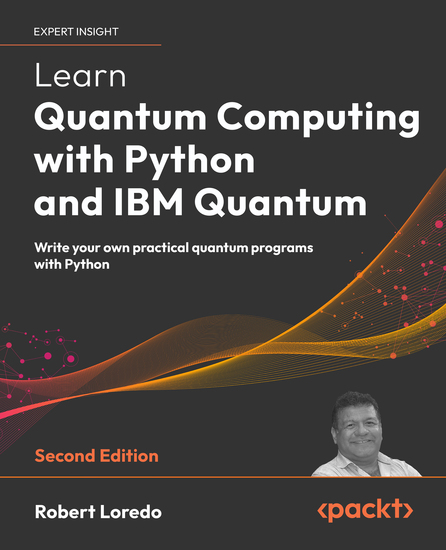
Learn Quantum Computing with Python and IBM Quantum - Write your own practical quantum programs with Python - cover

Learn Quantum Computing with Python and IBM Quantum - Write your own practical quantum programs with Python

Robert Loredo

Publisher: Packt Publishing

  • 0
  • 0
  • 0

Summary

The IBM Quantum Platform was built to enable developers to learn the basics of quantum computing by providing access to high performant quantum computers and provide documentation and courses to help get up to speed with the latest features in quantum computing. Updated with new examples and changes to the platform, this edition begins with an introduction to the IBM Quantum Platform and the Quantum Information Science Kit (Qiskit) SDK. You will become well versed in the IBM Quantum Composer interface as well as running your quantum circuits on a real quantum computer. Along the way, you’ll learn some of the fundamental principles regarding quantum mechanics, qubits, quantum gates, quantum circuits, and the error mitigation techniques that are used to perform operations on qubits. As you build on your knowledge, you’ll understand the functionality of IBM Qiskit and the developer-focused resources so you can create your own quantum algorithms. You’ll learn how to monitor and optimize your quantum circuits. Lastly, you’ll look at the fundamental quantum algorithms and understand how they can be applied effectively. By the end of this quantum computing book, you'll know how to build quantum algorithms and will have gained a practical understanding of quantum computation that you can apply to your research or business.
Available since: 02/25/2025.
Print length: 420 pages.
Other books that might interest you

  • Alien Question The: The History of the Debate and Search for Extraterrestrials - cover

    Alien Question The: The History...

    Editors Charles River

    • 0
    • 0
    • 0
    The question of man’s place in the extended universe has been pondered by every known culture since the beginning of recorded history. Lacking the means to prove otherwise, discussions of an alternative to Earth’s solitary existence have remained conceptual. The ongoing debate is spurred by the appearance of unexplainable phenomena through the centuries in the atmosphere and the space beyond. Naturally, as technological advances and the creation of flying aircraft became realities, the sighting of UFOs increased, as did the interest in potential contact with aliens. While incidents like the one at Roswell led to conspiracies and a craze among those who insisted the government was hiding proof of extraterrestrials’ existence, governments across the world were actually secretly studying UFO sightings by the mid-20th century. 
    Given all of that, it would hardly be groundbreaking for scientists in the 20th century to have a lunchtime discussion in which the search for extraterrestrial life arises, and the question of where it might reside is innocuous enough. However, a furor was created somewhat innocently when physicist Enrico Fermi voiced his “casual lunchtime remark” in the presence of colleagues in 1950. The august company included Edward Teller, a Hungarian physicist, Herbert York, am American nuclear physicist whose lineage included Mohawk heritage, and Emil Konopinski, a nuclear physicist of Polish origin. Fermi himself, an Italian-American born in Rome, was renowned for developing a statistical base for subatomic phenomena, work on nuclear alterations caused by neutrons, and for leading the first controlled chain reaction from nuclear fission. In pursuit of managing the atom, he created the first nuclear reactor. A gifted theoretician, he advanced the field of statistical mechanics, and won the Nobel Prize over a decade before he asked his important question.
    Show book
  • Emotional Self-Care and Positive Affirmations for Black Women - A Guided Spiritual Journal for Self-Discovery and Eliminate Negative Thinking How to Raise Your Self-Esteem Confidence and Self-Love - cover

    Emotional Self-Care and Positive...

    Jorah San

    • 0
    • 0
    • 0
    Are you a black woman struggling with self-doubt and low self-esteem?  
    Do you feel like your experiences and perspectives are undervalued and underrepresented in society?  
    Are you tired of dealing with the constant stress and pressures of everyday life?  
    If you answered yes to any of these questions, then Jorah San's "Emotional Self-Care and Positive Affirmations for Black Women" is the perfect audiobook for you! 
    This audiobook is a guided spiritual journal specifically designed to address the unique challenges that black women face in their daily lives. With this audiobook, you can listen and engage with Jorah San's powerful affirmations, guided journal prompts, spiritual practices, and self-care strategies while you go about your day. 
    Jorah San's approach is rooted in the belief that black women deserve to prioritize their own mental and emotional health. With her guidance, you will learn to let go of self-doubt, build a positive self-image, and cultivate a deeper sense of self-love. 
    So, are you ready to prioritize your well-being and embrace your full power as a black woman?  
    Let "Emotional Self-Care and Positive Affirmations for Black Women" be your companion on your journey.  
    As Jorah San says, "We as black women deserve to live happy, healthy, and fulfilling lives. Let this audiobook be a tool to help you get there."
    Show book
  • The Woman Inside - from Outer Space to Inner Peace - cover

    The Woman Inside - from Outer...

    Bobbi Waterman

    • 0
    • 0
    • 0
    The Woman Inside: From Outer Space to Inner Peace will take you on a journey of self-discovery. Throughout a 34-year career at NASA, launching rockets or leading teams, while literally traveling around the world, the book takes you on a journey of discovery and transformation. This is one woman’s experience of transitioning from presenting as male to presenting as female. You will join me as I overcome the societal expectations that are assigned at birth and learn to, understand the difference between sexual hardware and gender software. Finally, you will see how I discovered the ultimate truth -- that you are never too old to live life as your authentic self. If you are interested in NASA or exploring distant lands or how one makes the decision to transition, then this book is for you. This is my story and my life. By the end, you will know me almost as well as I know myself. I hope you enjoy it. Bobbi
    Show book
  • ChatGPT AI Book Writing Formula - 9 Steps to Prompt Write Publish a Non-fiction Client-Attraction Book 10-100X Faster and Easier Assisted by Articicial Intelligence - cover

    ChatGPT AI Book Writing Formula...

    Caryl Westmore

    • 0
    • 0
    • 0
    Coaches, Wellness Experts, and Entrepreneurs—Write Your Book Faster and Easier with AI! 
    Struggling to find time or the right approach to writing your book? Stop the overwhelm—ChatGPT AI makes book writing faster, easier, and smarter than ever! 
    The AI revolution is here, and this book reveals a 9-step formula to write, publish, and launch a client-attraction book—without losing your unique voice and authenticity. 
    ✅ Inside, you’ll discover how to:Master AI book writing with expert prompts (become a Prompt Ninja)Brainstorm compelling book titles and winning ideasOutline a clear book structure and seamless chapter flowWrite your first draft effortlessly—no writer’s block!Edit, refine, and polish to professional standardsFormat, publish, and launch—with 15+ five-star reviews on day oneLeverage your book for business growth and attract ideal clients 
    BONUS: Includes a time-saving AI Prompt Cheat Sheet for Authors, packed with all the prompts used in this book—your go-to guide for writing a non-fiction book step-by-step! 
     Empower your voice. Boost your impact.  Write your book NOW—AI makes it possible!
    Show book
  • Bad Nature - How Rat Control Shapes Human and Nonhuman Worlds - cover

    Bad Nature - How Rat Control...

    Andrew McCumber

    • 0
    • 0
    • 0
    Offers insights into the social and cultural implications of humans’ relationships with rats and the natural world. Apart from the occasional pet owner who has rats, most people regard rats as disease-carrying nocturnal pests, scurrying around dumpsters and dragging slices of pizza through New York City subways. Since rats are seemingly omnipresent in human life, why do we harbor such negative feelings about them, and why are they among the creatures most frequently targeted for systematic extermination?In Bad Nature, sociologist Andrew McCumber draws out the cultural underpinnings of rat extermination across three countries and two continents. Drawing from ethnographic, interview, and textual data from the frigid prairie of Alberta, Canada; the heart of downtown Los Angeles, California; and the iconic Galápagos Islands of Ecuador, McCumber studies how humans have sought to suppress and exterminate rat populations in a variety of environmental, social, and political situations. He shows how, in these disparate locations, rat control is a social practice that draws and clarifies the spatial and symbolic boundaries between “good” and “bad” forms of nature. Rats are near the bottom of a symbolic hierarchy of species that places human life at the top, companion animals and majestic wildlife just below them, and the “invasive species” that call for systematic extermination at the very bottom. This hierarchy of living things that places rats at the bottom, McCumber argues, mirrors human systems of social inequalities and power dynamics.  Both original and engaging, Bad Nature urges readers to consider, when charting a just and sustainable future, where will the rats be placed in the worlds we envision?
    Show book
  • The Plague Years - A Doctor’s Journey through the AIDS Crisis - cover

    The Plague Years - A Doctor’s...

    Ross A. Slotten MD

    • 0
    • 0
    • 0
    In 1992, Dr. Ross A. Slotten signed more death certificates in Chicago—and, by inference, the state of Illinois—than anyone else. As a family physician, he was trained to care for patients from birth to death, but when he completed his residency in 1984, he had no idea that many of his future patients would be cut down in the prime of their lives. Among those patients were friends, colleagues, and lovers, shunned by most of the medical community because they were gay and HIV positive. Slotten wasn’t an infectious disease specialist, but because of his unique position as both a gay man and a young physician, he became an unlikely pioneer, swept up in one of the worst epidemics in modern history. 
     
    Plague Years is an unprecedented first-person account of that epidemic, spanning not just the city of Chicago but four continents as well. Slotten provides an intimate yet comprehensive view of the disease’s spread alongside heartfelt portraits of his patients and his own conflicted feelings as a medical professional, drawn from more than thirty years of personal notebooks. In telling the story of someone who was as much a potential patient as a doctor, Plague Years sheds light on the darkest hours in the history of the LGBT community in ways that no previous medical memoir has.
    Show book