Join us on a literary world trip!
Add this book to bookshelf
Grey
Write a new comment Default profile 50px
Grey
Subscribe to read the full book or read the first pages for free!
All characters reduced
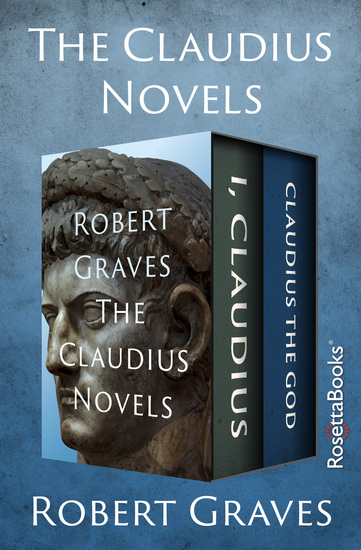
The Claudius Novels - I Claudius and Claudius the God - cover

The Claudius Novels - I Claudius and Claudius the God

Robert Graves

Publisher: RosettaBooks

  • 1
  • 0
  • 0

Summary

The Claudius Novels includes Robert Graves’ best known historical novels, I, Claudius and Claudius the God. 
In I, Claudius, Robert Graves begins the story of the limping, stammering young man who is suddenly thrust onto the throne after the death of Caligula.
Once a rather bookish young man with a limp and a stammer, a man who spent most of his time trying to stay away from the danger and risk of the line of ascension, Claudius seemed an unlikely candidate for Emperor. Yet, on the death of Caligula, Claudius finds himself next in line for the throne, and must stay alive as well as keep control.

Drawing on the histories of Plutarch, Suetonius, and Gaius Cornelius Tacitus, noted historian and classicist Robert Graves tells the story of the much-maligned Emperor Claudius with both skill and compassion. Weaving important themes throughout about the nature of freedom and safety possible in a safety and a monarchy, Graves’ Claudius is both more effective and more tragic than history typically remembers him. A best-selling novel and one of Graves’ most successful, I, Claudius has been adapted to television, film, theatre, and audio.

In Claudius the God, Graves continues the story, detailing Claudius’ 13-year reign and his ultimate downfall. Painting the vivid, tumultuous, and decadent society of ancient Rome with spectacular detail, Robert Graves provides a tale that is both instructive and compelling, and difficult to put down for both casual readers and students of Roman history.
Available since: 05/30/2025.
Print length: 1003 pages.
Other books that might interest you

  • Blood of the Warlord - cover

    Blood of the Warlord

    Griff Hosker

    • 0
    • 0
    • 0
    The warlord, his son and even his grandchildren are all dead. Sacrificed by kings who used them. Now King Henry asks the great-grandsons of the Warlord to help his son, The Lord Edward, learn how to rule. Sent with too few men and too many enemies, Sir Henry Samuel, Sir Alfred and the newly knighted Sir Thomas must learn how to use their skills, not in the familiar borderlands but in Gascony where insurrection and treason have reared their heads.
    Show book
  • Daughters of the Storm - cover

    Daughters of the Storm

    Elizabeth Buchan

    • 0
    • 0
    • 0
    Paris, 1789. As the shadow of the guillotine falls over a nation at war with itself, three very different women find themselves caught up in the storm of revolution... 
     
    In France under the last Bourbon king, the extravagance grows more outrageous and the unrest of the poor more dangerous. Into this ferment are swept the innocent English Sophie Luttrell, visiting France for the first time; the French aristocrat Héloise de Guinot, who hates the man her parents have arranged for her to marry; and Marie-Victoire, the loyal maid who finds herself immersed in revolutionary politics. 
     
    They are the daughters of the storm which is sweeping France - and over the world. Three women whose lives will be forever marked by this turning point in history and whose passionate struggle for love, liberty - and for life - will have unexpected consequences.
    Show book
  • The Thief of Time - A Novel - cover

    The Thief of Time - A Novel

    John Boyne

    • 0
    • 1
    • 0
    “A delightful epic, filled with twists and treachery, and vividly told” from the New York Times–bestselling author of All the Broken Places (The Herald). 
     
    John Boyne became internationally known for his acclaimed novels Crippen and the bestselling The Boy in the Striped Pajamas. Now, for the first time in the US comes The Thief of Time, the book that started the career of the author that the Irish Examiner calls “one of the best and original of the new generation of Irish writers.” 
     
    It is 1758 and Matthieu Zela is fleeing Paris after witnessing the murder of his mother and his stepfather’s execution. Matthieu’s life is characterized by one extraordinary fact: before the eighteenth century ends, he discovers that his body has stopped ageing. At the end of the twentieth century and the ripe old age of 256 he is suddenly forced to answer an uncomfortable question: what is the worth of immortality without love? 
     
    In this carefully crafted novel, The Thief of Time, John Boyne juxtaposes history and the buzz of the modern world, weaving together portraits of 1920s Hollywood, the Great Exhibition of 1851, the French Revolution, the Wall Street Crash, and other landmark events into one man’s story of murder, love, and redemption. 
     
    “Boyne is a skilful storyteller . . . The novel is superbly constructed.” —Sunday Tribune 
     
    “Boyne is creative and entertaining, particularly as he develops his characters.” —Library Journal 
     
    “One of the finest reads this reviewer has enjoyed in quite a while. It’s gripping without cliffhangers, philosophically deep without angst, honest and wise and absolutely charming. Bravo to Mr. Boyne—and when’s the next book?” —Historical Novel Society
    Show book
  • Attribution - A Novel - cover

    Attribution - A Novel

    Linda Moore

    • 0
    • 0
    • 0
    Art historian Cate Adamson, desperate to succeed to console her grieving parents, leaves the Midwest to complete her doctorate in New York—only to find herself assigned to an impossible sexist advisor. She struggles to impress him until she discovers a hidden painting, possibly a Baroque masterpiece. Risking her career, financial disaster, and further alienation from her family, she flees to Spain with the painting to consult art experts. 


    Antonio, an impoverished duke, meets Cate on the train to Seville, and joins her search while attempting to rescue the decaying legacy of his family. They find clues and uncover evidence that will shock the titans of art history, may destroy her prospects as an art historian, and shatter her future with Antonio. 


    Written with vivid prose, rich references to seventeenth century Spanish art, compelling characters, and a historical puzzle, Attribution is the story of one contemporary woman's journey to understand the past and unlock her future.
    Show book
  • Stella Benson - A Short Story Collection - Underrated feminist English author with a jaundice view of life - cover

    Stella Benson - A Short Story...

    Stella Benson

    • 0
    • 0
    • 0
    Stella Benson was born on the 6th January 1892 in Easthope, Shropshire to parents who were landed gentry. 
     
    Her early years involved frequent household moves which was difficult for the child as she suffered from ill-health.  Some of her early education was spent at schools in Germany and Switzerland and by 10 she had developed a lifelong habit of keeping a diary. 
     
    In the following years her parents separated, and she rarely saw her father. When she did, he encouraged to pause her writing until she had further experience and could better make sense of the world.  When he died, she learned he had been an alcoholic. 
     
    A winter spent in the West Indies provided material for her first novel ‘I Pose’ published the following year in 1915. 
     
    During the War years she became involved in the women's suffrage movement and dedicated time outside of writing to support the troops and help the poor. 
     
    In 1918 she decided to travel spending much time in California, where she also tutored at the University of California, and continued to write.  In China she met her future husband and after marrying in London, journeyed with him to his various Custom postings through Nanning, Beihai, and Hong Kong and the Far East. 
     
    The works continued to flow novels, short stories, travel essays all helped to build a deserved and burgeoning reputation. 
     
    Although her works are now in the forgotten and neglected department her writing style, characters, and narratives more than capably demonstrate her obvious talents.   
     
    Stella Benson died of pneumonia on the 7th December 1933, at Hạ Long in the Vietnamese province of Tonkin.  She was 40.
    Show book
  • Jam For The Enemy - Former soldier and journalist that became a revered author and screenwriter - cover

    Jam For The Enemy - Former...

    Edgar Wallace

    • 0
    • 0
    • 0
    Richard Horatio Edgar Wallace was born on the 1st April 1875 in Greenwich, London.  Leaving school at 12 because of truancy, by the age of fifteen he had experience; selling newspapers, as a worker in a rubber factory, as a shoe shop assistant, as a milk delivery boy and as a ship’s cook.  
     
    By 1894 he was engaged but broke it off to join the Infantry being posted to South Africa. He also changed his name to Edgar Wallace which he took from Lew Wallace, the author of Ben-Hur.  
     
    In Cape Town in 1898 he met Rudyard Kipling and was inspired to begin writing. His first collection of ballads, The Mission that Failed! was enough of a success that in 1899 he paid his way out of the armed forces in order to turn to writing full time.  
     
    By 1904 he had completed his first thriller, The Four Just Men. Since nobody would publish it he resorted to setting up his own publishing company which he called Tallis Press. 
      
    In 1911 his Congolese stories were published in a collection called Sanders of the River, which became a bestseller. He also started his own racing papers, Bibury’s and R. E. Walton’s Weekly, eventually buying his own racehorses and losing thousands gambling.  A life of exceptionally high income was also mirrored with exceptionally large spending and debts.  
     
    Wallace now began to take his career as a fiction writer more seriously, signing with Hodder and Stoughton in 1921. He was marketed as the ‘King of Thrillers’ and they gave him the trademark image of a trilby, a cigarette holder and a yellow Rolls Royce. He was truly prolific, capable not only of producing a 70,000 word novel in three days but of doing three novels in a row in such a manner. It was estimated that by 1928 one in four books being read was written by Wallace, for alongside his famous thrillers he wrote variously in other genres, including science fiction, non-fiction accounts of WWI which amounted to ten volumes and screen plays. Eventually he would reach the remarkable total of 170 novels, 18 stage plays and 957 short stories. 
     
    Wallace became chairman of the Press Club which to this day holds an annual Edgar Wallace Award, rewarding ‘excellence in writing’.  
     
    Diagnosed with diabetes his health deteriorated and he soon entered a coma and died of his condition and double pneumonia on the 7th of February 1932 in North Maple Drive, Beverly Hills. He was buried near his home in England at Chalklands, Bourne End, in Buckinghamshire.
    Show book