Join us on a literary world trip!
Add this book to bookshelf
Grey
Write a new comment Default profile 50px
Grey
Subscribe to read the full book or read the first pages for free!
All characters reduced
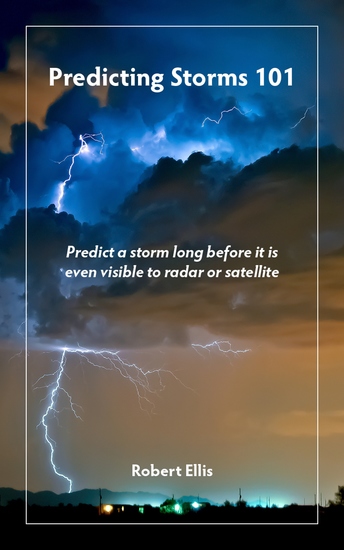
Predicting Storms 101 - cover

Predicting Storms 101

Robert Ellis

Publisher: Publishdrive

  • 0
  • 0
  • 0

Summary

PREDICTING STORMS 101 BY ROBERT ELLIS The full colour Ebook - EPUB shows ordinary people how to predict a storm long before it is even visible to radar or satellite. Many lives can be saved by using the simple rules explained in the book. As many as 500,000 people worldwide may die in large storms each year. You can get early warning of all storms using the rules given in this book. Know when you will be safe from storms. Predicting Storms covers practical information such as whether you can walk to work, or if there will be a storm in your area within the next hour or two. All types of storms are covered in the book. Rules apply to storms on land and at sea. Whether you are a general reader, a surfer, a weather watcher, a storm-spotter, or a storm-chaser, Predicting Storms 101 will give you the tools to predict all storms confidently. Author is a scientist and storm expert who has been referred to in recent years in the media as a storm chaser. Getting started is easy: download MARINE BAROGRAPH app (iPhone, iPad, iPod touch or Android). Riding the storm - your ultimate adventure awaits!
Available since: 08/24/2024.
Print length: 11 pages.

Other books that might interest you

  • The Elements of Marie Curie - How the Glow of Radium Lit a Path for Women in Science - cover

    The Elements of Marie Curie -...

    Dava Sobel

    • 0
    • 0
    • 0
    The acclaimed Pulitzer Prize finalist and #1 New York Times bestselling author of Galileo’s Daughter crafts a luminous chronicle of the most famous woman in the history of science, and the untold story of the remarkable young women trained in her laboratory 
     
    “Even now, nearly a century after her death, Marie Curie remains the only female scientist most people can name,” writes Dava Sobel at the opening of her shining portrait of the sole Nobel laureate decorated in two separate fields of science—Physics in 1903 with her husband, Pierre, and Chemistry by herself in 1911. And yet, as brilliant and creative as she was in the laboratory, Marie Curie was equally memorable outside it. Grieving Pierre’s untimely death in 1906, she took his place as professor of physics at the Sorbonne, devotedly raised two brilliant daughters, drove a van she outfitted with X-ray equipment to the front lines of World War I, befriended Albert Einstein and other luminaries of twentieth-century physics, won support from two US presidents, and inspired generations of young women to pursue science as a way of life.  
     
    As Sobel did so masterfully in her portrait of Galileo through the prism of his daughter, she approaches Marie Curie from a unique angle, narrating her remarkable life of discovery and fame alongside the women who became her legacy—from France’s Marguerite Perey, who discovered the element francium, and Norway’s Ellen Gleditsch, to Mme. Curie’s elder daughter, Irène, winner of the 1935 Nobel Prize in Chemistry. For decades the only woman in the room at international scientific gatherings that probed new theories about the interior of the atom, Marie Curie traveled far and wide, despite constant illness, to share the secrets of radioactivity, a term she coined. Her two triumphant tours of the United States won her admirers for her modesty even as she was mobbed at every stop; her daughters, in Ève’s later recollection, “discovered all at once what the retiring woman with whom they had always lived meant to the world.” 
     
    With the consummate skill that made bestsellers of Longitude and Galileo’s Daughter, and the appreciation for women in science at the heart of The Glass Universe, Dava Sobel has authored a radiant biography and a masterpiece of storytelling, illuminating the life and enduring influence of one of the most consequential figures of our time.
    Show book
  • Dispossessing the Wilderness - Indian Removal and the Making of the National Parks - cover

    Dispossessing the Wilderness -...

    Mark David Spence

    • 0
    • 0
    • 0
    National parks like Yellowstone, Yosemite, and Glacier preserve some of this country's most cherished wilderness landscapes. While visions of pristine, uninhabited nature led to the creation of these parks, they also inspired policies of Indian removal. By contrasting the native histories of these places with the links between Indian policy developments and preservationist efforts, this work examines the complex origins of the national parks and the troubling consequences of the American wilderness ideal. The first study to place national park history within the context of the early reservation era, it details the ways that national parks developed into one of the most important arenas of contention between native peoples and non-Indians in the twentieth century.
    Show book
  • Space to Grow - Unlocking the Final Economic Frontier - cover

    Space to Grow - Unlocking the...

    Matthew Weinzierl, Brendan Rosseau

    • 0
    • 0
    • 0
    Space is a place of unparalleled possibility for humanity, and it's undergoing a revolution. A wave of companies led by gutsy entrepreneurs are unlocking opportunities that fire the imagination. No, it's not hotels on Mars or day trips to orbit (yet), but it's an awe-inspiring transformation driven by innovative technologies, creative approaches, hard work, and—for the first time—market forces. Above all, this revolution is uncovering the simple but unfamiliar truth that space is a place: a place where countries, markets, and each of us can play a vital role in realizing some of our biggest, boldest dreams. 


    But we won't succeed through dreams alone. The space economy is just that—an economy—governed by the same laws of supply and demand that apply here on Earth. The authors, who teach a highly popular course on the topic at Harvard Business School, bring the revolution in space to life through players you know—like SpaceX and Blue Origin—and many you may not, like Astroscale, founded by a Japanese IT executive who quit his job to start a company to clean up space debris. They also bring to bear fundamental tools from economics to understand how the market in space is forming, how it's fast becoming a source of value for businesses across industries and for society as a whole, and how we can best ensure that its growth benefits us all.
    Show book
  • Watershed - Herman Murrah and the Pascagoula River Swamp - cover

    Watershed - Herman Murrah and...

    Davy Murrah

    • 0
    • 0
    • 0
    The Pasagoula River is the largest unobstructed river in the continuous United States. Because of this lack of restraint, the river has been left to rise and fall naturally with the seasons, overflowing annually into the adjoining bottomland surrounded by some of the most ecologically diverse woodlands, in North America. 


    Herman Murrah (1935-2022) lived his entire life on the banks and in the swamp surrounding this river in southeast Mississippi. In this book, Herman's eldest son, Davy, details the adventures that continue to inspire young conservationists in the fight to protect our remaining natural ecosystems. 


    As a young adult, Herman worked as a game warden in the Pascagoula River Swamp. When the Pascagoula Hardwood Company, then owners of the swamp, decided to sell the vast tract of forest for clearcutting, Herman was incensed. Determined to protect this natural wonder, Herman teamed up with other visionaries to persuade the State of Mississippi to purchase the land and preserve it in perpetuity. Herman was appointed area manager for the upper portion of the newly designated Pascagoula River Wildlife Management Area. He dedicated the remainder of his life to preserving, protecting, and improving the swamp for the good of south Mississippi.
    Show book
  • Turn Ideas Into Products - Managing Products using the Quartz Open Framework - cover

    Turn Ideas Into Products -...

    Steve Johnson, Rich Mironov

    • 0
    • 0
    • 0
    We’ve all heard stories of amazing product successes: the brilliant college kid who started a business in his dorm room; the team who built a business from the back of a napkin with just a few friends and sold it for millions. 
    Yet for every amazing success story, there are thousands of stories of products that went nowhere. 
      
    Most of us aren't looking at billion-dollar valuations; we’re not looking for an exit. Instead we have a few ideas — some innovative, some not — and we’re trying to determine which to pursue. Likely, you’re working for a company today and you need a step-by-step approach to turn ideas, regardless of their source, into businesses. 
      
    In Turn Ideas into Products, author Steve Johnson introduces a nimble idea-to-market process with strong emphasis on personal experience with customers. From business planning to product launch, this approach for managing products empowers your product team to work smarter and collaborate better with colleagues and customers.
    Show book
  • The Human Planet - How We Created the Anthropocene - cover

    The Human Planet - How We...

    Simon L. Lewis, Mark A. Maslin

    • 0
    • 0
    • 0
    An exploration of the Anthropocene and “a relentless reckoning of how we, as a species, got ourselves into the mess we’re in today” (The Wall Street Journal). 
     
    Meteorites, mega-volcanoes, and plate tectonics—the old forces of nature—have transformed Earth for millions of years. They are now joined by a new geological force—humans. Our actions have driven Earth into a new geological epoch, the Anthropocene. For the first time in our home planet's 4.5-billion-year history a single species is increasingly dictating Earth’s future. 
     
    To some the Anthropocene symbolizes a future of superlative control of our environment. To others it is the height of hubris, the illusion of our mastery over nature. Whatever your view, just below the surface of this odd-sounding scientific word—the Anthropocene—is a heady mix of science, philosophy, history, and politics linked to our deepest fears and utopian visions. 
     
    Tracing our environmental impacts through time, scientists Simon Lewis and Mark Maslin reveal a new view of human history and a new outlook for the future of humanity in the unstable world we have created.
    Show book