Junte-se a nós em uma viagem ao mundo dos livros!
Adicionar este livro à prateleira
Grey
Deixe um novo comentário Default profile 50px
Grey
Assine para ler o livro completo ou leia as primeiras páginas de graça!
All characters reduced
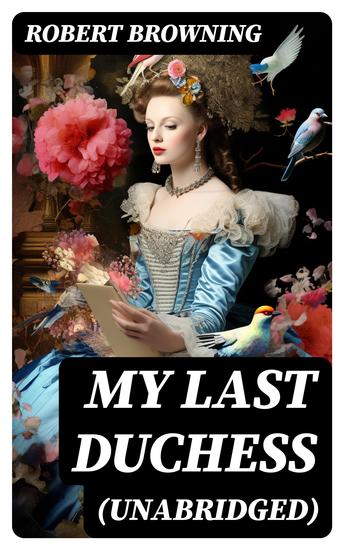
My Last Duchess (Unabridged) - cover
LER

My Last Duchess (Unabridged)

Robert Browning

Editora: DigiCat

  • 0
  • 0
  • 0

Sinopse

Robert Browning's "My Last Duchess" serves as a quintessential example of dramatic monologue, encapsulating the poet's mastery of characterization and psychological depth. Set in Renaissance Italy, this chilling narrative unfolds through the voice of a Duke as he unveils a portrait of his deceased wife. The interplay of power, jealousy, and the male gaze is deftly crafted, with Browning's intricate use of enjambment and vivid imagery creating a haunting yet compelling portrait of a man who equates affection with possession. The poem not only engages with historical context but also probes the darker aspects of human nature, encapsulating the tension between art and human emotion amidst an elite social backdrop. Browning, an influential figure of the Victorian era, drew upon his fascination with the dramatic, the psychological, and the moral complexities of individuals. His experiences in Italy and his deep interest in character-driven narratives significantly influenced "My Last Duchess." Drawing from historical accounts and Renaissance art, Browning skillfully channels the voice of the Duke, reflecting the era's themes of power dynamics and emotional manipulation. This masterpiece is highly recommended for those interested in poetic narrative and character exploration. Students of literature, poetry enthusiasts, and anyone intrigued by the intricate dance of love, power, and tragedy will find Browning's work both intellectually stimulating and emotionally resonant.
Disponível desde: 04/12/2023.
Comprimento de impressão: 482 páginas.

Outros livros que poderiam interessá-lo

  • The Poetry of Thomas Chatterton - Despite tragically committing suicide at only 17 Chattertons influence would stretch far beyond his years being a huge spark to poets such as Shelley Keats Wordsworth and Coleridge - cover

    The Poetry of Thomas Chatterton...

    Thomas Chatterton

    • 0
    • 0
    • 0
    Thomas Chatterton was born in Bristol on 20th November 1752 some 15 weeks after the death of his father. For a time he was admitted to Edward Colston's Bristol charity school, on a limited curriculum of reading, writing, arithmetic and the catechism. 
      
    Although fascinated by the church of St Mary Redcliffe where his uncle was sexton, he was liable to fits of abstraction, sitting for hours in a trance or crying for no reason. When Chatterton was 8 he was so eager for books that he would read and write all day long and by 11 he had become a contributor to Felix Farley's Bristol Journal. He lived in thought with his 15th-century heroes and heroines. 
      
    The first of his literary mysteries, the dialogue of "Elinoure and Juga," was written before he was 12, and he showed it to the usher at the boarding school Colston's Hospital where he was a pupil, pretending it was the work of a 15th-century poet. Chatterton remained a boarder at Colston's Hospital for more than six years. His little pocket-money was spent borrowing books from a circulating library and always attempting to ingratiate himself with book collectors. 
      
    His holidays were mostly spent at his mother's house, and much of that in the attic study living for the most part in an ideal world of his own, centered on his mid-15th century imaginary world. 
      
    Chatterton soon conceived the romance of Thomas Rowley, an imaginary monk of the 15th century, and adopted for himself the pseudonym Thomas Rowley for poetry and history. He imagined he would become a famous poet who by his talents would be able to rescue his mother from poverty. 
      
    Chatterton needed a patron. Many were not interested. Horace Walpole was but discovering that the poems were most probably fake and Chatterton himself only 16 scornfully sent him away. 


    Badly hurt by Walpole's snub, Chatterton wrote very little for a summer. Then he turned his attention to periodical literature and politics, and the London periodicals. He was frequently published but received little reward for his startling efforts. 
      
    Chatterton wrote at Easter 1770, ‘‘Last Will and Testament,’’ a satirical mix in jest and seriousness. The will was possibly prepared so that John Lambert, the attorney to whom he was apprenticed, cancelled his indentures. His friends and acquaintances, having donated money, Chatterton proceeded to London. 
      
    He continued to write and publish in various styles and was paid little for his efforts. He wrote hopefully to his mother and sister, and spent his first earnings in buying gifts for them. 
      
    In June 1770, after nine weeks in London, he moved from a shared room in Shoreditch to an attic in Brook Street, Holborn. He now enjoyed uninterrupted solitude and now could write all night. The romance of his earlier years revived, and he transcribed from an imaginary parchment of the old priest Rowley his "Excelente Balade of Charitie." This poem, disguised in archaic language, he sent to the editor of the Town and Country Magazine, where it was rejected. 
      
    A neighbouring apothecary, repeatedly invited him to come for dinner or supper; but he refused. His landlady also, suspecting his necessity, pressed him to share her dinner, but in vain. "She knew," as she afterwards said, "that he had not eaten anything for two or three days." But he assured her that he was not hungry. 
      
    In August 1770, while walking in St Pancras Churchyard, Chatterton was much absorbed in thought, and did not notice a newly dug open grave in his path, and subsequently tumbled into it. His walking companion helped Chatterton out of the grave, and told him that he was happy in assisting at the resurrection of a genius. Chatterton replied, "My dear friend, I have been at war with the grave for some time now." 
     
    On 24th August 1770, Thomas Ch
    Ver livro

  • Word-Play (NHB Modern Plays) - cover

    Word-Play (NHB Modern Plays)

    Rabiah Hussain

    • 0
    • 0
    • 0
    In the Downing Street Press Office an emergency meeting has been called. The Prime Minister has been ad-libbing on live TV (again) and his words are going viral.
    There is a flurry of accusations, and demands for an apology; but as his team debate what to do next, it's already too late. His words have found their way to dinner parties, bus journeys and newspaper columns across the nation – and not everyone is angry.
    Rabiah Hussain's play Word-Play explores how language seeps into public consciousness and reverberates with far-reaching consequences that will last for generations. It premiered at the Royal Court Theatre Upstairs, London, in July 2023, directed by Nimmo Ismail.
    Ver livro
  • Quiet Night Think - Poems & Essays - cover

    Quiet Night Think - Poems & Essays

    Gillian Sze

    • 0
    • 16
    • 0
    “One function of the poet at any time is to discover by his own thought and feeling what seems to him to be poetry at that time,” writes Wallace Stevens. In Quiet Night Think, award-winning poet Gillian Sze expresses her own definition.
    		 
    During the remarkable period of early parenthood, Sze’s new maternal role urges her to contemplate her own origins, both familial and artistic. Comprised of six personal essays, poems, and a concluding long poem, Quiet Night Think takes its title from a direct translation of an eighth-century Chinese poem by Li Bai, the subject of the opening essay. Sze’s memory of reading Li Bai’s poem as a child marks the beginning of an unshakable encounter with poetry. What follows is an intimate anatomization of her particular entanglement with languages and cultures.
    		 
    In her most generically diverse book yet, Sze moves between poetry and prose, mother and writer, the lyrical and the autobiographical, all the while inviting readers to meditate with her on questions of emergence and transformation: What are you trying to be? Where does a word break off? What calls to us throughout the night?
    Ver livro
  • Bleak Expectations - (West End edition) - cover

    Bleak Expectations - (West End...

    Mark Evans

    • 0
    • 0
    • 0
    The story Charles Dickens might have written after drinking too much gin…
    Follow half-orphan Pip's extraordinary exploits with sisters Pippa and Poppy and best friend Harry Biscuit, as they attempt to escape the calculating clutches of the dastardly Mr Gently Benevolent, defeat the hideous Hardthrasher siblings, and deflect disaster at every turn! Will evil be vanquished by virtue? Can love triumph over hate?
    Mark Evans' stage play Bleak Expectations is a hilarious, chaotic caper, featuring dastardly villains, preposterous names, pulse-quickening romances, heart-rending death scenes, and definitely, probably, hopefully a happy ending.
    Based on the award-winning BBC Radio 4 series, the play opened at The Watermill Theatre, Newbury, in 2022, directed by Caroline Leslie. It transferred to the Criterion Theatre in London's West End in 2023, where it featured a medley of many well-known actors and comedians.
    It offers rich opportunities to amateur theatre companies looking for a gloriously daft Dickensian romp which will have their audiences joyfully transported and begging for more.
    Ver livro
  • Leaves of Grass The Original 1855 Edition - cover

    Leaves of Grass The Original...

    Walt Whitman

    • 0
    • 0
    • 0
    Leaves of Grass is a poetry collection by the American poet Walt Whitman (1819–1892).The poems of Leaves of Grass are loosely connected, with each representing Whitman's celebration of his philosophy of life and humanity. This book is notable for its discussion of delight in sensual pleasures during a time when such candid displays were considered immoral. Where much previous poetry, especially English, relied on symbolism, allegory, and meditation on the religious and spiritual, Leaves of Grass exalted the body and the material world.Influenced by Ralph Waldo Emerson and the Transcendentalist movement, itself an offshoot of Romanticism, Whitman's poetry praises nature and the individual human's role in it. However, much like Emerson, Whitman does not diminish the role of the mind or the spirit; rather, he elevates the human form and the human mind, deeming both worthy of poetic praise.
    Ver livro
  • Dear Mom: Wait That’s Me! - cover

    Dear Mom: Wait That’s Me!

    LaTanya Coleman-Carter

    • 0
    • 0
    • 0
    “Dear Mom, Wait That’s Me!” Is a collection of essays, prose, and poems from the perspective of a black mother’s experiences while parenting in today’s society. It journeys her awareness and release of the holds society, family, TV, social media, and her religion had on her. She discovers that all her children are different and shouldn’t be parented the same. The stories in the book take place over 23 years of parenting seven children, 4 of which she birthed. The story doesn’t particularly have an end as she is still parenting and evolving. It is written as an expression of her liberation and to hopefully inspire other mothers to explore the freedoms that can be experienced in their parenting.
    Ver livro