Join us on a literary world trip!
Add this book to bookshelf
Grey
Write a new comment Default profile 50px
Grey
Subscribe to read the full book or read the first pages for free!
All characters reduced
Fichte - cover

Fichte

Robert Adamson

Publisher: CLXBX

  • 0
  • 0
  • 0

Summary

Fichte by Robert Adamson is a philosophical study of Johann Gottlieb Fichte, one of the key figures in German Idealism. The book offers a clear and structured examination of Fichte's ideas, placing them within the broader development of modern philosophy and tracing their influence on later thinkers.

Adamson explores Fichte's central philosophical concepts, including the nature of self-consciousness, the role of the "I" in constructing reality, and the relationship between individual freedom and moral responsibility. The work carefully situates these ideas within the intellectual context of post-Kantian philosophy, highlighting both their originality and their impact on subsequent philosophical movements.

The book also discusses Fichte's contributions to ethics, epistemology, and political philosophy. Adamson presents Fichte not only as a systematic thinker but also as a figure engaged with questions about human agency, knowledge, and the structure of experience.

Themes of selfhood, idealism, knowledge, freedom, moral philosophy, and intellectual development run throughout the work. Adamson's analysis is both scholarly and accessible, making complex philosophical arguments understandable for readers interested in the history of ideas.

Fichte remains a valuable introduction to one of the foundational thinkers of German philosophy. It continues to serve as a useful resource for students and readers interested in metaphysics, ethics, and the evolution of modern philosophical thought.
Available since: 06/16/2026.
Print length: 230 pages.
Other books that might interest you

  • Folk Tales from the Russian - The Tsarevna Frog Seven Simeons and Other Tales - cover

    Folk Tales from the Russian -...

    Verra Xenophontovna Kalamatiano...

    • 0
    • 0
    • 0
    Russian tales as they were told rather than as they were tidied: Baba Yaga's hut on hen's legs, the frog princess, the seven Simeons, the girl sent to fetch fire from the witch. Verra de Blumenthal translated them in 1903 from the versions she had heard as a child, and kept the cruelty and the sudden mercies both. The Russian fairy world runs on rules that are stated once and never explained. Forty-six plates by painters including Venetsianov and Vasnetsov carry the peasant fields, villages and weather that ground these tales in the Russia that told them.
    Show book
  • Moving Past Marriage - Why We Should Ditch Marital Privilege End Relationship-Status Discrimination and Embrace Non-marital History - cover

    Moving Past Marriage - Why We...

    PhD Jaclyn Geller

    • 0
    • 0
    • 0
    A must-listen for anyone who has felt they are at a disadvantage simply because they are single or unmarried. 


    Married Americans enjoy over 1,000 benefits and entitlements that are withheld from our nonmarital counterparts. Health insurance, immigration rights, tax privileges (such as the estate tax), and hiring policies favor the married. Marriage is financially supported and incentivized by the federal government. Social customs such as blockbuster weddings, subvented honeymoons, and gifts reserved for wedded couples reify matrimony as a centering norm and further the idea that "marriage is best," a commonplace in popular psychology, where marriage-averse people are often tarred as "commitment-phobes." Despite this blatant and widespread prejudice, nonmarital Americans—nonmarital people—have not galvanized as a group to demand equality and inclusion. Why? 


    Moving Past Marriage argues that it is because of our troubled relationship to history. As women's history once was, nonmarital history has been buried, so the disenfranchisement that nonmarital people share in wedlock-dominated societies, as well as our remarkable, far-ranging achievements, have been hard to spot. In recovering our own history, nonmarital people can become self-aware as a group and begin to challenge marriage-centric thinking and practice.
    Show book
  • Echoes of Certainty - Finding the Stillness in the Storm - cover

    Echoes of Certainty - Finding...

    Matthias Zing

    • 0
    • 0
    • 0
    In a world drowning in noise, doubt, and distraction, certainty has become a rare treasure. Echoes of Certainty is a contemplative guide that leads readers back to the deepest sources of clarity, purpose, and inner calm. 
    Through timeless stories, spiritual insight, and modern psychological reflection, Matthias Zing invites you on a journey into the heart of wisdom. Each chapter reveals a new layer of what it means to live with intention—whether confronting fear, navigating uncertainty, or rediscovering trust in a world that constantly shifts beneath our feet. 
    You will explore: 
    ✨ The Compass of Trust — why true confidence is born from surrender, not control 
     ✨ The Currency of Moments — how time shapes your destiny in silence 
     ✨ The Wisdom of Unlearning — freeing the mind from ego and illusion 
     ✨ The Burden of Choice — the hidden power of decisive living 
     ✨ The Ripple Effect — how even the smallest act can transform generations 
     ✨ The Tapestry of Events — seeing life’s challenges through the eyes of the Weaver 
    Written with poetic clarity and grounded in universal spiritual principles, Echoes of Certainty is not a book you simply read—it is a mirror that reveals who you truly are. 
    Whether you seek meaning, resilience, or a deeper connection to the Divine, this book offers a pathway back to stillness, insight, and unshakable certainty. 
    Let these echoes guide you. 
     Let them remind you of the truth you always carried within.
    Show book
  • Learn Arabic: The Master Guide to Egyptian Holidays for Beginners - Discover Egyptian Culture Festivals & Traditions with 25 Easy Audio Lessons - cover

    Learn Arabic: The Master Guide...

    ArabicPod101.com

    • 0
    • 0
    • 0
    How does Egypt celebrate Ramadan? What happens on Coptic Christmas? Learn Arabic: The Master Guide to Egyptian Holidays for Beginners answers questions like these while you pick up the Arabic words and phrases that go with every celebration. 
     
    This beginner-friendly audiobook from Innovative Language, the creators of ArabicPod101, walks you through the Egyptian calendar in clear English. For each holiday, you learn when it's celebrated, why, where, and by whom, plus the key Arabic vocabulary to talk about it. It's an easy way to understand Egyptian culture and build your Arabic at the same time. 
     
    Holidays and traditions include Ramadan, the Fast Breaking Feast, the Feast of the Sacrifice, Coptic Christmas and Easter, the Spring Festival, Henna Night, and the Flooding of the Nile Festival. 
     
    What's inside: 
    • 25 audio lessons, about 2 hours in total 
    • Every lesson presented in English, with key Arabic words and phrases 
    • PDF lesson notes so you can read along 
    • Fresh talking points for conversations with Arabic speakers 
     
    Who it's for: 
    • Beginner learners of Arabic, and learners of all levels 
    • Travelers planning a trip to Egypt 
    • Heritage learners and families connecting with Egyptian traditions 
    • Anyone curious about Egyptian culture, festivals and customs 
     
    By the end, you'll understand the most important Egyptian holidays, know the Arabic words to talk about them, and be ready to chat with native speakers about the next celebration.
    Show book
  • The Notorious Edward Low - Pursuing the Last Great Villain of Piracy's Golden Age - cover

    The Notorious Edward Low -...

    Len Travers

    • 0
    • 0
    • 0
    Following the War of the Spanish Succession (1702–1713) a decade-long wave of sea-robbery plagued the Atlantic rim—often glamorized as the "Golden Age of Piracy". Boston-based laborer, Edward Low, left his mark on pirate history as the most vicious and sadistic raider of them all. Low's reputation, and those of other pirates, was crafted through newspapers and literature. Romanticized as anti-heroes and egalitarians in a monarchical world who had liberated themselves from the constraints of law and society ashore, these marauders came to enjoy an immortality bestowed upon them by generations of historians, novelists, and movie makers. That persistent gloss masks a more sordid reality. 


    Travers demonstrates that, feared as they certainly were, pirates were largely ordinary seamen trapped in desperate circumstances who, in the end, had little to show for their efforts. Contrary to popular portrayals, for pirates it was a time of radically diminishing returns, scant treasure, and increasingly successful suppression by state authorities. The Notorious Edward Low puts individual actors, from colonial governors to captains to common seamen, at center stage, and reveals how British authorities used new anti-piracy laws to reclaim authority over their fractious North American colonies—a compelling story with its own brand of true-life swashbuckling on the high seas.
    Show book
  • Human History and the Trust Between Strangers - A Brief History of Humankind's Real Superpower and the Archaeology That Shows How Fire Farming and Money Widened Our Circle of Trust - cover

    Human History and the Trust...

    World History House

    • 0
    • 0
    • 0
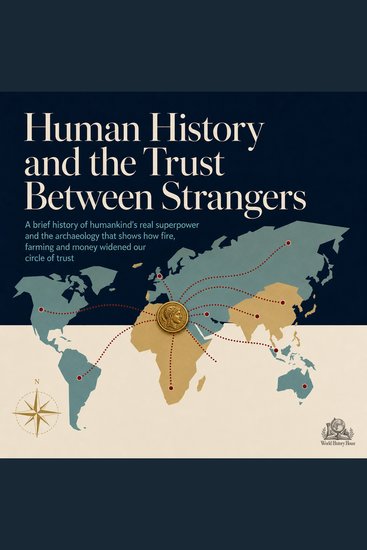
    You have read the big books about where humans came from, and you still wonder about the simplest puzzle of all. Why do millions of us share streets, money and rules with people we will never meet?
    
    This audiobook argues that our species' real superpower is learning to trust strangers, and it follows that idea through seven leaps. Each chapter opens inside a scene drawn from real archaeology, from a hearth where early humans shared cooked meat to the clay tablets of the first cities and the coins that let strangers trade. Along the way you hear how gossip, farming villages, writing and global networks each widened the circle. The narrator marks clearly what researchers know and what they only suspect, so the bold thesis stays honest.
    
    In six to eight tight hours you come away with a fresh lens on human history and a story you will want to retell at dinner. Press play and step up to the first fire.
    Show book