Join us on a literary world trip!
Add this book to bookshelf
Grey
Write a new comment Default profile 50px
Grey
Subscribe to read the full book or read the first pages for free!
All characters reduced
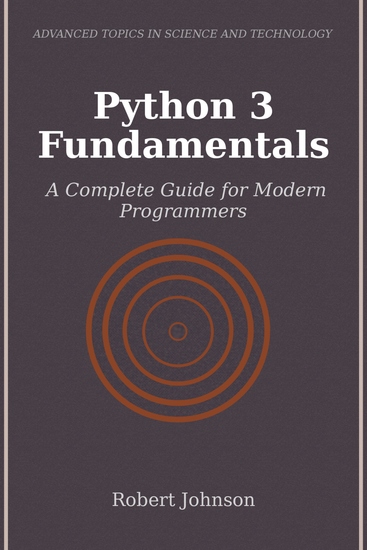
Python 3 Fundamentals - A Complete Guide for Modern Programmers - cover

Python 3 Fundamentals - A Complete Guide for Modern Programmers

Robert A. Johnson

Publisher: HiTeX Press

  • 0
  • 0
  • 0

Summary

"Python 3 Fundamentals: A Complete Guide for Modern Programmers" is an authoritative resource designed to equip both novice and experienced developers with a thorough understanding of Python programming. Written by an expert in computer science and software engineering, this comprehensive guide navigates through essential Python topics, providing readers with a definitive pathway to mastery. From setting up the Python environment and understanding variables and data types, to exploring control flow, functions, and data structures, every chapter is meticulously crafted to offer clear, insightful explanations alongside practical examples.Delving deeper, the book expands on advanced concepts such as object-oriented programming, exception handling, and file management, ensuring readers gain a solid foundation in developing scalable, efficient Python applications. With sections dedicated to leveraging Python's expansive libraries and frameworks, as well as integrating best practices for testing and debugging, this guide is not only a learning tool but also a valuable reference for creating robust, high-quality software. Whether you're building web applications, automating tasks, or embarking on data analysis, this guide empowers you with the skills needed to harness the full potential of Python in any domain.
Available since: 10/29/2024.
Print length: 342 pages.

Other books that might interest you

  • Cetology - Whales Dolphins and Porpoises: Life in the Deep - cover

    Cetology - Whales Dolphins and...

    Mike Crawford

    • 0
    • 0
    • 0
    Cetology, the scientific study of cetaceans—whales, dolphins, and porpoises—plays a vital role in understanding the complexities of marine ecosystems. This branch of marine biology delves into the behaviors, anatomy, physiology, ecology, and conservation of these magnificent creatures. The field's significance extends beyond simply observing and classifying different species; it also serves as a lens through which we can better comprehend the delicate balance of life in the ocean and the various environmental pressures influencing it. 
    The study of cetology has captivated scientists and marine enthusiasts alike for centuries. Early observations of cetaceans were often based on myths, folklore, and a limited understanding of the creatures' biology and behavior. However, as marine exploration advanced and the field of marine science grew, researchers began to focus on the detailed study of cetaceans, uncovering insights into their complex lives. The 19th and 20th centuries brought with them key developments in cetological research, including advancements in the identification of different species, the discovery of migration patterns, and breakthroughs in understanding cetacean communication. 
    Cetology covers a vast range of topics, from the anatomical and physiological traits that make cetaceans uniquely adapted to life in water to their social structures and interactions within pods. The study of cetacean communication, including their use of sound to navigate, hunt, and socialize, has proven to be one of the most fascinating aspects of cetology. Researchers have discovered that whales and dolphins use a complex system of vocalizations, clicks, and whistles, which play a critical role in their survival and social organization.
    Show book
  • Habit Forming - Drug Addiction in America 1776-1914 - cover

    Habit Forming - Drug Addiction...

    Elizabeth Kelly Gray

    • 0
    • 0
    • 0
    Habitual drug use in the United States is at least as old as the nation itself. Habit Forming traces the history of unregulated drug use and dependency before 1914, when the Harrison Narcotic Tax Act limited sales of opiates and cocaine under US law. Many Americans used opiates and other drugs medically and became addicted. Some tried Hasheesh Candy, injected morphine, or visited opium dens, but neither use nor addiction was linked to crime, due to the dearth of restrictive laws. After the Civil War, American presses published extensively about domestic addiction. Later in the nineteenth century, many used cocaine and heroin as medicine. As addiction became a major public health issue, commentators typically sympathized with white, middle-class drug users, while criticizing such use by poor or working-class people and people of color. When habituation was associated with middle-class morphine users, few advocated for restricted drug access. By the 1910s, as use was increasingly associated with poor young men, support for regulations increased. In outlawing users' access to habit-forming drugs at the national level, a public health problem became a larger legal and social problem, one with an enduring influence on American drug laws and their enforcement.
    Show book
  • Mastering Prompt Engineering (AI): From Beginner to Expert - cover

    Mastering Prompt Engineering...

    AVH

    • 0
    • 0
    • 0
    In a world where artificial intelligence (AI) is redefining the boundaries of what's possible, "Mastering Prompt Engineering (AI): From Beginner to Expert" emerges as the indispensable guide for anyone aspiring to fully harness the potential of AI, particularly ChatGPT. This transformative work takes you on a journey from absolute novice to master of prompt engineering, a crucial skill in the digital era. 
    Why is this book different? 
    This book breaks down complex concepts into clear, accessible explanations, complemented by concrete examples, case studies, and proven strategies. Whether you're a professional looking to optimize your processes, a creative eager to explore new avenues, or simply curious about technology, you'll find a treasure trove of practical knowledge within these pages. 
    What you will learn: 
    The fundamentals of prompt engineering and why it's the key skill in using ChatGPT. 
    How to formulate prompts that generate precise, creative, and useful results. 
    Advanced techniques for customizing and refining AI responses to unprecedented levels. 
    Strategies for integrating ChatGPT into your workflow, enhancing productivity and innovation. 
    Real case studies demonstrating the transformative impact of prompt engineering across various fields. 
    Practical tips for staying at the forefront of the rapid evolution of AI. 
    Why buy this book? 
    "Mastering Prompt Engineering (AI): From Beginner to Expert" is not just a manual; it's an invitation to actively participate in the future of technology. By mastering the art of prompt engineering, you'll open doors to limitless possibilities, making AI not a distant tool, but a collaborative partner in your quest for success and innovation. 
    Don't let the future pass you by. Embark on this captivating adventure and transform your interaction with AI today.
    Show book
  • A Rare Recording of US Naval Rear Admiral and Computer Pioneer Grace Hopper Volume 1 - cover

    A Rare Recording of US Naval...

    Grace Hopper

    • 0
    • 0
    • 0
    Grace Brewster Hopper (December 9, 1906 to January 1, 1992) was an American computer scientist, mathematician, and United States Navy rear admiral. A pioneer of computer programming, Hopper was the first to devise the theory of machine-independent programming languages and used this theory to develop the FLOW-MATIC programming language and COBOL, an early high-level programming language still in use today. She was also one of the first programmers on the Harvard Mark I computer. She is credited with writing the first computer manual, "A Manual of Operation for the Automatic Sequence Controlled Calculator." The following audio recording is from a 1982 presentation.
    Show book
  • Mental Disorder - cover

    Mental Disorder

    Saab Jackson

    • 0
    • 0
    • 0
    Mental Disorder: The Ultimate Guide to Mental Illness and Brain Disorders, Learn All the Important Information About Common Mental Illnesses and DisordersMental Illness is a serious medical condition that can affect the person's ability to function in their daily life. It affects their personal, social and professional life. Sadly, some of the people suffering from mental disorders are not even diagnosed. Millions of Americans are affected by mental health illnesses. Statistics from Mental Health America shows that nearly 1 in 5 American adults will have a diagnosable mental health condition in any given year. The overall number of US adults with Mental Illness is 44 million.In this audiobook, you will learn about different mental disorders to give you a better understanding in each and every one. You will discover the possible causes of some mental health issues as well as remedies that can assist you in supporting individuals who have some of the conditions mentioned here.. You will learn about ADHD, antisocial and psychopathic disorders, avoidant personality disorder, dependent personality disorder, schizophrenia, impulsive behaviors. alcohol and drug abuse, multiple personality disorder, PTSD, dangerous personality disorder, underdeveloped child separation and passive aggressive disorders.In this audiobook, the following topics will be discussed:- Understanding Mental Illness and Diagnosis- Cognitive Mental Health Disorders- The Roots of Mental Health Issues- What You Should Ask a Mental Health Expert- Common Mental IllnessesIf you or someone you know suffers from mental disorder and you want to learn more about it so you can better help them, this audiobook is perfect for you. scroll up and c
    Show book
  • Mystical Matter - Unlocking the Secrets of the Universe's Dark Ingredients - cover

    Mystical Matter - Unlocking the...

    Dirk Fallon

    • 0
    • 0
    • 0
    The universe we see is only a small fraction of what actually exists. All the stars, planets, galaxies, and nebulae make up less than five percent of the total mass and energy in the cosmos. The rest remains invisible, undetectable by traditional telescopes, and yet it shapes the structure and evolution of everything. Scientists refer to this unseen majority as dark matter and dark energy — mysterious ingredients that hold the key to understanding the true nature of the universe. 
    The mystery began when astronomers started noticing something strange in the way galaxies moved. Based on the visible matter alone, galaxies should not hold together. They rotate so fast that stars on the outer edges should fly off into space. But they don’t. Something must be providing the extra gravity needed to keep them in place. This unseen substance is what scientists call dark matter. It does not emit light, reflect it, or interact with electromagnetic radiation in any detectable way. Yet its gravitational effects are undeniable. 
    In the 1930s, Swiss astronomer Fritz Zwicky was one of the first to point out this discrepancy. He observed clusters of galaxies and found that there wasn’t enough visible mass to account for the gravitational forces at work. He proposed the existence of “dunkle Materie,” or dark matter, to explain the missing mass. His ideas were largely ignored at the time, but decades later, further evidence confirmed his observations. Today, dark matter is widely accepted as a fundamental part of the universe, even though we still don’t know what it’s made of.
    Show book