Join us on a literary world trip!
Add this book to bookshelf
Grey
Write a new comment Default profile 50px
Grey
Subscribe to read the full book or read the first pages for free!
All characters reduced
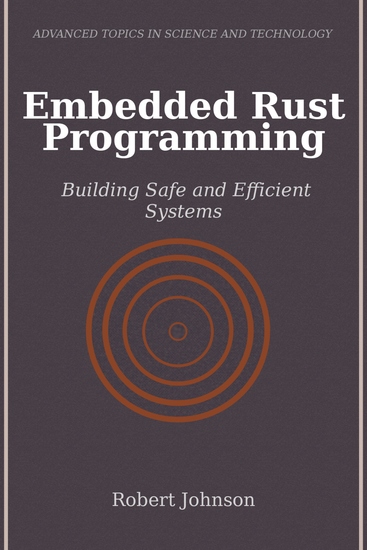
Embedded Rust Programming - Building Safe and Efficient Systems - cover

Embedded Rust Programming - Building Safe and Efficient Systems

Robert A. Johnson

Publisher: HiTeX Press

  • 0
  • 0
  • 0

Summary

"Embedded Rust Programming: Building Safe and Efficient Systems" is a comprehensive guide for developers eager to leverage Rust's unique capabilities in the realm of embedded systems. This book meticulously unravels the intricacies of using Rust in embedded environments, from crafting reliable real-time applications to effectively interfacing with hardware. By focusing on Rust's memory safety, concurrency features, and powerful programming paradigms, readers will gain a deep understanding of how to build robust, efficient, and secure embedded applications.Throughout this book, readers will explore practical case studies, providing a bridge between theoretical concepts and real-world applications. With detailed chapters addressing every critical aspect of embedded Rust development—setting up a development environment, managing concurrency, optimizing performance, and more—this book is an essential resource for both newcomers and seasoned professionals. Packed with insights and best practices, it is designed to elevate your understanding and skill in developing cutting-edge embedded systems using Rust.
Available since: 10/26/2024.
Print length: 264 pages.


Other books that might interest you

  • How To: GPT-4 for Financial Freedom - The Entrepreneur's Guide to Thriving in the AI Era - cover

    How To: GPT-4 for Financial...

    Ben Jakobsen

    • 0
    • 0
    • 0
    Discover the ultimate guide to starting a lucrative online business or side hustle using the groundbreaking power of GPT-4 and its innovative plugins. If you've ever dreamed of making money online, this book is for you! 
    How To: GPT-4 for Financial Freedom is tailored specifically for aspiring entrepreneurs and side hustlers eager to carve out their own path to success in the digital world. This comprehensive guide dives deep into the potential of GPT-4 and its game-changing plugins, unlocking the secrets to easily building a thriving online venture. 
    In this book, you'll learn how GPT-4 and its plugins can revolutionize how you approach online businesses, dramatically reducing the effort needed to succeed. With this knowledge, you'll be equipped to disrupt a wide array of existing industries and create your own profitable niche. 
    Get ready to:Start your online business or side hustle with confidence and easeHarness the power of GPT-4 plugins to streamline your operations and boost profitabilityDisrupt existing business models and reshape the digital landscape 
    Don't miss this opportunity to transform your online aspirations into reality. Start your journey to financial freedom and entrepreneurial success with How To: GPT-4 for Financial Freedom today!
    Show book
  • Wild Journeys - cover

    Wild Journeys

    Anonymous

    • 0
    • 0
    • 0
    Discover a world of wild, mysterious and audacious journeys 
     In Wild Journeys Bruce Ansley retraces the path of the doomed surveyor John Whitcombe across the Southern Alps, follows the raiding party of the northern chief Te Puoho along the West Coast, sails around New Zealand's northern and southern capes; walks through the Valley under the Two Thumb Range to the mythical Mesopotamia; drives from Waiheke to Wanaka (in a hurry), sets off on a hunt for the South Island's Grey Ghost, looks deep into the heart of volcanic New Zealand and tracks our most unlikely hero, the prison escaper George Wilder.
    Show book
  • Domain-specific LLMs - Unleashing the Power of Language Models in Specialized Fields - cover

    Domain-specific LLMs -...

    Et Tu Code

    • 0
    • 0
    • 0
    This audiobook is a comprehensive guide to leveraging Language Models (LLMs) tailored for specific domains. Here's what each section offers: 
    Introduction to Domain-specific LLMs: Lay the groundwork by understanding the fundamentals of Domain-specific LLMs 
    Key Concepts in Domain-specific LLMs: Delve deeper into core principles like domain adaptation, fine-tuning, and transfer learning, 
    Creating Custom LLMs: Learn to build custom Language Models tailored to specific domains 
    Steps to Create LLMs: Follow a roadmap for creating Domain-specific Language Models, from data acquisition to model training and evaluation. 
    Popular LLMs: Explore popular models like BERT, GPT, and XLNet customized for specific industries, comparing features and performance. 
    Fine-tuning LLMs: Master techniques for optimizing model performance and adapting to new tasks in specialized domains. 
    Integration with Systems: Discover best practices for integrating LLMs into existing systems and workflows seamlessly. 
    Resources and Tools: Access a curated collection of resources, datasets, and tools to support LLM development. 
    Pre-trained Models: Harness pre-trained models to expedite development and enhance efficiency in LLM projects. 
    Security Considerations: Address security concerns related to LLM deployment, ensuring robustness and integrity. 
    Hugging Face LLMs: Discover Hugging Face's Domain-specific LLMs platform for accessing pre-trained models. 
    Whether you're a researcher, developer, data scientist, or industry professional, "Domain-specific LLMs" equips you with the knowledge, skills, and insights to harness the full potential of Language Models in specialized domains.
    Show book
  • Python Data Science for Beginners - Analyze and Visualize Data Like a Pro - cover

    Python Data Science for...

    Brian Murray

    • 0
    • 0
    • 0
    Python Data Science for Beginners: Analyze and Visualize Data Like a Pro is the ultimate guide to learning the fundamentals of data science with Python. This book is perfect for anyone who is new to data science or wants to expand their skills in this field. 
    In this book, you'll learn how to manipulate and transform data using the popular pandas library, explore and visualize data using matplotlib and seaborn, build and evaluate machine learning models with scikit-learn, and even delve into advanced topics such as time series analysis and deep learning with Keras. 
    The book follows a step-by-step approach to data science, with plenty of code examples and exercises to help you apply your knowledge. It also includes practical tips and best practices for data analysis and visualization, as well as real-world examples of data science projects. 
    Whether you're a student, professional, or hobbyist, Python Data Science for Beginners is the perfect resource to help you master data science with Python. Get ready to analyze and visualize data like a pro! 
     
    Show book
  • The Indisputable Existence of Santa Claus - The Mathematics of Christmas - cover

    The Indisputable Existence of...

    Thomas Oléron Evans, Hannah Fry

    • 0
    • 0
    • 0
    How do you apply game theory to select who should be on your Christmas shopping list? What equations should you use to decorate the Christmas tree? Will calculations show Santa is getting steadily thinner—shimmying up and down chimneys for a whole night—or fatter—as he munches on cookies and milk in billions of houses across the world?In The Indisputable Existence of Santa Claus, distinguished mathematicians Hannah Fry and Thomas Oléron Evans demonstrate, with eminent clarity, how applied mathematics are so thoroughly interwoven throughout our everyday lives by explaining mathematical concepts through one very merry motif: Christmas. In their quest to provide mathematical proof for the existence of Santa, the authors take listeners on a festive journey through a traditional holiday season, wherein every activity, from wrapping presents to playing board games to cooking the perfect turkey, is painstakingly and hilariously analyzed. Because who hasn't always wondered how to set up a mathematically perfect Secret Santa?Lighthearted and diverting with Christmasy equations, Markov chains, and matrices, The Indisputable Existence of Santa Claus brightens up the bleak midwinter with a stockingful of mathematical marvels.
    Show book
  • Science and Technology in Ancient Rome: The History and Legacy of the Romans’ Technological Advances - cover

    Science and Technology in...

    Editors Charles River

    • 0
    • 0
    • 0
    The modern world has the ancient Romans to thank for the origins of many modern technologies, conveniences, and ideas, from running water, baths, and republican style government to roads. Similarly, by the 3rd century BCE, the Romans were prodigious monument builders, so much so that the memory of the great Roman Republic and the Roman Empire continues to exist within a cityscape of stone. Rome’s public spaces were filled with statues, arches, temples, and many other varieties of monumental images, and each of these structures had its own civic or religious function. At the same time, most were embedded with stories, messages, and symbolism so that they also tended to function as propaganda. These monuments allowed the leading citizens of Rome, especially its emperors, to sculpt their own self-image and embed themselves and their most memorable deeds into the very structure of the Roman city.  
    	While some of the most famous examples, like the Colosseum and Pantheon, remain striking testaments to Roman engineering and technology, many of the scientific advances the Romans ushered into the world were smaller in scope but not necessarily any less important. Indeed, the Roman Empire was not just one of the most technologically advanced civilizations within the ancient world but also proportionately one of the most prolific throughout all history. A substantial number of these innovations were lost following the eventual fall of the Western Roman Empire in 476 and the subsequent centuries of decline of the Byzantine Empire starting in the early 7th century, but rediscoveries of their advancements began during the later Middle Ages and the beginning of the Modern Era (c. 1400s). Some of their ideas and designs are only now being improved upon thanks to newer, far more advanced modern technologies.  
    Show book