Join us on a literary world trip!
Add this book to bookshelf
Grey
Write a new comment Default profile 50px
Grey
Subscribe to read the full book or read the first pages for free!
All characters reduced
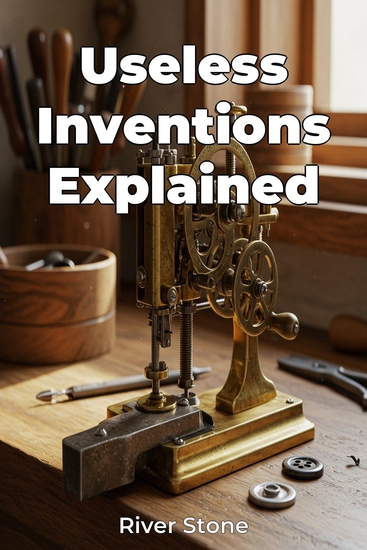
Useless Inventions Explained - cover

Useless Inventions Explained

River Stone

Translator A AI

Publisher: Publifye

  • 0
  • 0
  • 0

Summary

Useless Inventions Explained explores the captivating history of technological missteps—inventions that, despite good intentions, never quite found their purpose. It's a journey into the world of innovation history where failure offers just as much insight as success. The book highlights how seemingly brilliant ideas can falter due to a lack of market need, technological limitations, or flawed concepts. Consider, for example, the elaborate Victorian gadgets designed to automate simple household tasks, or early personal transportation attempts that proved utterly impractical.


The book uniquely approaches its topic by categorizing these inventions thematically, examining those that lacked market acceptance, those limited by technology, and those conceptually flawed from the start. It emphasizes that these "useless" inventions, while impractical, serve as crucial learning experiences, pushing boundaries and paving the way for future breakthroughs. By drawing on historical records, patent filings, and even anecdotal accounts, the book paints a vivid picture of each creation's journey.


The book progresses from defining "practical uselessness" to exploring specific categories of inventions across thematic chapters. These chapters cover everything from Victorian gadgets to war contraptions, ultimately leading to an exploration of the implications for modern inventors and risk-takers. By understanding why these inventions failed, readers gain a deeper appreciation for the complexities of technological progress and the importance of learning from both successes and failures.
Available since: 03/31/2025.
Print length: 61 pages.
Other books that might interest you

  • This is Europe - The Way We Live Now - cover

    This is Europe - The Way We Live...

    Ben Judah

    • 0
    • 0
    • 0
    A Times, Financial Times and Telegraph Book of the Year 2023'Illuminates some of the great trends of our time' - Gideon Rachman, Financial Times'Vivid, urgent and unsettling' - Tom Holland, author of Dominion_____What does it now mean to call yourself European? Who makes up this population of some 750 million, sprawled from Ireland to Ukraine, from Sweden to Turkey? Who has always called it home, and who has newly arrived from elsewhere? Who are the people who drive our long-distance lorries, steward our criss-crossing planes, lovingly craft our legacy wines, fish our depleted waters, and risk life itself in search of safety and a new start?In a series of vivid but always empathetic portraits of other people’s lives, journalist Ben Judah invites us to meet them. Drawn from hours of painstaking interviews, these vital stories reveal a vibrant continent which has been transformed by diversity, migration, the internet, climate change, Covid, war and the quest for freedom.Laid dramatically bare, it may not always be a Europe we recognize – but this is Europe._____'An astonishing achievement' - Evening Standard'Brilliantly told . . . highly readable' - The Times
    Show book
  • License to Travel - A Cultural History of the Passport - cover

    License to Travel - A Cultural...

    Patrick Bixby

    • 0
    • 0
    • 0
    Discover the surprising global history of how the passport has shaped art, thought, and human experience to define the modern world. 
     
    License to Travel exposes the passport as both an instrument of personal freedom and a tool of government surveillance powerful enough to define our very humanity. 
     
    Patrick Bixby examines the passports of artists and intellectuals, ancient messengers and modern migrants to reveal how these seemingly humble documents implicate us in larger narratives about identity, mobility, citizenship, and state authority. 
     
    This concise cultural history:  
    • Takes the reader on a captivating journey from pharaonic Egypt and Handynasty China to the passport controls and crowded refugee camps of today. 
    • Connects intimate stories of vulnerability and desire with vivid examples drawn from world cinema, literature, art, philosophy, and politics 
    • Highlights the control that travel documents have over our bodies as we move around the globe. 
     
    With unexpected discoveries at every turn, from narrow escapes and new starts, tearful departures and hopeful arrivals, License to Travel shares some of our most memorable experiences involving the passport.
    Show book
  • Running from Bondage - Enslaved Women and their Remarkable Fight for Freedom in Revolutionary America - cover

    Running from Bondage - Enslaved...

    Karen Cook Bell

    • 0
    • 0
    • 0
    Running from Bondage tells the compelling stories of enslaved women, who comprised one-third of all runaways, and the ways in which they fled or attempted to flee bondage during and after the Revolutionary War. Karen Cook Bell's enlightening and original contribution to the study of slave resistance in eighteenth-century America explores the individual and collective lives of these women and girls of diverse circumstances, while also providing details about what led them to escape. She demonstrates that there were in fact two wars being waged during the Revolutionary Era: a political revolution for independence from Great Britain and a social revolution for emancipation and equality in which Black women played an active role. Running from Bondage broadens and complicates how we study and teach this momentous event, one that emphasizes the chances taken by these 'Black founding mothers' and the important contributions they made to the cause of liberty.
    Show book
  • Emily Dickinson: 15 Poems and Analyses - with an Original Piano Underscore Adapted for each Poem - cover

    Emily Dickinson: 15 Poems and...

    Emily Dickinson, A. M. Bly

    • 0
    • 0
    • 0
    This audiobook is narrated by an AI Voice.   
    "Emily Dickinson: 15 Poems and Analyses; with an Original Piano Underscore Adapted for Each Poem" brings the quiet power of one of America’s greatest poets to life in a fresh, immersive way. Each poem is presented with a uniquely crafted piano backdrop, composed to reflect the emotion, rhythm, and inner music of Dickinson’s words. 
    From the blinding stillness of “A Light Exists In Spring” to the mind-numbing irony of “Your Riches Taught Me Poverty,” the gentle interplay of voice and piano invites listeners into the intimate spaces where her poetry lives and breathes. The result is an experience that feels both timeless and newly awakened. 
    Perfect for poetry lovers, meditative listening, or anyone seeking a moment of reflection, this curated collection offers a graceful fusion of literature and music—celebrating Emily Dickinson’s brilliance in a form that resonates long after the final note fades. 
    The works of Emily Dickinson are in the public domain.
    Show book
  • Ikigai: Japanese secret to long and happy life - cover

    Ikigai: Japanese secret to long...

    Francesc Miralles

    • 0
    • 0
    • 0
    Ikigai: The Japanese Secret to a Long and Happy Life explores the age-old Japanese philosophy of finding one's "reason for being." Written by Héctor García and Francesc Miralles, the book delves into how the people of Okinawa, Japan, achieve extraordinary longevity and happiness by embracing Ikigai—a balance of passion, mission, vocation, and profession. Through insights into Japanese culture, habits, and mindfulness practices, the authors reveal practical steps to discover your own Ikigai, cultivate meaningful relationships, and lead a life filled with purpose and joy. This book is an inspiring guide to unlocking fulfillment and living each day to the fullest.
    Show book
  • The Crusader States - Kingdoms in the Holy Land - cover

    The Crusader States - Kingdoms...

    Nova Ashford

    • 0
    • 0
    • 0
    The story of the Crusader States begins with a cry for help and a call to arms that would echo across Christendom. In 1095, at the Council of Clermont, Pope Urban II delivered a fiery sermon urging the Christian knights of Europe to take up arms and reclaim the Holy Land from Muslim control. This call to crusade was not merely a military summons—it was framed as a sacred duty, a spiritual journey that promised the remission of sins and eternal reward for those who participated. The response was overwhelming. Nobles, peasants, and knights alike took up the cross, inspired by religious fervor, promises of salvation, and, for some, the allure of land and glory. 
    The roots of the crusading movement were complex. The Byzantine Empire, under threat from the Seljuk Turks, had appealed to the West for military support. Urban II seized the opportunity not only to assist a fellow Christian empire but also to assert papal authority, redirect knightly violence away from Europe, and perhaps reunite the Eastern and Western Churches. His appeal resonated deeply in a Europe rife with feudal conflict, religious devotion, and a growing warrior culture. The concept of "holy war" gave new legitimacy to warfare as a religious act, transforming knights into pilgrims with a sword. 
    The First Crusade, launched in 1096, was both chaotic and remarkable. It was not a single army but a series of loosely organized forces, including the infamous People's Crusade led by Peter the Hermit, which was largely destroyed before reaching the Holy Land. The main crusading armies followed, composed of powerful lords such as Godfrey of Bouillon, Raymond of Toulouse, Bohemond of Taranto, and others. These forces traversed hostile territory, besieged cities, and faced hunger, disease, and internal divisions. Yet, against the odds, they succeeded in capturing Jerusalem in July 1099.
    Show book