Join us on a literary world trip!
Add this book to bookshelf
Grey
Write a new comment Default profile 50px
Grey
Subscribe to read the full book or read the first pages for free!
All characters reduced
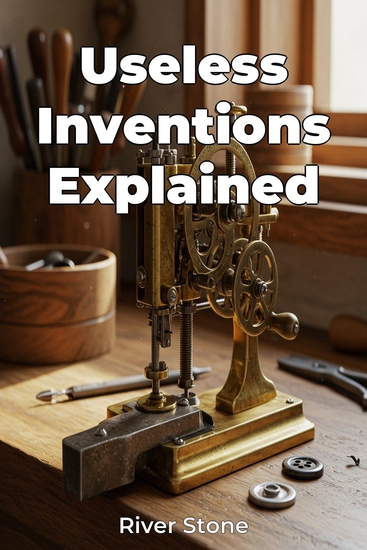
Useless Inventions Explained - cover

Useless Inventions Explained

River Stone

Translator A AI

Publisher: Publifye

  • 0
  • 0
  • 0

Summary

Useless Inventions Explained explores the captivating history of technological missteps—inventions that, despite good intentions, never quite found their purpose. It's a journey into the world of innovation history where failure offers just as much insight as success. The book highlights how seemingly brilliant ideas can falter due to a lack of market need, technological limitations, or flawed concepts. Consider, for example, the elaborate Victorian gadgets designed to automate simple household tasks, or early personal transportation attempts that proved utterly impractical.


The book uniquely approaches its topic by categorizing these inventions thematically, examining those that lacked market acceptance, those limited by technology, and those conceptually flawed from the start. It emphasizes that these "useless" inventions, while impractical, serve as crucial learning experiences, pushing boundaries and paving the way for future breakthroughs. By drawing on historical records, patent filings, and even anecdotal accounts, the book paints a vivid picture of each creation's journey.


The book progresses from defining "practical uselessness" to exploring specific categories of inventions across thematic chapters. These chapters cover everything from Victorian gadgets to war contraptions, ultimately leading to an exploration of the implications for modern inventors and risk-takers. By understanding why these inventions failed, readers gain a deeper appreciation for the complexities of technological progress and the importance of learning from both successes and failures.
Available since: 03/31/2025.
Print length: 61 pages.
Other books that might interest you

  • Lessons from the Light - What Near-Death Experiences Teach Us about Living in the Here and Now - cover

    Lessons from the Light - What...

    Kenneth Ring, Evelyn Elsaesser

    • 0
    • 0
    • 0
    “No other researcher has been able to transmit to the rest of us the true meaning and impact of near-death phenomena for the planet.” —Bruce Greyson, MD, bestselling author of After   “A major contribution that offers a wealth of case materials together with balanced and insightful commentary.” —Raymond A. Moody, PhD, bestselling author of Life After Life   While providing many remarkable accounts of near-death experiences (NDEs), Lessons from the Light is much more than an inspiring collection of NDEs. In clear language, the practical lessons for living and dying are to be found from the study of these experiences. Written by one of the foremost authorities on NDEs, Lessons from the Light is a book for those looking to gain knowledge and wisdom to enhance their own lives by incorporating the insights stemming from what many people have come to believe is the ultimate spiritual experience.   Although Lessons from the Light recounts many moving stories of NDEs, it is not just another book filled with inspiring testimonies—it includes helpful guidance and practical exercises concerning how readers can make use of this knowledge to live with greater self-insight, self-compassion and concern for others, as well as be better prepared for death, dying, and bereavement. Readers can easily apply what they have learned to their own lives and absorb and internalize these lessons from the Light in such a way as to lead to deep personal and spiritual transformation.   This edition replaces the previous edition (ISBN 978-1-930491-11-3) and contains a new postscript by the author.
    Show book
  • History of England from the Accession of James II - (Volume 3 Chapter 13) - cover

    History of England from the...

    Thomas Babington Macaulay

    • 0
    • 0
    • 0
    This chapter traces the history of the Glorious Revolution in Scotland, including the reaction of the country's religious parties, the installment of William and Mary, and the campaigns of the Highland Army.  (Summary by Leon Mire)
    Show book
  • Seven Against Thebes - cover

    Seven Against Thebes

    Aeschylus

    • 0
    • 0
    • 0
    In this, the only extant tragedy from Aeschylus' trilogy about the House of Oedipus, Thebes is under siege from Polynices, a former prince of Thebes. After King Oedipus left his city and cursed the princes, Polynices and his brother, Eteocles, decided to rule alternately, switching at the end of every year. However, at the end of his year as king, Eteocles refused to turn power over to his brother and exiled him, fulfilling his father's curse that the two brothers could not rule peacefully. In the action of the play, Polynices and a group of Argive soldiers are attacking Thebes so that he can take his place as ruler. Eteocles must combat both the foreign forces outside the walls and the crazed, frightened women within. Note: The ending of this play is suspect. The lines Antigone and Ismene's entrance to the end may have been added later, either after Sophocles' Theban plays became popular or in the Middle Ages. (Summary by Libby Gohn) Narrator: Charlotte DuckettEteocles:  Daniel VimontChorus 1: Elizabeth KlettChorus 2: Libby Gohn Spy: Cynthia Moyer Anigone: Amanda Friday Ismene: Caprisha Page Herald: Alan Mapstone
    Show book
  • Revisionaries - What We Can Learn from the Lost Unfinished and Just Plain Bad Work of Great Writers - cover

    Revisionaries - What We Can...

    Kristopher Jansma

    • 0
    • 0
    • 0
    Find creative inspiration in this fascinating rummage through the wastebaskets, secret diaries, and abandoned files of twenty literary superstars. 


    If you like to write—whether it's a pastime, a passion, or a profession—you've probably found yourself reading something brilliant and thinking, "I could never do this! I might as well give up." But if there's one thing every great author has in common, it's this: they've all written some hot garbage. 


    Revisionaries takes you on an engrossing tour through the discarded drafts, false starts, and abandoned projects of influential writers. In the process, it dismantles some of our most deeply held—and most suffocating—ideas about what it takes to produce great creative work. You'll learn that Franz Kafka lacked confidence; Octavia Butler had writer's block blocked; F. Scott Fitzgerald wrote bad drafts; Ralph Ellison got overwhelmed; Louisa May Alcott got off to a bad start; and more deep, dark secrets about the authors you most admire. 


    Written by an award-winning novelist and creative-writing professor, Revisionaries is a compelling peek behind the scenes of genius for writers and readers alike.
    Show book
  • The Art of Status - Looted Treasures and the Global Politics of Restitution - cover

    The Art of Status - Looted...

    Jelena Subotić

    • 0
    • 0
    • 0
    An illuminating exploration of the relationship between the restitution of looted art, global status, and the international construction of national cultural heritage.Why is art restitution a matter of politics? How does the artwork displayed in national museums reflect the international status of the state that owns it? Why do some states agree to return looted art and others resist?National art collections have long been a way for states to compete with each other for status, prestige, and cultural worth in international society. In many former imperial nations, however, these collections include art looted during imperial expansions and colonial occupations. While this was once a sign of high international standing, the markers of such status, particularly in the context of art, have since significantly changed. A new international legal and normative architecture governing art provenance developed after World War II and became institutionalized in the 1990s and 2000s. Since then, there have been national and global social movements demanding the return of looted art. This shift has established not only that looting is wrong but, more importantly, that restitution is morally right. As a result of this reframing of what it means to own art, an artifact's historical provenance has become a core element of its value and the search for provenance and demands for restitution have become a direct threat to state status. The same objects that granted states high international status now threaten to provoke status decline. In The Art of Status, Jelena Subotić illustrates the larger questions of how national cultural heritage is internationally constructed and how it serves states' desire for international status and prestige.
    Show book
  • Creative Imagination - cover

    Creative Imagination

    Warren Hilton

    • 0
    • 0
    • 0
    "Creative Imagination" by Warren Hilton explores the power of the human mind in generating innovative ideas and solutions. Hilton delves into the process of harnessing one's imagination to enhance problem-solving skills and boost personal and professional creativity. Through practical insights and exercises, the book aims to inspire readers to unlock their creative potential and apply it to various aspects of life. Read in English, unabridged.
    Show book