Join us on a literary world trip!
Add this book to bookshelf
Grey
Write a new comment Default profile 50px
Grey
Subscribe to read the full book or read the first pages for free!
All characters reduced
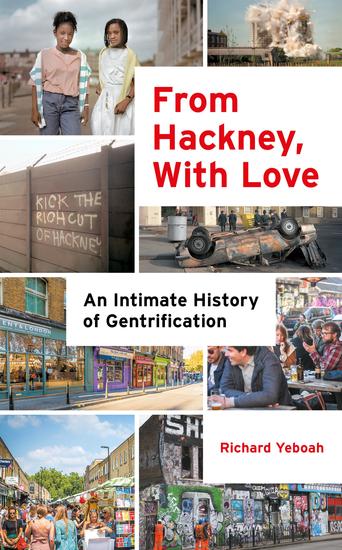
From Hackney With Love - An Intimate History of Gentrification - cover

From Hackney With Love - An Intimate History of Gentrification

Richard Yeboah

Publisher: Biteback Publishing

  • 0
  • 0
  • 0

Summary

For so many decades, Hackney was the pinnacle of the dynamic multicultural spirit of modern Britain, demonstrated by the borough's vibrant and energetic streets and often controversial political, cultural and socio-economic character. But today, the Hackney that long-standing residents once treasured seems to be disappearing. The borough's diverse working-class communities – who survived the run-down council estates, the overwhelming deprivation and the postcode wars – are increasingly being pushed out by the middle classes who buy up their homes, rename their shops and reshape their neighbourhoods.
How did Hackney go from being one of the poorest and most uninviting places in the country to being one of the most sought-after locations? In these pages, lifelong resident Richard Yeboah uncovers the borough's lively history, revealing the uncomfortable story of how gentrification has transformed Hackney, for better or for worse.
Examining some of the most contested issues facing the borough today – including housing and regeneration, politics, class, race, education, youth violence, culture and gender identity – Yeboah amplifies the voices of Hackney's new, existing and former communities and explores the relationship between gentrification and feelings of belonging and loss.
From Hackney, With Love is both a unique love letter to one of the most vibrant parts of London and a warning that its very existence is in jeopardy.
Available since: 05/29/2025.
Print length: 256 pages.
Other books that might interest you

  • The Crocodile - A Satirical Tale of Absurdity Society and Human Delusion - cover

    The Crocodile - A Satirical Tale...

    Fyodor Dostoevsky

    • 0
    • 0
    • 0
    What if the loudest voice in society came from inside a reptile? 
    Step right up to hear Ivan Matveich—safely lodged in a crocodile’s stomach—proclaim his grand designs for the future of civilization!  
    Dostoevsky’s outrageous satire comes alive in this dynamic audio edition, where bustling market sounds, astonished onlookers, and Ivan’s echoing monologues plunge you into the heart of 19th-century spectacle. 
    What you’ll hear inside: 
     — The Complete Story of The Crocodile – Every absurd twist delivered in a crisp, contemporary performance 
     — Rich Soundscapes of St. Petersburg – Street vendors, gasping crowds, and the reptile’s rumbling belly 
     — Four‐Dimensional Characters in Comic Conflict – Ivan’s self-importance, his wife Elena’s scheming, and the narrator’s exasperation 
     — A Swift, Satirical Experience – Under two hours, perfect for a single listening session that will leave you laughing—and thinking 
    Pop in your earbuds and discover why Dostoevsky’s strangest tale remains a deadly accurate mirror of our media-obsessed age.
    Show book
  • Prehistoric Warfare: The History of Early Human Conflicts - cover

    Prehistoric Warfare: The History...

    Editors Charles River

    • 0
    • 0
    • 0
    Raymond C. Kelly, an anthropologist and ethnologist who has written extensively on societal inequality and subsequent warfare suggests that among the hunter-gatherer groups of Homo erectus, the population density was low enough to avoid armed conflict in most cases. In the same vein, a perception has persisted that during this less populated time of Earth’s history, life among the Homo species was relatively peaceful. Archaeologists have supported this theory through early cave art, little of which ever depicts humans hunting or killing each other explicitly. Kelly theorized that the migration out of Africa by Homo erectus 1.8 million years ago was “a natural consequence of conflict avoidance.” He believes that this general period of “Paleolithic warlessness” was to persist until the appearance of Homo sapiens approximately 350,000 years ago, and that it began with the occurrence of “economic and social shifts associated with sedentism.” 
    However, depictions of humans pierced with arrows began to appear in the Aurignacian-Périgordian eras (30,000 years ago), and in the early Magdalenian era (17,000 years ago). A work of Mesolithic art (20,000 to 10,000 years ago) shows an explicit battle between groups of archers, and in Valencia, a group of three archers are seen surrounded by four of the similarly armed enemy in the Cova del Roure la Vella in Castellón. In the Ares del Maestrat in Alcañiz of Aragon, another work depicts warriors fleeing a group of eight archers, while a similar work at Val del Charco del Agua in Aragon shows seven archers with plumed headgear. Other examples show warriors in lines and columns with a “distinctly garbed leader at the front.”
    Show book
  • Gangster's Paradise - The much anticipated follow-up to the bestseller that exposed the escalation of organised crime in New Zealand - cover

    Gangster's Paradise - The much...

    Jared Savage

    • 0
    • 0
    • 0
    The much anticipated follow-up to the bestseller that exposed the escalation of organised crime in New Zealand. 
      
    Gangster's Paradise is about drugs, guns, gangs and money. Lots of money. 
    A gang which took over a small rural town. A police officer shot and killed in a routine traffic stop. A port-worker who helped a gang whisk a shipping container off a wharf in the middle of the night. A crew of corrupt baggage handlers smuggling meth into the country during Covid lockdowns. A shooting inside a 5-star hotel in broad daylight. Turf wars, retaliation, and retribution: new gangs like the Mongols and Comancheros have brought with them better connections with international syndicates, challenging the established gangs like the Head Hunters - so dominant for many years - who have had to up their game in response.  
    Jared Savage's bestselling book Gangland was about the evolution of gangs in New Zealand. Gangster's Paradise is about the deadly escalation.   
    HarperCollins Australia 2023
    Show book
  • Personality Isn't Permanent - cover

    Personality Isn't Permanent

    Carmine Wesley

    • 0
    • 0
    • 0
    Personality Isn't Permanent: A Guide to Understanding Different Personality Types and How You Can Use This to Design the Person You Want to BeThe word "personality" refers to a person's distinctive and consistent manner of thinking, feeling, and doing. Once this is understood, it becomes evident that "personality" embraces almost every facet of human existence. As a consequence, our personalities have the potential to have a substantial impact on our overall well-being and happiness. It also has a significant impact on the quality of our interpersonal connections. Our personalities have a big impact on our overall level of success and enjoyment in life.In this audiobook, you will learn more about different personality types, how to understand them and how to use this information so you could become the person you always wanted to be.This audiobook will discuss the following topics:- What is Personality?- Personality Myths- Types of Personality- How to Reframe Your Past- Become the Person You Want to Be- Design Your Future- And many more!If you want to learn more, download your copy of this audiobook today!
    Show book
  • Acropolis and the Agora The: The History of Ancient Athens’ Most Important Sites - cover

    Acropolis and the Agora The: The...

    Editors Charles River

    • 0
    • 0
    • 0
    The Acropolis, which literally means “a city on the heights,” is a citadel whose currently surviving structures were mostly built during the 5th century B.C. in honor of Athena, the patron goddess of Athens. It functioned as a sacred precinct that contained the city’s most important religious and municipal structures, many of which have remained relatively intact for over 2,000 years. The Propylaea (the gateway to the Acropolis), the Parthenon (the principal shrine to the goddess), the Erechtheion (a shrine that supposedly houses the burial grounds of mythical Athenian kings), and the Temple of Athena Nike all survive to this day, and for these reasons, the Acropolis is perhaps the definitive and most eloquent expression of classical architecture, if not of the classical form itself. The Acropolis, which literally means “a city on the heights,” is a citadel whose currently surviving structures were mostly built during the 5th century B.C. in honor of Athena, the patron goddess of Athens.  
    	The center of political and commercial interaction in the Ancient Greek polis was the agora. The word essentially means a gathering place or an open space, and in all Greek city states, the agora was central to all aspects of daily life and commerce. As the agora developed as a civic space, particularly from the 6th century B.C. onward in Athens, the architectural splendor of the buildings associated with it became an ever more obvious demonstration of the power and glory of Athenian democracy. 	In its earliest forms, an agora in maritime cities was invariably situated near the sea, while in inland urban centers, it was usually located at the foot of the hill that normally provided the city’s ultimate defense. The agora was always the oldest part of any city and, as such, and as well as being the commercial hub of the area, also became the center of the religious and political life of the polis.
    Show book
  • Fridays of Rage - Al Jazeera the Arab Spring and Political Islam - cover

    Fridays of Rage - Al Jazeera the...

    Sam Cherribi

    • 0
    • 0
    • 0
    Fridays of Rage provides a glimpse into how Al Jazeera strategically cast its journalists as martyrs in the struggle for Arab freedom while promoting itself as the mouthpiece and advocate of the Arab public. 


    In addition to heralding a new era of Arab democracy, Al Jazeera has become a major influence over Arab perceptions of American involvement in the Arab World, the Arab-Israeli conflict, the rise of global Islamic fundamentalism, and the expansion of the political far right. Al Jazeera's blueprint for "Muslim-democracy" was part of a vision announced by the network during its earliest broadcasts. The network embarked upon a mission to reconstruct the Arab mindset and psyche. Al Jazeera introduced exiled Islamist leaders to the larger Arab public while also providing Muslim feminists a platform. 


    The inclusion and consideration of Westerners, Israelis, Hamas, secularists, and others earned the network a reputation for pluralism and inclusiveness. Al Jazeera presented a mirror to an Arab world afraid to examine itself and its democratic deficiencies. But rather than assuming that Al Jazeera is a monolithic force for positive transformation in Arab society, Fridays of Rage examines the potentially dark implications of Al Jazeera's radical re-conceptualization of media as a strategic tool or weapon.
    Show book