Join us on a literary world trip!
Add this book to bookshelf
Grey
Write a new comment Default profile 50px
Grey
Subscribe to read the full book or read the first pages for free!
All characters reduced
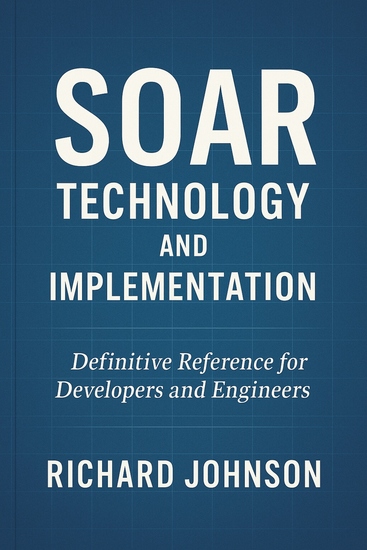
SOAR Technology and Implementation - Definitive Reference for Developers and Engineers - cover

SOAR Technology and Implementation - Definitive Reference for Developers and Engineers

Richard Johnson.

Publisher: HiTeX Press

  • 0
  • 0
  • 0

Summary

"SOAR Technology and Implementation""SOAR Technology and Implementation" offers a comprehensive exploration of Security Orchestration, Automation, and Response (SOAR) technologies, providing readers with an expert-level understanding of their foundational principles, architecture, and operational impact. The book meticulously surveys the landscape of SOAR, delving into its evolution, key components, distinctions from related systems such as SIEM, and the critical use cases driving its adoption. Through a granular analysis of the SOAR ecosystem—including vendors, open source projects, and integration patterns—it equips practitioners and decision-makers with the knowledge required to navigate an increasingly complex cybersecurity environment.Blending theory with practical guidance, the text presents in-depth discussions on platform design, playbook engineering, and seamless integration with both security and IT infrastructure. Readers will find detailed considerations for workflow orchestration, extensibility, data management, and robust security architectures. The book also addresses advanced topics such as machine learning integration, adaptive automation, and cloud-native deployment, strengthening the reader's ability to optimize SOAR implementations for scalability, high availability, and regulatory compliance. Each chapter includes actionable insights into deployment, continuous improvement, and real-world case studies, offering a blueprint for successful operationalization across diverse industries.With forward-looking analysis on emerging trends—such as autonomous SOCs, DevSecOps, open standards, and collaborative threat intelligence—this volume positions itself as an essential resource for security architects, engineers, and technology leaders. Whether you are architecting a new SOAR deployment, maturing your incident response program, or seeking to leverage the latest advances in automation and analytics, "SOAR Technology and Implementation" delivers the clarity, breadth, and depth needed to excel in today’s high-stakes cybersecurity landscape.
Available since: 05/28/2025.
Print length: 250 pages.

Other books that might interest you

  • Dynamic Systems Development Method - Comprehensive Guide to Agile Project Success - cover

    Dynamic Systems Development...

    Daniel Green

    • 0
    • 0
    • 0
    "Dynamic Systems Development Method: Comprehensive Guide to Agile Project Success" is the essential guide for project managers, software developers, and IT professionals seeking to implement or enhance their understanding of the Dynamic Systems Development Method (DSDM). This comprehensive book offers a deep dive into the DSDM framework, an agile project delivery framework that emphasizes user involvement, teamwork, frequent delivery, and a flexible approach to project management. 
    As businesses face ever-increasing pressure to deliver results in fast-moving environments, the need for an adaptable and efficient project management approach has never been greater. DSDM, with its roots in rapid application development (RAD), provides a solid foundation for managing projects with flexibility and efficiency, ensuring that deliverables meet business needs in a timely manner. 
    "Dynamic Systems Development Method: Comprehensive Guide to Agile Project Success" covers every aspect of the DSDM framework, from its principles and practices to real-world applications, offering readers a thorough understanding of how to apply DSDM for project success. 
    "Dynamic Systems Development Method: Comprehensive Guide to Agile Project Success" is designed to equip readers with the knowledge and skills to effectively apply the DSDM framework in their projects, ensuring they can navigate the complexities of modern project delivery with confidence and agility.  
     
    Show book
  • The Study of Mental Health - The Unofficial Guide to Self-Study - cover

    The Study of Mental Health - The...

    Steven Johnson

    • 0
    • 0
    • 0
    We wrote this book, Statistics for Psychology, specifically to serve as a resource for schooling and instruction. After spending several decades as a teacher of behavioural statistics, the author, who became widely known for his pedagogical prowess, intended to create a textbook that would apply the most effective classroom approaches to the written page. He did this by combining the textbook with the most effective classroom approaches. To achieve this, this book employs a variety of tactics, including timely pointing and highlighting devices, strategic reviews and reminders, a focus on the most pertinent content, and timely anticipating of the student's perspective. Additionally, Evans' technique emphasizes underlying logic and intuitive conceptions rather than sophisticated mathematical formulas and proofs, and it does so within the context of an engaging writing style. This contrasts other methods, which emphasize both of these aspects. One can say that there is a healthy balance between conceptual and computational aspects across the entirety of the object. This work is suitable for students taking their first course in behavioural statistics. After experiencing this subject, the reader will be better prepared for advanced courses and direct applications. We also provide internet links to complimentary additional supplements at www.ebookslimited.com to enhance your reading experience. Teachers of behavioural statistics and their students are the intended beneficiaries of these supplements.
    Show book
  • City Nature - Tales of Ornery Plants Opinionated Birds Gardening Triumphs and Tragedies and Capturing It All Through A Lens - cover

    City Nature - Tales of Ornery...

    Martha Retallick

    • 0
    • 0
    • 0
    In the midst of ongoing news about Southwestern water scarcity, Martha Retallick sees an opportunity. For 20 years, she has been transforming her central Tucson home into an urban oasis. The secret to her success: Water harvesting. Since Retallick purchased her central Tucson home in 2004, she has incorporated two types of water harvesting – passive and active – into her landscape. Passive water harvesting is simply the act of sculpting the landscape to direct the water to where it should be – like plants – and away from where it shouldn’t be – like a home’s foundation. Retallick’s landscape incorporates three passive water harvesting features – basins, berms, and drainage swales. Collectively, these earthworks eliminate the need for landscape irrigation that’s connected to the municipal water supply, which is served by Tucson Water. According to Tucson Water, approximately 40 percent of water use in Tucson is outdoors. This includes residential uses like landscape irrigation and garden watering. Retallick’s irrigation-free landscape also includes two active water harvesting features, a 1,500-gallon cistern that collects rainwater for use in the back-yard vegetable garden, and a laundry-to-landscape greywater harvesting system that diverts wastewater from the washing machine to three fruit trees. City Nature is illustrated with more than 60 of Retallick’s color photographs, which show the wide variety of plant life on her property, the birds she shares it with, and her various do-it-herself projects, the most notable being a kinetic sculpture created from a recycled chandelier. The book also includes a list of suggested resources that encompasses books, websites, organizations, and businesses that can aid readers interested in desert gardening and landscaping, and in water conservation.
    Show book
  • Ultimate Python Libraries for Data Analysis and Visualization - Leverage Pandas NumPy Matplotlib Seaborn Julius AI and No-Code Tools for Data Acquisition Visualization and Statistical Analysis - cover

    Ultimate Python Libraries for...

    Abhinaba Banerjee

    • 0
    • 0
    • 0
    Test your Data Analysis skills to its fullest using Python and other no-code tools


    Book Description
    Ultimate Data Analysis and Visualization with Python is your comprehensive guide to mastering the intricacies of data analysis and visualization using Python. This book serves as your roadmap to unlocking the full potential of Python for extracting insights from data using Pandas, NumPy, Matplotlib, Seaborn, and Julius AI. Starting with the fundamentals of data acquisition, you'll learn essential techniques for gathering and preparing data for analysis. From there, you’ll dive into exploratory data analysis, uncovering patterns and relationships hidden within your datasets. 


    Through step-by-step tutorials, you'll gain proficiency in statistical analysis, time series forecasting, and signal processing, equipping you with the tools to extract actionable insights from any dataset. What sets this book apart is its emphasis on real-world applications. With a series of hands-on projects, you’ll apply your newfound skills to analyze diverse datasets spanning industries such as finance, healthcare, e-commerce, and more. 


    By the end of the book, you'll have the confidence and expertise to tackle any data analysis challenge with Python. To aid your journey, the book includes a handy Python cheat sheet in the appendix, serving as a quick reference guide for common functions and syntax. 


    Table of Contents
    
    1. Introduction to Data Analysis and Data Visualization using Python
    2. Data Acquisition
    3. Data Cleaning and Preparation
    4. Exploratory Data Analysis
    5. Statistical Analysis
    6. Time Series Analysis and Forecasting
    7. Signal Processing
    8. Analyzing Real-World Data Sets using Python   
    APPENDIX A Python Cheat Sheet   
    Index
    Show book
  • Evolution Is Wrong - A Radical Approach to the Origin and Transformation of Life - cover

    Evolution Is Wrong - A Radical...

    Erich von Däniken

    • 1
    • 1
    • 0
    A Fascinating Exploration on Why the Darwinists’ Theory No Longer Explains Everything 
    There was once a set of ideas called the theory of evolution, conceived by clever people and confirmed by countless scientists. Then people discovered the electron microscope. This made it possible to make the molecules within the cell visible, and suddenly questions about evolution arose that were not possible before. Which force actually bundles the atoms in the right order? What moves the molecular chains into the correct position? How did the first living unit within the cell actually come about? How does inheritance work, how does information pass on to the next generation? Did humans descend only and exclusively from primates—as Charles Darwin and countless other great minds assumed—or did additional “engines” intervene in evolution?  
    Today it is clear: countless questions can no longer be answered with the previous theory of evolution. There is a form of life called “Blob” (Physarum polycephalum). The “thing” has neither eyes nor ears, neither a mouth nor a nose or even a brain. Nevertheless, it takes in food, overcomes obstacles by the shortest route and exchanges information with other “blobs.” The “blob” contradicts any evolutionary thought that one develops from the other. Or the “gastric-brooding frogs” (Rheobatrachus) found in Australia. They hatch their young in the stomach. Impossible in a slow, evolutionary process.  
    Everywhere there are characteristics of animals that do not want to fit into the theory of evolution anywhere. And man? Are we really the most adapted life-form on this planet? Today, more and more scientists who contradict the previous theory of evolution speak out. The theory fits the changes within the species, but it can no longer be reconciled with the inner workings of the cell. Some other influence that has so far escaped us is affecting evolution. It is called “Intelligent Design.” Intelligent planning is suspected behind this. Anyone or anything—a spirit of the universe? Aliens?—could be behind this planning.  
    Erich von Däniken uses countless examples to demonstrate the impossibility of the previous evolutionary idea. He quotes scientists who argue against the previous teaching, but also those who defend it. Unfortunately, established science still refuses to look at discrepancies and holes in the theory of evolution, even though it is quite obvious that there is more going on with regard to the development of all species, as well as human culture, than could be explained by the theory of evolution alone.
    Show book
  • Year of No Garbage - cover

    Year of No Garbage

    Eve O. Schaub

    • 0
    • 0
    • 0
    In this book, Eve O. Schaub, humorist and stunt memoirist extraordinaire, tackles her most difficult challenge to date: garbage. Convincing her husband and two daughters to go along with her, Schaub attempts the seemingly impossible: living in the modern world without creating any trash at all—for an entire year and, as it turns out, during a pandemic. In the process, Schaub learns some startling things: that modern recycling is broken and single stream recycling is a lie, that flushable wipes aren’t flushable and compostables aren’t compostable, and that plastic drives climate change, fosters racism, and is poisoning the environment and our bodies at alarming rates, as microplastics are being found everywhere, from the top of Mount Everest to the placenta of unborn babies. If you’ve ever thought twice about that plastic straw in your drink, you’re gonna wanna read this book.
    Show book