Join us on a literary world trip!
Add this book to bookshelf
Grey
Write a new comment Default profile 50px
Grey
Subscribe to read the full book or read the first pages for free!
All characters reduced
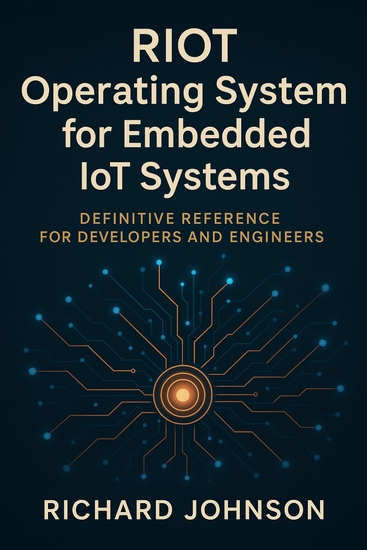
RIOT Operating System for Embedded IoT Systems - Definitive Reference for Developers and Engineers - cover

RIOT Operating System for Embedded IoT Systems - Definitive Reference for Developers and Engineers

Richard Johnson

Publisher: HiTeX Press

  • 0
  • 0
  • 0

Summary

"RIOT Operating System for Embedded IoT Systems"In the rapidly evolving landscape of the Internet of Things (IoT), **"RIOT Operating System for Embedded IoT Systems"** serves as a comprehensive and authoritative guide for engineers, researchers, and advanced practitioners. The book meticulously covers the foundations of embedded IoT systems, focusing on the unique challenges of resource constraints, real-time requirements, and heterogeneous hardware environments. Through a holistic exploration of RIOT OS’s philosophy, modular kernel architecture, and core design goals, readers gain a deep understanding of what sets RIOT apart from contemporaries like Contiki, Zephyr, and FreeRTOS, along with practical insights into the setup of robust development environments.Delving into the heart of RIOT OS, the text provides an in-depth examination of microkernel principles, advanced thread and process management, real-time scheduling, and efficient memory allocation—crucial for high-performance, energy-aware IoT devices. Readers are guided through the implementation and integration of device drivers, peripheral management strategies, and low-power design methodologies. Dedicated chapters on networking elucidate the rich protocol stack, including support for low-power wireless standards, IPv6/6LoWPAN, RPL, and secure constrained communication protocols like CoAP and MQTT. The book also thoroughly addresses system-level concerns such as security, privacy, secure boot, cryptographic services, and robust firmware update frameworks, ensuring IoT deployments are resilient and future-proof.Further enriching its practical value, this volume presents advanced topics in application development, continuous integration, and cloud connectivity. It highlights RIOT’s expanding role within industrial, vehicular, and edge computing domains, its capacity to support emerging paradigms such as machine learning on constrained devices, and its alignment with interoperability and semantic IoT standards. Closing with a forward-looking perspective on research trends, massive IoT scalability, and sustainable open-source ecosystem growth, "RIOT Operating System for Embedded IoT Systems" establishes itself as an essential reference and strategic roadmap for those building the next generation of intelligent, connected devices.
Available since: 05/30/2025.
Print length: 250 pages.

Other books that might interest you

  • Other Axis & Allied Armored Fighting Vehicles - World War II AFV Plans - cover

    Other Axis & Allied Armored...

    George Bradford

    • 0
    • 0
    • 0
    This fully illustrated volume presents an authoritative and highly detailed study of WWII’s lesser-known armored fighting vehicles.   The iconic tanks of WWII, such as America’s Shermans and the Germany’s Panzers, have been exhaustively studied. In Other Axis & Allied Armored Fighting Vehicles, military historian and technical artist George Bradford offers an in-depth look at a range of significant yet often-overlooked models.    This volume is filled with fine-scale drawings of Australian, Belgian, Canadian, Czech, French, Hungarian, Italian, Japanese, Polish, Romanian, and South African armored vehicles, including: ·       Centauro Tank Destroyer (Italy) ·       TKS Light Reconnaissance Tank (Poland) ·       Ram “Kangaroo” Personnel Carrier (Canada) ·       Renault R-35 Light Tank (France) ·       Type 3 Chi-nu Heavy Tank (Japan) ·       Scorpion AC1 Cruiser Tank (Australia) ·       TACAM R-2 Tank Hunter (Romania) ·       And many, many more . . .
    Show book
  • But Whose Fault? - The AK-47 Found - cover

    But Whose Fault? - The AK-47 Found

    AMOS ASEMONE

    • 0
    • 0
    • 0
    Do you keep an eye on world events through mainstream media? If so, chances are you have missed out on many essential news stories from countries around the world. 
    While many news outlets will cover European, U.K., and U.S. news in great detail, they often leave out essential news from other continents, especially Africa. 
    And yet, that doesn’t mean that newsworthy events occur there every day, just like in the UK. 
    In fact, some of the most newsworthy stories have occurred in Africa in recent years. 
    If you want to learn more about the conflicts of African communities, you have come to the right place. 
    Introducing, But, Whose Fault? Part One, a true story based in Ghana, where two AK-47s mysteriously vanished before reappearing without ammunition. 
    Not only does this book shed light on an incident that is still to be answered to this day, but it also highlights one of the many conflicts that African communities go through and are never displayed on the big screen. 
    In many ways, the conflict surrounding the missing rifles is a point of convergence of the exploitation of Africa and the negligence shown toward the local people and their value to the world. 
    It is one of the main reasons it continues to go unnoticed in many countries, yet it is a story that must be told. 
    Inside, But, Whose Fault? Part One, discover: 
    ●	essential background information about the local people and community 
    ●	the political context behind the events that unfolded 
    ●	the initial factors that influenced the confrontation 
    ●	the company behind the Nguvu mining project 
    ●	the disappearance, search, and fallout from the missing rifles 
    If you are at all interested in the rich history and real-life stories of Africa, this book is a must-read. 
    Grab a copy of But, Whose Fault? Part One today!
    Show book
  • Kubernetes - The Updated Guide to Master Kubernetes for Everyone - cover

    Kubernetes - The Updated Guide...

    Steve D. Pountol

    • 0
    • 0
    • 0
    Have you been trying to learn Kubernetes but didn't know where to start? 
    Kubernetes is the new need to know technology for anyone who wants to make a serious living at working on the Google platform. It's the most popular container-orchestration system used for automating application deployment. Originally designed by Google Kubernetes is now an open-source product that is being used by more companies every day.Taking the time to learn Kubernetes will set you apart from other application developers by ensuring that you can handle all aspects of application development and deployment. By learning Kubernetes you're ensuring that you will have a bright future in app design. 
    What will you learn in this Audiobook:You will learn exactly what Kubernetes is and how to use it for your businessHow to secure Kubernetes and other security aspectsLeveraging the power of scheduling in KubernetesWhat is PODHow to deploy your application inside KubernetesLingo (Object-oriented language)Kubernetes build procedure 
    And so much more! 
    Kubernetes is the future of app development. If you are serious about maintaining a long term career in this field then you need to learn it sooner rather than later. Already, Kubernetes is becoming a staple in the app development life cycle and this book will show you everything you need to know to get started in it. 
    Unlike other audiobooks, this audiobook will teach you exactly what you need to know about Kubernetes without wasting your time with outdated information. Instead of showing you step by step how to make Kubernetes work for you with lessons crafted by an expert in the field. Kubernetes is changing the way app development happens, you cannot afford not to learn it. 
     If you are serious about learning Kubernetesthen you need to get this audiobook today!
    Show book
  • Cornerstone at the Confluence - Navigating the Colorado River Compact's Next Century - cover

    Cornerstone at the Confluence -...

    Jason A. Robison

    • 0
    • 0
    • 0
    Signed on November 24, 1922, the Colorado River Compact is body of laws colloquially called the "Law of the River" that governs how human beings use water from the river system dubbed the "American Nile." No fewer than forty million people have come to rely on the Colorado River system in modern times—a system immersed in an unprecedented, unrelenting megadrought for more than two decades. Attempting to navigate this "new normal," policymakers are negotiating new management rules for the river system, a process coinciding with the compact's centennial that must be completed by 2026. 


    Animated by this remarkable confluence of events, Cornerstone at the Confluence leverages the centennial year to reflect on the compact and broader "Law of the River" to envision the future. It is a volume inviting dialogue about how the river system's flows should be apportioned given climate change, what should be done about environmental issues such as ecosystem restoration and biodiversity protection, and how long-standing issues of water justice facing Native American communities should be addressed. 


    These topics touch on the concept of "equity" embedded within the compact—a concept that tees up what is perhaps the foundational question confronted by Cornerstone at the Confluence: Who should have a seat at the table of Colorado River governance?
    Show book
  • Coding with Python - Advanced Methods and Strategies to Learn Coding with Python - cover

    Coding with Python - Advanced...

    Alexander Cane

    • 0
    • 0
    • 0
    This book will help you learn advanced level coding in Python. The first thing is to install Python. I have used Python IDLE that also is called Python shell for coding. I have also used Python text editor to write and run full programs. You can open an editor. Open the shell first and then open a new file from the file menu on the top bar. The newly opened file will appear different because it is not a shell but a text editor. Once you write a program in the editor, you can run it by clicking f5. The editor will ask you to save the file. Save it and run accordingly to get the results.  
    Python programming, just like all other types of coding, is meant to solve the problems that end-users face. To do that, you need to get additional information from the end-user. For example, if someone needs to check whether he is eligible to qualify for playing in the basketball team or whether he is qualified to vote in the election, you can create a program that can give him the right answer he needs.  
    In this kind of program, we must know the age of the user before we provide an answer, which means that we must build an interface that demands an answer from the user with respect to his or age. The user will enter his or her age in the program with the help of the input() method. Once he or she enters the age, they can know the answer. You can design your program, such as to ask them their names so that you can store their information for future reference.
    Show book
  • (L)earn Bitcoin - Become Financially Sovereign - cover

    (L)earn Bitcoin - Become...

    Anita Posch

    • 0
    • 0
    • 0
    Learn Bitcoin is the best Bitcoin book to decide why and how you should begin to use Bitcoin. It presents all its facets from technical, economical, political and social implications. It provides a step-by-step roadmap to navigate this new financial world and sets you up with concrete recommendations on bitcoin investing, earning and storing bitcoin. Ascending the staircase of financial sovereignty will grant you personal freedom and control over your bitcoin money. 
    In this book you will find answers to the questions of what money is, where it comes from, its history, blockchain technology and Bitcoin specifically. It gives answers to the why and how to use Bitcoin while debunking popular myths and misunderstandings surrounding cryptocurrencies. You'll find a deep dive into Bitcoin's development since its inception in 2008 and an outlook on the future of cryptocurrency based on Bitcoin. 
    While mainstream media and economic pundits in the Western world think that it's just a tool for speculation, my goal is to spread the word about Bitcoin as an enabler of financial fairness and social change. What goes unmentioned in most other publications are the positive real world implications that a truly permissionless, uncensorable, neutral digital asset with a fixed supply offers. 
    Later the cryptocurrency book focuses on the more practical applications of Bitcoin (BTC) and how you can safely acquire, use and store it. 
    This is not financial advice, it's for people who want to (l)earn and understand the fundamentals of Bitcoin. 
    Show book