Join us on a literary world trip!
Add this book to bookshelf
Grey
Write a new comment Default profile 50px
Grey
Subscribe to read the full book or read the first pages for free!
All characters reduced
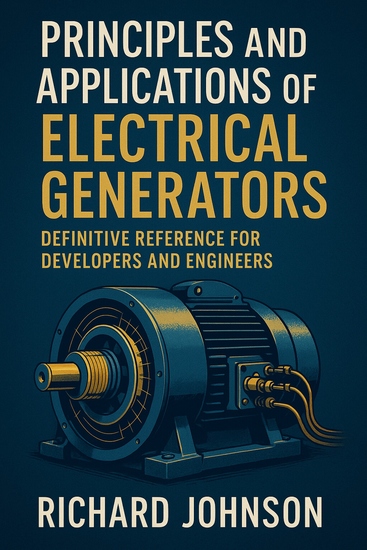
Principles and Applications of Electrical Generators - Definitive Reference for Developers and Engineers - cover

Principles and Applications of Electrical Generators - Definitive Reference for Developers and Engineers

Richard Johnson

Publisher: HiTeX Press

  • 0
  • 0
  • 0

Summary

"Principles and Applications of Electrical Generators""Principles and Applications of Electrical Generators" is an authoritative and comprehensive exploration of the science and technology underpinning modern electrical generation. Beginning with a rigorous treatment of electromagnetic theory as applied to rotating machines, the book guides readers through core principles—such as Maxwell’s equations, Faraday’s law, and magnetic circuit optimization—before advancing to the intricate behaviors that shape generator performance. With in-depth analyses of transient phenomena, flux distribution, and energy conversion, this text lays a robust theoretical foundation for students, engineers, and researchers dedicated to understanding and designing efficient generator systems.The book excels in bridging theoretical knowledge with practical design and application. Extensive chapters detail the construction, operation, and comparative performance of a wide array of generator types—from direct current and synchronous AC machines to cutting-edge brushless, permanent magnet, hybrid, and nano-scale generators. Practical engineering concerns are addressed through sections on electromagnetic design optimization, sophisticated winding techniques, cooling and insulation systems, and the application of finite element modeling. Beyond design, readers are equipped with expertise in generator control, protection, condition monitoring, and integration with advanced power electronics and smart grid infrastructures.Amidst a backdrop of transformative changes in global power systems, this volume looks ahead to the future of electrical generation. Topics such as digital twin applications, hardware-in-the-loop testing, integration with renewable and distributed resources, and the realities of cyber-physical security are presented alongside in-depth coverage of reliability engineering, international standards, and sustainability practices. “Principles and Applications of Electrical Generators” serves as an essential resource—connecting deep technical insight with the emerging challenges and innovations shaping the next generation of energy systems.
Available since: 06/09/2025.
Print length: 250 pages.

Other books that might interest you

  • Summary: The Real Anthony Fauci - Bill Gates Big Pharma and the Global War on Democracy and Public Health by Robert F Kennedy Jr: Key Takeaways Summary & Analysis Included - cover

    Summary: The Real Anthony Fauci...

    Brooks Bryant

    • 0
    • 0
    • 0
    Disclaimer: This book is not the official, but a summary & it does not accompany the official. 
    Our summary unravels the vast network of influence purportedly held by Dr. Fauci, one that extends across global health policy, prestigious institutions, and a cohort of the most powerful individuals and organizations globally. Through meticulous research, Kennedy presents a narrative where Dr. Fauci navigates the intricacies of global health, leveraging a financial powerhouse to allegedly shape narratives, control media, and dictate scientific outcomes on a global scale. 
    As you delve deeper into our summary, explore claims of dark partnerships formed in the corridors of power, from alleged alliances with pharmaceutical giants to reportedly orchestrating fraudulent studies. Kennedy unveils a landscape where, according to him, federal laws are bypassed and ethical boundaries crossed to foster personal and financial growth at the expense of the vulnerable. 
    Kennedy claims that the collaboration between Dr. Fauci and Bill Gates goes beyond mere association, morphing into an alleged powerhouse controlling a multi-billion dollar global vaccine market. The summary sheds light on assertions of a syndicate exercising unrestrained influence over global health policies, orchestrating narratives, and allegedly silencing any voice of dissent with an iron fist. 
    'The Real Anthony Fauci' seeks to awaken the populace to what Kennedy perceives as the realities behind the media portrayals, encouraging readers to question the established narratives and delve into what he presents as the untold story of a figure wielding unseen influence over a generation's health trajectory. 
    Get ready to navigate the intricate web of claims and narratives as our summary guides you through a controversial exploration, urging you to question and analyze the deep-seated systems that govern global health.
    Show book
  • Life Between the Tides - cover

    Life Between the Tides

    Adam Nicolson

    • 0
    • 0
    • 0
    Inside each rockpool, tucked into one of the infinite crevices of the tidal coastline, lies a rippling, silent, unknowable universe. Below the stillness of the surface course different currents of endless motion—the ebb and flow of the tide, the steady forward propulsion of the passage of time, and the tiny lifetimes of its creatures, all of which coalesce into the grand narrative of evolution. 


    In Life Between the Tides, Adam Nicolson investigates one of the most revelatory habitats on earth. Under his microscope, we see a prawn's head become a medieval helmet and a group of "winkles" transform a Dickensian social scene, with mollusks munching on Stilton and glancing at their pocket watches. Or, rather, is a winkle more like Achilles, an ancient hero, throwing himself toward death for the sake of glory? For Nicolson, the world of the rockpools is infinite and as intricate as our own. 


    As Nicolson journeys between the tides, both in the pools he builds along the coast of Scotland and through the timeline of scientific discovery, he is accompanied by great thinkers. We meet Virginia Woolf and her Waves; a young T. S. Eliot peering into his own rockpool in Massachusetts. And, of course, scientists populate the pages; not only their discoveries, but also their doubts and errors, their moments of quiet observation and their realizations.
    Show book
  • Quantum Computing for Beginners - Unveiling the Future of Technology and Transforming Computational Horizons - cover

    Quantum Computing for Beginners...

    Steve Abrams

    • 0
    • 0
    • 0
    Embark on a journey into the fascinating world of quantum computing with Quantum Computing for Beginners: Unveiling the Future of Technology and Transforming Computational Horizons. This comprehensive guide is designed to make the complex principles of quantum mechanics accessible to everyone, from curious enthusiasts to aspiring professionals. 
    Discover the fundamental concepts that distinguish quantum computing from classical computing, including qubits, superposition, and entanglement. Delve into the mathematics that underpins quantum theory, and explore how these principles are applied to create powerful quantum algorithms like Shor's and Grover's. 
    Learn about the various types of quantum hardware, from superconducting circuits to trapped ions, and understand the importance of quantum error correction. Get hands-on with quantum programming through user-friendly languages and development kits, and follow step-by-step examples to write your first quantum programs. 
    Explore the revolutionary applications of quantum computing in fields such as cryptography, optimization, drug discovery, and artificial intelligence. Understand the technical challenges that researchers face, and consider the ethical and societal implications of this transformative technology. 
    Quantum Computing for Beginners provides a clear, engaging introduction to one of the most exciting frontiers of modern science. With this book, you'll gain the knowledge and confidence to understand and participate in the quantum revolution. 
     
    Show book
  • Mayan Astronomy: The History of the Maya’s Measurements of the Planets and Stars - cover

    Mayan Astronomy: The History of...

    Editors Charles River

    • 0
    • 0
    • 0
    Many ancient civilizations have influenced and inspired people in the 21st century, and the Greeks and Romans continue to fascinate the West today, but of all the world’s civilizations, none have intrigued people more than the Mayans, whose culture, astronomy, language, and mysterious disappearance all continue to captivate people. In the past decade especially, there has been a renewed focus on the Mayans, whose advanced calendar led many to speculate the world would end on the same date the Mayan calendar ended in 2012.  
    	For the Maya, astronomy was not a purely scientific pursuit but intimately linked to religious, mythological, and ideological elements that were of the highest importance. The celestial realm held a sacred nature, as did the many gods and goddesses that dwelt there, so for all Mesoamerican cultures, astronomy was a fundamental part of their everyday lives. Thus, astronomy was present in their calendars, religion, and even agriculture, and in close relation to astronomy, the concept of time was also an essential part of their worldview. The Maya recorded time on almost every surface they could, including lintels, cornices, panels, stelae, friezes, ceramics, and paper. This insistence on capturing dates has led many scholars to suggest the Maya were obsessed with time. 
    The Maya had some of the most advanced astronomical measurements in the world, and their work built upon thousands of years, spanning from around 2500 BCE until the the arrival of the Spanish in 1519. Thanks to their hieroglyphic writing, archaeologists have been able to learn a wealth of information about the way they lived and their complex system of beliefs.
    Show book
  • Mastering Deep Learning - Fundamentals to Cutting-Edge Applications - cover

    Mastering Deep Learning -...

    Chuck Sherman

    • 0
    • 0
    • 0
    Dive into the captivating realm of artificial intelligence with "Mastering Deep Learning: From Fundamentals to Cutting-Edge Applications." This comprehensive guide is a must-have for both aspiring and experienced AI enthusiasts, offering an enlightening journey from the core principles of deep learning to the forefront of its revolutionary applications. 
    Unlock the mysteries of neural networks and delve into the intricate layers that power modern AI. Starting with the basics, this book provides a crystal-clear introduction to the fundamental concepts that underpin deep learning, making it accessible even to those with limited technical knowledge. As you progress, you'll grasp the inner workings of convolutional networks, recurrent networks, and attention mechanisms, gaining the knowledge needed to design your own intelligent systems. 
    What sets this book apart is its seamless transition from theory to practice. With hands-on examples and practical exercises, you'll seamlessly bridge the gap between abstract concepts and real-world implementations. Navigate through code snippets that bring algorithms to life and develop a deep intuition for their behavior. As you refine your skills, you'll find yourself ready to tackle challenges in various domains, including computer vision, natural language processing, and even advanced topics like generative adversarial networks. 
    Embark on a transformative journey that demystifies the intricacies of deep learning and propels you into the heart of AI innovation. "Mastering Deep Learning: From Fundamentals to Cutting-Edge Applications" is your essential companion in unraveling the mysteries of artificial intelligence and unleashing its boundless potential. 
     
    Show book
  • Ripple - An Intimate Exchange of Urgency and Hope Between An Ecologist and His Daughter - cover

    Ripple - An Intimate Exchange of...

    William Powers

    • 0
    • 0
    • 0
    Ripple: An Intimate Exchange of Urgency and Hope Between An Ecologist and His Daughter is a narrative of letters written by an ecologist dad to his daughter upon her coming-of-age. Drawing upon his personal history, family anecdotes, and shared memories, Powers envisions a path for humanity's reintegration with nature, and a chance to save the life force that runs through all of us. A story of separation has long gripped the human race: that people are separate—with more advanced habitats, technologies, and values—from our natural surroundings and fellow creatures. We have been told this story for generations. But as Powers watches his daughter approach adulthood, with all of society's expectations, he knows that the story we pass down has to change. In Ripple, he tells a different tale, one of community and family, inner wisdom, and shared existence within a living planet.
    Show book