Join us on a literary world trip!
Add this book to bookshelf
Grey
Write a new comment Default profile 50px
Grey
Subscribe to read the full book or read the first pages for free!
All characters reduced
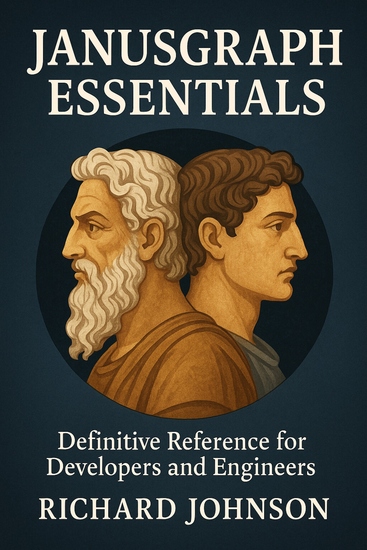
JanusGraph Essentials - Definitive Reference for Developers and Engineers - cover

JanusGraph Essentials - Definitive Reference for Developers and Engineers

Richard Johnson

Publisher: HiTeX Press

  • 0
  • 0
  • 0

Summary

"JanusGraph Essentials"JanusGraph Essentials is a definitive, in-depth guide to mastering the design, implementation, and operation of distributed graph databases using JanusGraph. This book peels back the layered architecture of JanusGraph, examining its core principles, storage abstractions, indexing integrations, and internal mechanisms that drive both scalability and reliability. Readers will gain a robust understanding of distributed transaction management, schema creation and evolution, and the intricacies of maintaining data integrity at scale, all illuminated through practical explanations and system deep-dives.With a strong emphasis on real-world applications, the book covers advanced data modeling for property graphs, efficient Gremlin traversals, and high-performance query patterns essential for analytics, recommendations, and knowledge graph deployments. It navigates the complexities of deploying JanusGraph in production—addressing high-availability, load balancing, failure recovery, and zero-downtime operations—while providing practical runbooks and DevOps automation strategies for streamlined infrastructure management. Detailed case studies, backend integration guides for Cassandra, HBase, Elasticsearch, and Solr, and comprehensive migration playbooks empower practitioners to build and operate mission-critical graph solutions.Security, compliance, and data governance are explored alongside emerging trends in graph analytics, algorithms, ETL, and visualization. Readers will find authoritative guidance on authentication, encryption, multi-tenancy, and regulatory compliance, as well as insights into the vibrant JanusGraph ecosystem, community governance, and cutting-edge research directions. Whether you are an architect, engineer, or data scientist, JanusGraph Essentials offers the knowledge and strategies to unlock the full power of distributed graph technology.
Available since: 05/30/2025.
Print length: 250 pages.


Other books that might interest you

  • Bend or Break: From Empires to Algorithms - Lessons from History on How to Make Today’s Societies More Resilient - cover

    Bend or Break: From Empires to...

    Boyson Sante

    • 0
    • 0
    • 0
    Why do some societies crumble under pressure while others rise stronger? 
    What can the past teach us about surviving the shocks of the future? 
    And how can humanity adapt in the age of AI? 
    From the fall of empires to the dawn of algorithms, "Bend or Break" reveals the hidden patterns that determine whether societies endure or collapse. Boyson Sante takes readers across centuries of upheaval—wars, migrations, pandemics, financial crashes—to uncover the forces that shape resilience. At the heart of the book lies the Adaptation Equation, a framework showing how accountable institutions, trustworthy information, and shared progress make the difference between renewal and ruin.
    Show book
  • I Never Walk the Halls Alone - cover

    I Never Walk the Halls Alone

    Donna Kincheloe

    • 0
    • 0
    • 0
    Donna, an experienced nurse, is a master storyteller. Nurses help so many people during tragedy and heartache. Walking down hospital halls can be a frightening heart-breaking experience. Yet, some degree of hope and comfort can be found through sharing life-changing true experiences from friends, patients, and family.  A Christian perspective is given as scripture is creatively threaded throughout the chapters.  Consider the gems of our private collection of personal stories that can only be enjoyed if shared. Grandma will simplify the understanding of salvation with apple pie, in "Salvation by the Slice." Meet Louie in the ICU, an underground miner who survived an accident and encountered God in the most amazing way. Enjoy the way God orchestrates life when He is "My Paul Harvey God." Perhaps in  your life the word coincidence will be transformed into God-incidence. Ponder the power available to all who pray as you examine "Quality Connections."Scripture often states God's "Expectations and Promises" are connected. The topics of honor, giving, forgiving, and love saturated with obedience are helpful reminders of what we do well and what we may consider improving. The rich messages of "The Whatever Principle" will be familiar to so many. The chapters, "God's Gear" and "Enemy Tactics" shine a new perspective on those who choose to threaten or tarnish a persons reputation. And the chapter, "Are you Looking for a Sign" shares one of my favorite memories of a family of strong faith in the face of a loved one's death. Come seeking and you're sure to find;A blessing for your heart and mind,Some comfort for your pain.Listen to these words and I will tellstories that can make you well.God's grace will fall like rain.Lay down your heartaches and your fears.Accept His love. Let Him draw near.Your life will never be the same!Donna
    Show book
  • Machine Learning with Python - Advanced Methods and Strategies to Learn Machine Learning with Python - cover

    Machine Learning with Python -...

    Alexander Cane

    • 0
    • 0
    • 0
    Ways to combat retraining depend on the algorithm and consist of the correct values of the trainer's met parameters. In practice, model estimation is not performed on the same input data that was used to train the model. Divide 10-20% of all available data into a separate set and call it a set for evaluation. We will bring the other 10-20% into the set for ratification, and 60-80% of the remaining ones will be given to the trainer. The principle of data sharing depends on the data and the task. Random sampling is often a good method if inputs are independent of each other, and there is no strong imbalance between the number of positive and negative entries. 
    The intuitive analogy here is the same as with university studies: the teacher solves some problems with students in pairs and gives other’s similar tasks in the exam. What is important here (both in teaching students and models) is that these tasks are varied, and students cannot simply memorize the answers, and those who have mastered the material (similar tasks) will be able to repeat the thought process and answer correctly. 
    In machine learning, we split into data two sets: we will use the evaluation set to evaluate each model we train, using different approaches, algorithms, and model types to select the best one. That is, for each model, we will have two precision values - precision on the training dataset and precision on the evaluation dataset. It is normal for the former to be higher than the second, but not significantly. A big difference indicates retraining.
    Show book
  • Neurodiversity - A Very Short Introduction - cover

    Neurodiversity - A Very Short...

    Sue Fletcher-Watson, Robert Chapman

    • 0
    • 0
    • 0
    Neurodiversity is the idea that human brains function in a variety of ways. By understanding that people take in, process, and respond to information differently, we can appreciate how these profound differences affect the ways in which we experience the world and form relationships with one another. In spite of the central simplicity of this concept, the consequences of fully understanding and exploring neurodiversity can be transformative. 
     
    This Very Short Introduction looks at how neurodiversity has been understood in a variety of settings including education, research, workplace, health and social care, and criminal justice. Robert Chapman and Sue Fletcher-Watson also draw out interesting connections to models of disability, human rights, anti-capitalism, and intersectionality. Alongside this, they discuss how issues of gender, sexuality, neuroqueering, and decoloniality bear on neurodiversity. The book is an engaging listen for students, thinkers, and practitioners interested in neurodiversity and its links to philosophy, psychology, sociology, political theory, medicine, and biology.
    Show book
  • Critical Moral Reasoning - An Applied Empirical Ethics Approach - cover

    Critical Moral Reasoning - An...

    Mark T Holcombe

    • 0
    • 0
    • 0
    This textbook introduces students to contemporary moral issues through a casuistry-based approach. Unlike traditional anthologies, it emphasizes case based reasoning and empirical evidence to strengthen critical moral analysis. Students learn to distinguish legality from morality, formulate moral arguments, and apply normative theories such as utilitarianism, deontology, virtue ethics, and feminist ethics of care. 
    Through authentic case studies ranging from tipping and piracy to abortion, civil protest, and AI ethics, the book provides an engaging framework for developing moral reasoning skills essential for today’s complex ethical landscape.
    Show book
  • Cybersecurity for Executives - A practical guide to digital risk safer decisions and better security awareness for modern leaders - cover

    Cybersecurity for Executives - A...

    Claire Donnelly

    • 0
    • 0
    • 0
    Digital risk is no longer a technical byproduct. It is the primary friction point between your corporate strategy and market extinction. For decades, executives delegated cybersecurity to IT departments, treating it as an operational utility. That era is dead. Today, the velocity of cyber threats outpaces the traditional defenses of the average enterprise.


    Cybersecurity for Executives is a practical guide to digital risk, safer decisions, and better security awareness for modern leaders. This book strips away the technical jargon and provides a framework for leaders to oversee their organization’s most valuable assets. You will learn how to:
     
    - Assess and manage strategic cyber risks.
     
    - Build a resilient culture of security from the top down.
     
    - Govern cybersecurity effectively to prevent brand-shattering breaches.
     
    - Secure supply chains and third-party vendor relationships.
     
    - Future-proof your strategy against emerging technologies.


    If you view security as a checklist for your technicians, you have already surrendered control of your organization’s future. It is time to treat digital stewardship as a fundamental executive mandate.
    Show book