Join us on a literary world trip!
Add this book to bookshelf
Grey
Write a new comment Default profile 50px
Grey
Subscribe to read the full book or read the first pages for free!
All characters reduced
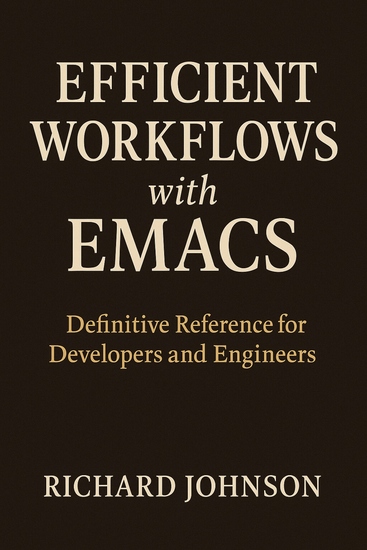
Efficient Workflows with Emacs - Definitive Reference for Developers and Engineers - cover

Efficient Workflows with Emacs - Definitive Reference for Developers and Engineers

Richard Johnson.

Publisher: HiTeX Press

  • 0
  • 0
  • 0

Summary

"Efficient Workflows with Emacs"Unlock the full potential of Emacs with "Efficient Workflows with Emacs," a comprehensive guide designed for advanced users and professionals seeking to optimize every aspect of their digital work environment. This book meticulously explores the core architecture and unique extensibility of Emacs, empowering readers to refine multitasking with sophisticated buffer, window, and frame management. From mastering navigation and rapid command completion to fine-tuning keybindings and startup performance, each chapter delivers actionable insights into transforming Emacs into a seamless powerhouse for productivity.Diving beyond the basics, the book delves into advanced text manipulation, programming environments, and robust knowledge management with Org-mode. Readers will discover expert techniques for automated editing, structural code navigation, project management, and language integration, bringing together tools like Projectile, LSP, and REPL interfaces for efficient development cycles. The Org-mode section demonstrates how to leverage Emacs as a true productivity hub—streamlining task management, note-taking, publishing, and implementing powerful knowledge workflows including Zettelkasten and reproducible research practices.In today’s interconnected world, "Efficient Workflows with Emacs" addresses the crucial demands of integration with external services, version control, automation, and system reliability. Comprehensive chapters cover email, scheduling, remote file editing, Git workflows, continuous integration, and batch processing—making Emacs the command center for coding, communication, and collaboration. Performance engineering, security, and future-facing strategies ensure readers are equipped to evolve alongside emerging technologies, making this volume an indispensable resource for anyone committed to mastering the modern Emacs ecosystem.
Available since: 06/08/2025.
Print length: 250 pages.

Other books that might interest you

  • Comprehensive Guide to Machine Learning for Beginners - Mastering the Basics - cover

    Comprehensive Guide to Machine...

    SAM CAMPBELL

    • 0
    • 0
    • 0
    In this accessible and engaging guide, we take you on a step-by-step exploration of machine learning, breaking down complex ideas into bite-sized pieces for beginners. Whether you're a student, professional, or someone curious about the future of technology, this book equips you with the knowledge needed to navigate the exciting field of machine learning. 
    "Comprehensive Guide to Machine Learning for Beginners: " is your comprehensive guide to unraveling the complexities of machine learning. Empower yourself with the knowledge to contribute to the exciting and rapidly evolving world of artificial intelligence. Whether you're taking your first steps or seeking to deepen your understanding, this book is your key to unlocking the potential of machine learning. Start your journey today! 
     
    Show book
  • Quantum God : At the Center of Reality - An Invitation to Explore the Intersection Between Quantum Physics and the Divine - cover

    Quantum God : At the Center of...

    Ecnal Ver

    • 0
    • 0
    • 0
    A New Way to Think About God 
    For centuries, people have struggled to bring together faith and science. Religion taught one way. Science often taught another. Quantum God: At the Center of Reality invites you to see both through fresh eyes. This audiobook explores the idea that God is not far away or divided from science, but instead is the very center of all reality. 
    From Tradition to New Ideas 
    Part One explains traditional views of God and why religion and science have often seemed in conflict. It then introduces a new perspective, one that does not force you to choose between faith and facts, but instead shows how they can work together. 
    The Quantum God Revealed 
    Part Two introduces the Quantum God, described as a unified force that holds everything together. You will hear about evidence for this reality and discover how the Quantum God can be seen even in worship and spiritual practice. The goal is to show that God’s presence is not limited to one place but is active everywhere, in all things. 
    Practical Ways to Experience the Quantum God 
    In Part Three, you will learn how this understanding changes daily life. Topics include how prayer and faith connect with quantum healing, how the Quantum God works for the greater good, and how lives intersect in a reality where everything is linked. You will also discover how to see the Quantum God at work in ordinary moments. 
    God in the Modern World 
    Part Four brings the message into today’s world. It explains how practicing faith with an awareness of the Quantum God can be a living religious practice. It explores the bridge between faith, quantum physics, and even artificial intelligence. It connects this vision with scripture, humanity, and the vast quantum universe itself. 
    Why You Will Love this Book 
    Quantum God is for seekers who want answers that make sense in both science and faith. It offers clarity, hope, and a practical path to live with purpose in a connected universe.
    Show book
  • Building Model-based Enterprise Architecture - Implementing model-based enterprise architecture with Sparx EA MDG and the TOGAF Standard - cover

    Building Model-based Enterprise...

    Mudar Bahri

    • 0
    • 0
    • 0
    DESCRIPTION  
    Building trust with your business stakeholders starts with providing them with accurate, up-to-date information. This book shows you how to create a unified enterprise architecture repository, a central database for all your diagrams, catalogs, and other artifacts. Information supporting stakeholders' decisions may be delivered through a single artifact or a combination of multiple artifacts. 
    This book systematically covers the entire process, starting with a crash course in Sparx EA and mastering the principles of Model Driven Generation (MDG) to build a custom metamodel. You will then learn how to structure your repository and model key architectural artifacts, including business capabilities, projects, applications, data integrations, and technology environments like the cloud. The book also provides detailed guidance on modeling business services, organizational structures, and strategies. Finally, you will discover crucial repository management processes and learn to publish your artifacts as professional documents or web content for wider consumption. 
    By the end of this book, you will be fully competent in using Sparx EA to build, manage, and publish a professional-grade EA repository. This expertise will enable you to effectively analyze, communicate, and drive strategic change within your organization, making you a vital asset in any enterprise architecture team. 
    WHAT YOU WILL LEARN 
    ● Developing a custom metamodel using MDG. 
    ● Maintaining EA artifacts and diagrams. 
    ● Distinguishing between physical, logical, and conceptual models.  
    ● Learn the TOGAF 10 content metamodel through practical EA workspace examples.
    Show book
  • Get Up! - Why Your Chair Is Killing You and What You Can Do about It - cover

    Get Up! - Why Your Chair Is...

    James A. Levine

    • 0
    • 0
    • 0
    From the codirector of the Mayo Clinic / Arizona State University Obesity Solutions Initiative and inventor of the treadmill desk comes a fascinating wake-up call about our sedentary lifestyle. 
    That the average adult spends 50 to 70 percent of their day sitting is no surprise to anyone who works in an office environment. But few realize the health consequences they are suffering as a result of modernity's increasingly sedentary lifestyle, or the effects it has had on society at large. In Get Up!, health expert James A. Levine's original scientific research shows that today's chair-based world, where we no longer use our bodies as they evolved to be used, is having negative consequences on our health, and is a leading cause of diabetes, cancer, and heart disease. Over the decades, humans have moved from a primarily active lifestyle to one that is largely sedentary, and this change has reshaped every facet of our lives—from social interaction to classroom design. Levine shows how to throw off the shackles of inertia and reverse these negative trends through simple changes in our daily lives.
    Show book
  • Stone by Stone - The Magnificent History in New England's Stone Walls - cover

    Stone by Stone - The Magnificent...

    Robert M. Thorson

    • 0
    • 0
    • 0
    There once may have been 250,000 miles of stone walls in America's Northeast, stretching farther than the distance to the moon. And even though most are crumbling today, they contain a magnificent scientific and cultural story. 


    Stone walls tell nothing less than the story of how New England was formed, and in Robert Thorson's hands they live and breathe. Millions of years ago, New England's stones belonged to ancient mountains thrust up by prehistoric collisions between continents. Buried again over centuries by forest and soil buildup, the stones gradually worked their way back to the surface, only to become impediments to the farmers cultivating the land in the eighteenth century, who piled them into "linear landfills," a place to hold the stones. Usually the biggest investment on a farm, often exceeding that of the land and buildings combined, stone walls became a defining element of the Northeast's landscape, and a symbol of the shift to an agricultural economy. 


    Stone walls layer time like Russian dolls, their smallest elements reflecting the longest spans, and Thorson urges us to study them, for each stone has its own story. Linking geological history to the early American experience, Stone by Stone presents a fascinating picture of the land the Pilgrims settled, allowing us to see and understand it with new eyes.
    Show book
  • Redefining the Boundaries of Medicine - The High-Tech High-Touch Path Into the Future - cover

    Redefining the Boundaries of...

    Paul Cerrato, John D. Halamka

    • 0
    • 0
    • 0
    Health care as it stands today needs to be re-imagined. Redefining the Boundaries of Medicine by Paul Cerrato and Dr. John Halamka challenges the profession to renegotiate its priorities and address the fact that it’s become timid and reluctant to explore new care delivery models. The guiding premise of this book is that rethinking and reimagining the way medicine is practiced in the 21st century will improve health outcomes, and that technology is central to this transformation. Dr. Halamka is the President and Paul Cerrato is the Senior Research Analyst and Communications Specialist for Mayo Clinic Platform, which is harnessing novel technologies to change how care is provided. This cutting-edge work, along with their combined 80 years of experience in healthcare, afford Dr. Halamka and Mr. Cerrato authoritative voices in technology and health care. This book shows how one-size-fits-all health care is slowly giving way to a more precise, personalized approach that takes into account each person’s unique environmental and genetic risk factors. It discusses the use of several emerging technological tools that give each patient a unique “topographical map” to navigate their journey. Artificial intelligence in health care must be accurate, equitable and ethical; providers need to embrace a better way to predict diseases, identify effective treatments and rethink much of the conventional wisdom that has been handed down over the decades. Redefining the Boundaries of Medicine provides the guide to doing just that.
    Show book