Join us on a literary world trip!
Add this book to bookshelf
Grey
Write a new comment Default profile 50px
Grey
Subscribe to read the full book or read the first pages for free!
All characters reduced
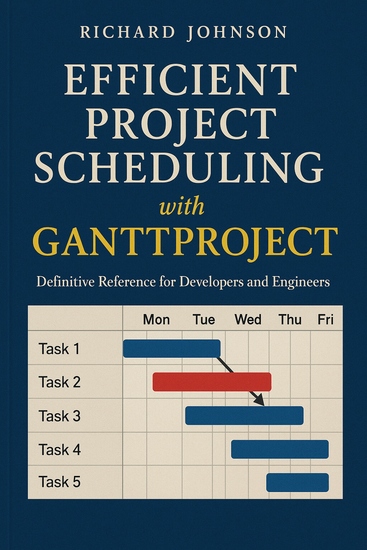
Efficient Project Scheduling with GanttProject - Definitive Reference for Developers and Engineers - cover

Efficient Project Scheduling with GanttProject - Definitive Reference for Developers and Engineers

Richard Johnson

Publisher: HiTeX Press

  • 0
  • 0
  • 0

Summary

"Efficient Project Scheduling with GanttProject""Efficient Project Scheduling with GanttProject" is a comprehensive technical guide for advanced project managers, systems architects, and software engineers seeking to master project scheduling using GanttProject. The book starts by delving into sophisticated scheduling concepts, exploring both the theoretical underpinnings—such as critical path analysis, risk modeling, and resource optimization—and their application within complex technical environments. By introducing frameworks for aligning business requirements with actionable project schedules, it equips readers to manage dependencies, model uncertainties, and optimize timelines efficiently.Building on this foundation, the guide dissects GanttProject’s system architecture, elaborating on its extensible plugin infrastructure, data persistence models, and integration with industry-standard tools like MS Project and enterprise version control systems. The text moves seamlessly between the conceptual and the practical: readers learn to configure advanced schedules, manage heterogeneous resources, enforce governance, and automate workflows through API integrations and custom scripting. Special emphasis is placed on collaboration in multi-user environments, large-scale interoperability, and portfolio-level coordination across diverse project ecosystems.To reinforce learning and bridge theory with practice, "Efficient Project Scheduling with GanttProject" concludes with in-depth case studies drawn from engineering, aerospace, disaster response, and IT sectors. These real-world scenarios showcase iterative and agile scheduling, automated data-driven schedule generation, and best practices for securing project artifacts and meeting regulatory standards. The book offers not only the tools to build robust, responsive, and scalable project schedules, but also the strategic insight to anticipate challenges and lead complex technical projects to successful completion.
Available since: 06/09/2025.
Print length: 250 pages.


Other books that might interest you

  • Insulin - A Hundred-Year History - cover

    Insulin - A Hundred-Year History

    Stuart Bradwel

    • 0
    • 0
    • 0
    In 1922, researchers made one of the most important medical breakthroughs of the century: insulin. Their discovery seemed miraculous. When it was given to diabetic patients on the brink of death, their condition rapidly improved. 


    However, this was no simple cure. Injections must be taken for life. Without them, symptoms quickly return, often with fatal results. But while a lifetime on insulin poses great challenges, it also offers opportunities. In this revelatory history, Stuart Bradwel looks back on one of medicine's most celebrated innovations. Setting professional narrative against subjective patient experience, he tells the story of a drug that has challenged many of the basic assumptions upon which medical practice is built, both inside and outside the clinic. 


    Nevertheless, Bradwel reminds us that the centenary of this apparent "wonder drug" should be no cause for celebration. Insulin often remains inaccessible to those who need it most: elusive prescriptions, uneven availability and sky-high prices result in rationing and desperate do-it-yourself research and development. In the face of bootstraps rhetoric and "Pharma Bro" capitalists, patients across the world are left to fend for themselves. There is a long way to go in the twenty-first century until insulin truly fulfills the extraordinary promises made by its discovery.
    Show book
  • The Lost Family - How DNA Testing Is Upending Who We Are - cover

    The Lost Family - How DNA...

    Libby Copeland

    • 0
    • 1
    • 0
    “A fascinating exploration of the mysteries ignited by DNA genealogy testing—from the intensely personal and concrete to the existential and unsolvable.” —Tana French, New York Times–bestselling author  
     
    You swab your cheek or spit in a vial, then send it away to a lab somewhere. Weeks later you get a report that might tell you where your ancestors came from or if you carry certain genetic risks. Or, the report could reveal a long-buried family secret that upends your entire sense of identity. Soon a lark becomes an obsession, a relentless drive to find answers to questions at the core of your being, like “Who am I?” and “Where did I come from?” Welcome to the age of home genetic testing. 
     
    In The Lost Family, journalist Libby Copeland investigates what happens when we embark on a vast social experiment with little understanding of the ramifications. She explores the culture of genealogy buffs, the science of DNA, and the business of companies like Ancestry and 23andMe, all while tracing the story of one woman, her unusual results, and a relentless methodical drive for answers that becomes a thoroughly modern genetic detective story. Gripping and masterfully told, The Lost Family is a spectacular book on a big, timely subject. 
     
    “An urgently necessary, powerful book that addresses one of the most complex social and bioethical issues of our time.” —Dani Shapiro, New York Times–bestselling author 
     
    “Before you spit in that vial, read this book.” —The New York Times Book Review 
     
    “Impeccably researched . . . up-to-the-minute science meets the philosophy of identity in a poignant, engaging debut.” —Kirkus Reviews (starred review)
    Show book
  • The Health Code - Aligning the Mind and Body for Optimal Wellness - cover

    The Health Code - Aligning the...

    John Daugherty, Dr. John Demartini

    • 0
    • 0
    • 0
    This audiobook production contains a supplemental PDF. Please see your audiobook listening platform's FAQs for how to access the PDF or contact them for more details. 
    Does your well-being hold you back? 
    Discover effective techniques to synergize your mental and physical needs and radically transform your life and regain your innate balance today! 
    Do your aches and pains plague you every day? Does it feel like your body is working against you? Is constant suffering getting in the way of joy? Chiropractic physician Dr. John Daugherty has over thirty-five years of experience as a healer and has helped countless clients unlock their natural potential. Now he’s here to share his therapeutic wisdom to help practitioners and patients alike find deep and impactful healing. 
    The Health Code: Aligning the Mind and Body for Optimal Wellness is an insightful system for tapping into your anatomy’s raw curative power. Full of energizing know-how, cathartic journaling exercises, and transformative visualizations, Dr. Daugherty presents his methods in an easily understood and accessible format. Using these innovative tactics, you’ll form a deeper link to your inner rhythms and finally reclaim your best soul-driven life. 
    In The Health Code, you’ll discover:Buddhist-inspired belly breathing to increase your focus and enjoy the momentHow to let go through breathwork to release trapped emotions and live more freelyWays to move past your mental blocks using the amazing gift of focused visualizationsThe power of ice cube therapy to let out pent up anger and melt into a more peaceful existenceEnlightening professional anecdotes, the means to manifest through beautiful meditations, the connective strength of empathic listening, and much, much more!
    Show book
  • End of Abundance in Tech - How IT Leaders Can Find Efficiencies to Drive Business Value - cover

    End of Abundance in Tech - How...

    Ben DeBow

    • 0
    • 0
    • 0
    Sustainable Tech Solutions for Enterprise Scalability 
     
    The modern economy runs on technology; it is the backbone of all major businesses. From firing packets of information between customers and websites to tracking customer demographics and purchase history–every bit of information that occurs online is captured through data. As businesses scale and transactions grow, the volume of data (and the number of servers required to store it) creates an increasingly complex environment that makes managing and monitoring the overall health of your organization’s technology stack a dizzying task for even the most well-informed IT professional. 
     
    Fortunately for today’s CDOs, CTOs, CIOs, and even CFOs, the founder and CEO of Fortified, a leading database managed service provider, Ben DeBow has written End of Abundance in Tech: How IT Leaders Can Find Efficiencies to Drive Business Value. 
     
    DeBow’s patent-pending approach allows IT executives to: 
    Develop a technology environment that’s more efficientIncrease server resource productivityProvide better financial transparency into the technology costsOptimize system scalability, performance, and stabilityPotentially save millions that were previously tied up in inefficient technology practices 
     
    To determine the health, efficiency, and capacity of their systems, leaders need solutions they can act on. Yet, many technology leaders lack real insights into the health of their technology environment at the organizational level. In a refreshing shakeup of the status quo, DeBow’s book equips IT executives with actionable solutions for managing and monitoring technology health so they can maximize the efficiency of the enterprise’s entire tech stack and deliver measurable value to the bottom line.
    Show book
  • Milo the Magic Mudskipper - A Nursery Rhyme - cover

    Milo the Magic Mudskipper - A...

    Christopher Allen

    • 0
    • 0
    • 0
    "Milo, the Magic Mudskipper" is an enchanting nursery rhyme that follows six-year-old siblings Charlie and Daphne on a magical underwater adventure. While crabbing at Mudeford Quay in Dorset, England, the children discover Milo, a talking mudskipper from Australia who has become lost after accidentally boarding a ship that carried him far from his mangrove home. 
    Milo possesses magical abilities that allow him to share his amphibious powers with the children, enabling them to breathe underwater and embark on a quest to Neptune's palace in the ocean depths. Their mission: to obtain a magical compass that will guide Milo safely home across the vast seas. 
    The trio faces three challenging trials in Neptune's underwater kingdom: the Riddle Deep, the Trial of Courage, and the Test of Heart. Through these adventures, they learn valuable lessons about friendship, bravery, and selflessness. When faced with choosing between helping Milo or a lost baby whale, they discover that true friendship means putting others' needs first. 
    Neptune, impressed by their noble hearts, rewards them with multiple magical compasses, ensuring both Milo and the whale can find their way home. The story concludes with Milo's joyful return to Australia and the establishment of a lasting friendship maintained through magical shells that allow the friends to communicate across the oceans. 
    Written in traditional nursery rhyme style with consistent AABB rhyme schemes, repetitive phrases, and musical rhythm, the tale emphasizes themes of friendship, courage, environmental awareness, and the magic that exists when we help others in need. 
    The opening music, is a lovely clear female vocal expressing the character of this nursery rhyme runs to nearly four minutes. 
    The appropriate background flutey music gives a happy atmosphere to the narration, and the closing music is an instrumental version of the same type of genre and instruments as the opening music and runs to about three minutes.
    Show book
  • Baikonur Man - Space Science American Ambition and Soviet Chaos at the Cold War's End - cover

    Baikonur Man - Space Science...

    Barry L. Stoddard

    • 0
    • 0
    • 0
    Against the backdrop of the late Cold War, a tiny American start-up company forged a secret deal to place American scientific payloads aboard the Soviet space station MIR. Born out of sheer desperation after the Challenger explosion and grounding of the United States space shuttle program, the agreement was negotiated and approved behind the backs of NASA and Congress, with the help of United States government officials inside the Commerce and Defense departments. 


    On a cold gray morning in February 1988, the company founder met with three graduate students and their professor at the Massachusetts Institute of Technology to put his plans into action. Baikonur Man, written by one of those students, recounts the subsequent five-year saga of how science, comradery, hardship, drama, and occasional lunacy led to the first American experiments and payloads to fly on Russian rockets.
    Show book