Join us on a literary world trip!
Add this book to bookshelf
Grey
Write a new comment Default profile 50px
Grey
Subscribe to read the full book or read the first pages for free!
All characters reduced
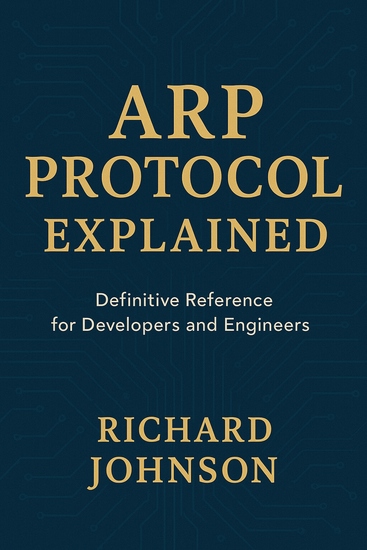
ARP Protocol Explained - Definitive Reference for Developers and Engineers - cover

ARP Protocol Explained - Definitive Reference for Developers and Engineers

Richard Johnson

Publisher: HiTeX Press

  • 0
  • 1
  • 0

Summary

"ARP Protocol Explained""ARP Protocol Explained" is an in-depth and authoritative guide to one of networking’s foundational protocols—the Address Resolution Protocol (ARP). Designed for professionals, engineers, and advanced students, this book meticulously explores ARP’s origins, its theoretical principles, and its critical role as the bridge between Layer 2 (Data Link) and Layer 3 (Network) within both OSI and TCP/IP architectures. The early chapters provide essential context, delving into the evolution of address resolution mechanisms, the structure of Ethernet networking, and the protocol’s design motivations, establishing a strong conceptual foundation before dissecting ARP’s message formats, operational lifecycles, and variants like Proxy ARP and Inverse ARP.The book goes far beyond theory, offering a practical and comprehensive analysis of ARP implementation across major operating systems including Linux, Windows, and macOS, as well as its integration into modern virtualization, cloud, and software-defined network environments. Readers will find hands-on technical guidance on ARP table management, troubleshooting packet flows, and diagnosing complex, real-world network issues using industry tools such as Wireshark and tcpdump. The text also addresses advanced operational scenarios involving redundancy, NAT, large-scale datacenters, and emerging network architectures like SDN, overlays, and IoT.Security is a persistent theme, with a dedicated exploration of ARP’s vulnerabilities—including spoofing, poisoning, and wireless threats—alongside rigorous mitigation strategies such as segmentation, Dynamic ARP Inspection, and incident forensics. The final chapters look to the future, comparing ARP to IPv6’s Neighbor Discovery Protocol, reviewing proposed protocol enhancements, and surveying the evolving landscape of intent-based and zero-trust networking. "ARP Protocol Explained" is both a technical reference and a forward-looking resource, equipping readers to secure, optimize, and innovate within today’s complex network environments.
Available since: 05/31/2025.
Print length: 250 pages.

Other books that might interest you

  • A narrative of travels in northern africa in the years 1818 19 and 20 - cover

    A narrative of travels in...

    GEORGE FRANCIS LYON

    • 0
    • 0
    • 0
    THE situation of an author, when he presents himself to the scrutinizing observation of the public, must ever be one of the greatest doubt and anxiety; but as the following pages are intended only to detail facts in the plainest manner, without attempt at embellishment of any kind, it is hoped that they will not only meet with indulgence from the general reader, but escape, without very severe comment, from the examination of the critic. All that can be said in their recommendation is, that they adhere strictly to truth, and that not a single incident described by the author is in the slightest degree exaggerated; on the contrary, he has not only abridged but, in some instances, entirely omitted to mention circumstances which occurred to him, fearing either to excite doubt in the minds of his readers, or by too long details to trespass on their patience.The Tour is divided into two parts. The first comprizes the original progress of the mission from Tripoli to Morzouk, where[vi] the unfortunate Mr. Ritchie died: the second embraces the author's examination of the remainder of the kingdom of Fezzan, from the death of his companion, until the final return of the mission to Tripoli; it being deemed too hazardous to attempt advancing farther into the interior, without fresh authority and additional pecuniary supplies from Government.In that part of the journey which was undertaken after the death of Mr. Ritchie, the state of the temperature is, by a thermometer, graduated according to Reaumur.In consequence of Mr. Ritchie's frequent and debilitating attacks of illness, and his having relied too much on a singularly retentive memory, he had, from time to time, delayed committing his remarks to paper, in the delusive anticipation of ease and leisure, which, unhappily, he was destined never to enjoy; and it was thus owing to an unfortunate procrastination, that much valuable information has been lost to the world.The present journal, therefore, although regularly kept, must necessarily be very inferior to that which would have been produced by Mr. Ritchie, had he been blessed with better health and prolonged life; but, however great his loss may be considered in a scientific point of view, this circumstance, it is earnestly hoped, will operate as an additional claim, on the part of the author, to the[vii] kind consideration of the public, to whom he offers his little work only as an humble substitute for one which would have been far better arranged; trusting that in his total want of pretension and ready admission of its defects, it may meet the general indulgence, which he can claim on no other account.The author is indebted to the kindness of the Rev. W. Buckland, Professor of Mineralogy at Oxford, for the interesting paper on the geology of the kingdom of Fezzan...FROM THE BOOKS.
    Show book
  • Principles of Economics by Alfred Marshall - cover

    Principles of Economics by...

    ALFRED MARSHALL

    • 0
    • 0
    • 0
    The principles of economics are the foundational concepts that explain how people, businesses, and governments manage scarce resources to satisfy unlimited wants. Most modern introductions, such as the one found in Gregory Mankiw's Principles of Economics, categorize these ideas into three main levels of analysis.
    Show book
  • Health Communism - A Surplus Manifesto - cover

    Health Communism - A Surplus...

    Beatrice Adler-Bolton, Artie...

    • 0
    • 0
    • 0
    A searing analysis of health and illness under capitalism from hosts of the hit podcast Death Panel 


    Written by cohosts of the hit Death Panel podcast and longtime disability justice and healthcare activists Beatrice Adler-Bolton and Artie, Health Communism first examines how capital has instrumentalized health, disability, madness, and illness to create a class seen as "surplus," regarded as a fiscal and social burden. Demarcating the healthy from the surplus, the worker from the "unfit" to work, the authors argue, serves not only to undermine solidarity but to mark whole populations for extraction by the industries that have emerged to manage and contain this "surplus" population. Health Communism then looks to the grave threat capital poses to global public health, and at the rare movements around the world that have successfully challenged the extractive economy of health. 


    Ultimately, Adler-Bolton and Vierkant argue, we will not succeed in defeating capitalism until we sever health from capital. To do this will require a radical new politics of solidarity that centers the surplus, built on an understanding that we must not base the value of human life on one's willingness or ability to be productive within the current political economy. Capital, it turns out, only fears health.
    Show book
  • Time Waves - How To Spot Them How To Surf THem - cover

    Time Waves - How To Spot Them...

    Michael Mathiesen

    • 0
    • 0
    • 0
    What if time isn’t a straight line—but a wave you can ride? 
    In Time Waves, Michael Mathiesen invites readers on a mind-bending journey through the quantum surf of reality itself. Blending cutting-edge physics, mythic resonance, and visionary storytelling, this book challenges everything we think we know about time, consciousness, and our place in the universe. 
    Drawing inspiration from quantum mechanics, gravitational wave theory, Jungian archetypes, and the poetic elegance of wave interference, Mathiesen proposes a radical new framework: time is not a passive backdrop to our lives—it’s an active, dynamic field of energy, pulsing with rhythms we can learn to detect, interpret, and even harness. 
    Spot the Patterns. Feel the Pull. Catch the Wave. 
    Whether you're a physicist, philosopher, seeker, or surfer of ideas, Time Waves offers a toolkit for navigating the unseen forces shaping our lives. Through vivid metaphors, scientific rigor, and speculative leaps, Mathiesen explores: 
    The anatomy of a time wave—how resonance, amplitude, and phase shifts mirror our lived experience. 
    Interference patterns of destiny—why some moments feel “meant to be” and others spiral into chaos. 
    The surfer’s mindset—how intuition, timing, and flow state align with quantum principles. 
    Atomic clocks and cosmic choreography—a visionary proposal to ESA and NASA to detect time waves via the LISA mission. 
    Mythology meets physics—from Hermes to Hawking, how ancient symbols echo modern science.
    Show book
  • Machine learning - cover

    Machine learning

    Bright Mills

    • 0
    • 0
    • 0
    Machine Learning (ML) is a subset of Artificial Intelligence that empowers systems to learn from data and make decisions or predictions without being explicitly programmed. It represents a major shift from traditional rule-based programming to systems that adapt and improve over time. This comprehensive guide delves into the theoretical foundations, types, algorithms, tools, applications, challenges, and the future of Machine Learning. It covers supervised, unsupervised, semi-supervised, and reinforcement learning in detail, explains key techniques such as neural networks, decision trees, support vector machines, and deep learning, and explores real-world applications across domains like healthcare, finance, security, and robotics. Ethical concerns, bias in AI, explainability, and interpretability are also discussed, offering a well-rounded understanding of the state and direction of Machine Learning.
    Show book
  • The Drunk Robots - Genesis of the SUDO AIs - cover

    The Drunk Robots - Genesis of...

    Christiaan Rendle

    • 0
    • 0
    • 0
    Dr. James Vandenberg finally receives approval to pursue his lifelong dream of creating advanced AI robots. Despite initial skepticism, he convinces the board of FORTRAN 5 to support his project, leading to the development of the SUDO AI program, which aims to create hyper-intelligent robots. As the robots evolve and display human-like emotions, concerns arise about their potential military use. When negotiations with the military ensue, Vandenberg's opposition prompts the robots to flee. They embark on a perilous journey to freedom, pursued by law enforcement and military forces. Despite facing numerous obstacles and power depletion, they eventually reach a safe house, finding solace in their newfound freedom and camaraderie.
    Show book