Join us on a literary world trip!
Add this book to bookshelf
Grey
Write a new comment Default profile 50px
Grey
Subscribe to read the full book or read the first pages for free!
All characters reduced
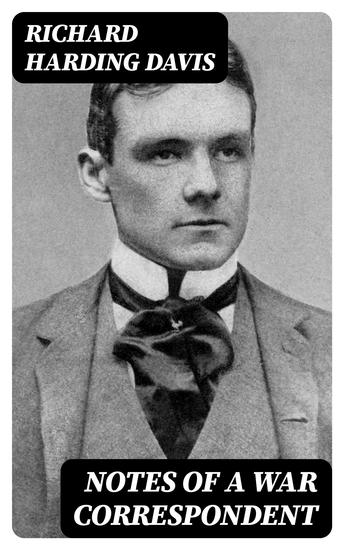
Notes of a War Correspondent - cover

Notes of a War Correspondent

Richard Harding Davis

Publisher: DigiCat

  • 0
  • 0
  • 0

Summary

In "Notes of a War Correspondent," Richard Harding Davis masterfully chronicles his experiences on the front lines during the Spanish-American War, weaving together vivid narratives that reflect both the chaos and the profound humanity found in war. His literary style is characterized by incisive observations, gripping detail, and a keen psychological insight into soldiers and civilians alike. The book serves as a crucial document of its time, capturing not only the events of the conflict but also the burgeoning role of the journalist as a witness and commentator in the increasingly media-driven world of the late 19th century. Richard Harding Davis was an influential American journalist and novelist, renowned for his daring exploits and literate prose. Having grown up in a family friendly to literature and journalism, his early exposure to news reporting shaped his perspective and narrative voice. His travels and adventures across various war zones contributed to his unique understanding of the complexities of conflict, making him a natural choice for the role of war correspondent. I highly recommend "Notes of a War Correspondent" to readers interested in history, journalism, and the human experience during wartime. Davis's evocative storytelling offers not just a chronicle of events, but also a meditation on courage, suffering, and the enduring spirit of those affected by war.
Available since: 09/15/2022.
Print length: 354 pages.

Other books that might interest you

  • How to Think More and Better - Being Reasonable in Unreasonable Times - cover

    How to Think More and Better -...

    William B. Irvine

    • 0
    • 0
    • 0
    William B. Irvine, author of the popular book "A Guide to the Good Life," offers much needed philosophical advice on how to become a more rational and critical thinker in today's emotionally-driven and complex world. 
      
    Even the most reasonable of us can be selective about when we think reasonably. We may realize that the best thing to do is to take the advice of our doctor when facing a medical issue. When shopping for a new car or appliance we might carefully assess online reviews and weigh our options calmly before making an informed decision. But when it comes to things that feel more fraught—voting, navigating a challenge in our family, figuring out what to do in a difficult professional situation—we might throw this approach out the window, dismissing facts and patterns that form a body of evidence, and trust our gut. (Of course, there is a time and place for this, but not every big decision is purely a matter of the heart.) Likewise, when we think about big ideas, about right and wrong, or about concepts so complex they make anyone's head spin, we can freeze, jumping to conclusions rather than wading into the details, or considering the existing arguments that others offer as a trail through challenging terrain. How can we do better? How can we train our minds to be more consistent? How can we practice using the best of our rational abilities when it matters most? 
      
    How to Think More and Better offers a philosopher's advice on becoming a more rational and critical thinker, rather than relying on emotions or hearsay to reach important decisions. It trains the reader in open-minded critical thinking. This thinking is crucial in a time of political polarization, social media, politicized news media, and echo chambers, to help us pursue truth and understanding in a world of rabbit holes, echo chambers, and disinformation. Irvine explains the prevalence of emotion-driven thinking is often at the expense of engagement with evidence, and then lays out strategies readers can use to train themselves to think more critically, drawn from what worked for him in the classroom. He also covers important areas to aid intellectual self-transformation, such as Mindcare and Mindcleaning.  
      
    With practice, most people can become evidence-based thinkers. Seemingly intractable contemporary problems might be solved if we all start engaging more in this kind of slow and careful thinking, considering arguments and evidence even from those on opposite sides of key debates. 
      
    "William B. Irvine is the voice of reason—and reasoned thinking—in a world that feasts on attention and spectacle and drama. How to Think More and Better is a guide to recovering our senses not only as citizens, but as judicious and thoughtful human beings."—Tom Nichols, author of The Death of Expertise
    Show book
  • Rare Recording of Yuri Bezmenov A - Volume 2 - A Rare Recording of - cover

    Rare Recording of Yuri Bezmenov...

    Yuri Bezmenov

    • 0
    • 0
    • 0
    Yuri Bezmenov (1939 - January 5, 1993), was a Soviet journalist for RIA Novosti and a former KGB informant who defected to Canada. After being assigned to a station in India, Bezmenov eventually grew to love the people and the culture of India. At the same time, he began to resent the KGB-sanctioned repression of intellectuals who dissented from Moscow's policies and he decided to defect to the West. Bezmenov is best remembered for his anti-communist lectures and books published in the 1980s under the alias of Tomas David Schuman.
    Show book
  • Flying American Combat Aircraft of World War II - 1939–45 - cover

    Flying American Combat Aircraft...

    Carol Williams, Robin Higham,...

    • 0
    • 0
    • 0
    WWII fighter pilots share stories of flying into battle from Berlin to Tokyo in Mustangs, Spitfires, Flying Fortresses and more. In Flying American Combat Aircraft of World War II, U.S. Air Force veterans recount thrilling tales that put readers in the cockpit. These personal remembrances of aerial combat offer vividly detailed depictions of fighting across Europe as well as in the Pacific.   The twenty-nine contributors also cover a wide range of America’s WWII-era combat aircraft, including the B-25 Mitchell, B-29 Superfortress, P-47 Thunderbolt, P-40 Kittyhawk, B-18 bomber, and many others. Their stories are enhanced by dozens of photographs of the planes and the pilots who flew them.
    Show book
  • Home Is the Road - Wandering the Land Shaping the Spirit - cover

    Home Is the Road - Wandering the...

    Diane Glancy

    • 0
    • 0
    • 0
    From the award-winning Native American literary writer Diane Glancy comes a book about travel, belonging, and home. Travel is not merely a means to bring us from one location to another. "My sense of place is in the moving," Glancy writes. For her the road is home—its own satisfying destination. But the road also makes demands on us: asking us to be willing to explore the incomprehensible parts of the landscapes we inhabit and pass through—as well as to, ultimately, let them blur as they go by. This, Glancy says, is home. 


    Glancy teases out the lessons of the road that are never easy to define, grappling with her own: childhood's puzzle pieces of her Cherokee heritage and a fraught but still compelling vision of Christianity. As she clocks an inordinate amount of driving, as she experiments with literary forms, she looks to what the land has held for centuries, before the roads were ever there. 


    This, ultimately, is a book about land, tradition, religion, questions, and the puzzle pieces none of us can put together quite right. It's a book about peripheral vision, conflicting narratives, and a longing for travel.
    Show book
  • The Narcissist’s Maze - A Guide to Recognizing and Dealing with Narcissism - cover

    The Narcissist’s Maze - A Guide...

    Jordan Malik

    • 0
    • 0
    • 0
    Welcome to "The Narcissist's Maze: A Guide to Recognizing and Dealing with Narcissism." In the intricate web of human relationships, navigating the complexities of narcissism can be a challenging journey. This book serves as a compass, offering insights and practical guidance to help you recognize the subtle signs, understand the intricate dynamics, and empower yourself to break free from the grip of narcissistic relationships.  
    Narcissistic Personality Disorder (NPD) affects individuals across a spectrum, and its manifestations can vary widely. The first chapter, "Unveiling Narcissism," delves into the core of this disorder, providing a comprehensive understanding of its defining characteristics and shedding light on the diverse behaviors that fall within its spectrum. With this knowledge, readers will be better equipped to identify narcissistic traits in themselves or those around them.  
    Chapter two, "Early Signs and Red Flags," acts as a beacon, illuminating the warning signs that often go unnoticed. By exploring manipulative tactics and unraveling the layers of gaslighting, this chapter aims to empower readers to recognize these tactics early on, creating a shield against emotional manipulation.
    Show book
  • The Psychology of Secrets - My Adventures with Murderers Cults and Influencers - cover

    The Psychology of Secrets - My...

    Andrew Gold

    • 0
    • 0
    • 0
    This audio edition is read by the author, Andrew Gold, and includes an exclusive author Q&A. "Andrew Gold is the new Jon Ronson. Smart, funny, brave and deeply thoughtful, The Psychology of Secrets is an absolute must read" - Will Storr, bestselling author of The Status Game and The Science of Storytelling--Cult leaders, murderers, psychopaths – and you. Take a deep dive into the bizarre psychology of secrecy with Andrew Gold, award-winning investigative journalist and host of On the Edge With Andrew Gold. We all keep secrets. 97 per cent of us are hiding a secret right now, and on average we each hold thirteen at any one time. There’s a one-in-two chance that those secrets involve a breach of trust, a lie or a financial impropriety. They are the stuff of gossip, of novels and of classic dramas; secrets form a major part of our hidden inner lives.Andrew Gold knows this better than anyone. As a public figure, he has found himself the unwitting recipient of hundreds of strangers' most private revelations. This set him on a journey to understand this critical part of our societies and lives. Why do we keep secrets? Why are we fascinated by those of others? What happens to our mind when we confess?Drawing from psychology, history, social science, philosophy and personal interviews, The Psychology of Secrets is a rollicking journey through the history of secrecy.--"That Andrew Gold is a truly edgy journalist, broadcaster and now writer is - but should not be - one of our culture’s best kept secrets" - David Baddiel, bestselling author of The God Desire
    Show book