Join us on a literary world trip!
Add this book to bookshelf
Grey
Write a new comment Default profile 50px
Grey
Subscribe to read the full book or read the first pages for free!
All characters reduced
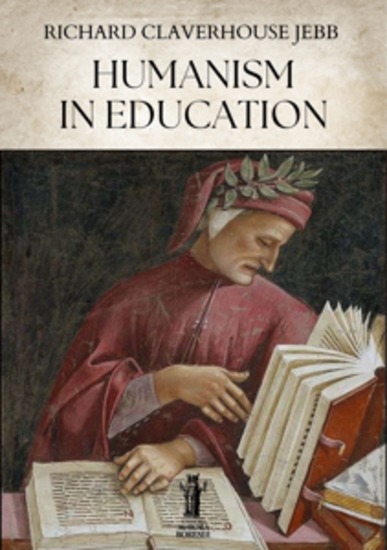
Humanism in Education - cover

Humanism in Education

Richard Claverhouse Jebb

Publisher: Edizioni Aurora Boreale

  • 0
  • 0
  • 0

Summary

Sir Richard Claverhouse Jebb (1841-1905) was a British classical scholar and Member of Parliament for Cambridge University. He was acknowledged to be one of the most brilliant classical scholars of his time, a humanist and an unsurpassed translator from and into the classical languages.
The Jebb’s essay Humanism in Education, which we propose to our readers today, is based on a Romanes Lecture, delivered by the scholar in the Sheldonian Theatre at Oxford on June 7, 1899. It was included in 1907 in the collection Essays and Addresses, published by the Cambridge University Press.
Renaissance humanism is a worldview centered on the nature and importance of humanity that emerged from the study of Classical antiquity.
Renaissance humanists sought to create a citizenry able to speak and write with eloquence and clarity, and thus capable of engaging in the civic life of their communities and persuading others to virtuous and prudent actions. Humanism, while set up by a small elite who had access to books and education, was intended as a cultural movement to influence all of society. It was a program to revive the cultural heritage, literary legacy, and moral philosophy of the Greco-Roman civilization. It first began in Italy and then spread across Western Europe in the 14th, 15th, and 16th centuries.
Available since: 02/01/2025.

Other books that might interest you

  • Around The World With Songs - Lucky Ladybug® Lessons From The Heart - cover

    Around The World With Songs -...

    Margo Joy

    • 0
    • 0
    • 0
    Learning is fun and captivating with the Lucky Ladybug® series, Lessons from the Heart.  Lucky Ladybug® and her friends Bubbly Butterfly, Buddy Bee, Flashy Fly, Toodaloo Turtle along with her class visit their places of origin and culture in this third book of the series. Together, they travel the world and learn about well known historic attractions in each country. The Lucky Ladybug® series brings you captivating printed books, engaging videos, ebooks, and coloring books, including a song about each lesson and activity available through audio books and music albums, and other resources that reiterate the importance of each lesson in the book and the value of sharing, caring, beauty from within; learn about school, happiness, honesty, listening, respect, forgiveness, giving, finding yourself, patience, musical instruments, singing, drama, reading, friendship, dancing, teamwork, relaxing, fun, cooking, nutrition, alphabet, numbers, time, confidence, acceptance, achievement, following your dreams and more. Enjoy learning with Lucky Ladybug® and Friends! While developed for children ages 0 to 6, children of all ages, and even adults, may find a special connection with the main character, the adorable and loving Lucky Ladybug. Lucky Ladybug is brought to life in a way that brightens children’s lives and homes, filling them with positive energy and love while teaching important life lessons. Toddlers and preschoolers have been unable to get enough of Lucky Ladybug’s first book, “Be A Better You.” “Learn With Us! Lucky Ladybug® And Friends!” promises to have the same charming effect.
    Show book
  • Embracing Exile - The Case for Jewish Diaspora - cover

    Embracing Exile - The Case for...

    David Kraemer

    • 0
    • 0
    • 0
    Jewish people have always wandered. According to their origin story, they wandered from Ur of Chaldees to Canaan, then Egypt, and then back to Canaan. From there, they were exiled to Babylon, where they lived for centuries. They also settled in Persia, Egypt, Morocco, Spain, Italy, Turkey, Poland, Ukraine, England, and the United States, among other places. Diaspora became normal to Jews, and though they may have hoped for a return to their "Promised Land" at the "End of Days," they made sense of their many homes, defending diaspora as the realm where Jewish life could grow and they could fulfill their obligations to God. 


    Embracing Exile analyzes biblical and rabbinic texts, philosophical treatises, studies of Kabbalah, Hasidism, and a multiplicity of modern expressions. It offers revised readings of the Bible's book of Esther, a survey of Talmudic treatments of exile, an in-depth analysis of the thought of the Maharal of Prague, as well as the work of Philip Roth, among other modern authors. David Kraemer shows that Diaspora Jews through the ages insisted that God joined them in their exiles and that, as citizens of the world, Jews could only live throughout the world. The result is a convincing assertion that lament has not been the most common Jewish response to diaspora and that Zionism is not the natural outcome of either Jewish ideology or history.
    Show book
  • Doorknob Bombshells in Therapy - The Deadline the Brain and Why It Is Important to End on Time - cover

    Doorknob Bombshells in Therapy -...

    Daniela V. Gitlin

    • 0
    • 0
    • 0
    What should a therapist do when a patient reveals critical information at the end of a session? 


    It's a near-universal experience among mental health practitioners: a patient drops a bombshell—a critical disclosure that moves the treatment forward—on their way out, with a hand on the doorknob. This "doorknob moment" creates a stressful dilemma for clinicians, especially when the patient is distraught. Should the clinician end the session on time, or run over and be late for the next patient? 


    Here, seasoned psychiatrist Daniela V. Gitlin provides clinicians with a clear, evidence-based answer. By conceptualizing the functional differences between patient and therapist in the treatment relationship as a metaphor for the functional differences between right and left cerebral hemispheres, Gitlin's argument yields a comprehensive explanation for why doorknob moments occur, why they are necessary to prevent treatment stagnation, and why ending on time makes patients feel safer to deliver them.
    Show book
  • Fascism: What It Is And How To Fight It - cover

    Fascism: What It Is And How To...

    Leon Trotsky

    • 0
    • 0
    • 0
    Leon Trotsky (1879-1940) was a Bolshevik revolutionary and Marxist theorist. He was one of the leaders of the Russian October Revolution, second only to Vladimir Lenin. During the early days of the Soviet Union, he served first as People's Commissar for Foreign Affairs and later as the founder and commander of the Red Army and People's Commissar of War. He was also among the first members of the Politburo. 
    Why fascism was able to conquer only in those countries where social democratic or Stalinist parties blocked the workers and their allies from utilizing a revolutionary situation to remove the capitalists from power. There is a scientific analysis of fascism. It was made by the exiled Bolshevik revolutionary Leon Trotsky not as a postmortem, but during the rise of fascism. This was — along with his analysis of the nature of Stalinism — Trotsky's greatest contribution to Marxist theory. He began the task after Mussolini's victory in Italy in 1922 and brought itto ahigh pointin the years preceding Hitler'striumphin Germany in 1933.
    Show book
  • Dispersals - On Plants Borders and Belonging - cover

    Dispersals - On Plants Borders...

    Jessica J. Lee

    • 0
    • 0
    • 0
    A prize-winning memoirist and nature writer turns to the lives of plants entangled in our human world to explore belonging, displacement, identity, and the truths of our shared future 


    A seed slips beyond a garden wall. A tree is planted on a precarious border. A shrub is stolen from its culture and its land. What happens when these plants leave their original homes and put down roots elsewhere? 


    In fourteen essays, Dispersals explores the entanglements of the plant and human worlds: from species considered invasive, like giant hogweed; to those vilified but intimate, like soy; and those like kelp, on which our futures depend. Each of the plants considered in this collection are somehow perceived as being "out of place"—weeds, samples collected through imperial science, crops introduced and transformed by our hand. Combining memoir, history, and scientific research in poetic prose, Jessica J. Lee meditates on the question of how both plants and people come to belong, why both cross borders, and how our futures are more entwined than we might imagine.
    Show book
  • Direct Perception is Freedom - Bombay (Mumbai) 1971 - Public Talk 2 - cover

    Direct Perception is Freedom -...

    Jiddu Krishnamurti

    • 0
    • 0
    • 0
    ". Direct perception is freedom - 10 February 1971 
    • Can the mind living in this world ever be free, not only superficially but 
    profoundly, at the very root of its existence? 
    • ‘Freedom from’ is an abstraction, but freedom in observing ‘what is’ and going 
    beyond it is actual freedom. 
    How do I observe greed? Do I observe it as an outsider looking in or do I observe it without the observer? 
    Without the mind being free you cannot live in order. 
    Q: Three years have passed; I have no energy to be aware of my reactions. Q: Can we seek God through observation?"
    Show book