Join us on a literary world trip!
Add this book to bookshelf
Grey
Write a new comment Default profile 50px
Grey
Subscribe to read the full book or read the first pages for free!
All characters reduced
Six Metaphysical Meditations - Wherein it is proved that there is a God and that mans mind is really distinct from his body - cover

Six Metaphysical Meditations - Wherein it is proved that there is a God and that mans mind is really distinct from his body

René Descartes

Translator William Molyneux

Publisher: Good Press

  • 0
  • 0
  • 0

Summary

In "Six Metaphysical Meditations," Ren√© Descartes embarks on an introspective journey that delves into the nature of existence, knowledge, and the mind-body relationship. Written in a clear and methodical style, the book reflects Descartes' commitment to rationalism, emphasizing analytical reasoning and systematic doubt. Each meditation serves as a building block for his foundational philosophical framework, culminating in the famous cogito, 'I think, therefore I am.' This work is situated within the broader context of early modern philosophy, where scholars sought to reconcile faith and reason amid growing scientific inquiry. Ren√© Descartes, often heralded as the father of modern philosophy, was influenced by his extensive education in mathematics and natural sciences. His dissatisfaction with the scholastic traditions of his time propelled him to explore radical new ideas about knowledge and perception. Descartes' unique perspective, shaped by his own existential queries and a desire for intellectual clarity, is palpably evident in this work, underscoring his legacy as a pivotal figure in philosophical thought. "Six Metaphysical Meditations" is essential reading for anyone engaged in philosophical inquiry or the history of ideas. Descartes'Äô meditations challenge readers to scrutinize their own beliefs and assumptions, ultimately guiding them toward a deeper understanding of the self and the metaphysical underpinnings of reality. This text not only informs the development of metaphysical thought but also invites ongoing reflection and dialogue.
Available since: 07/10/2023.
Print length: 86 pages.


Other books that might interest you

  • The Indonesian Famine of 1945-1946 - A Study in Post-War Disruption - cover

    The Indonesian Famine of...

    Sarah Willards

    • 0
    • 0
    • 0
    The conclusion of World War II marked a pivotal turning point in Indonesia’s history. As the Japanese forces surrendered in August 1945, the vacuum left behind in their wake exposed the fragility of colonial and wartime institutions. Indonesia, long under Dutch colonial rule and occupied by Japan since 1942, was suddenly thrust into a state of political and administrative chaos. The power void that followed the Japanese capitulation was quickly filled by nationalist fervor, culminating in the proclamation of Indonesian independence on August 17, 1945. However, the declaration did not result in immediate recognition or control. Instead, the country found itself caught between competing powers and clashing agendas. 
    The collapse of Japanese administrative structures left the newly proclaimed Republic of Indonesia struggling to assert its legitimacy. Republican leaders, including Sukarno and Mohammad Hatta, faced the monumental task of organizing a new government while also managing the fallout of war. Meanwhile, Dutch authorities, with Allied support, sought to re-establish their colonial presence. This led to violent confrontations and widespread instability, as various factions—including local militias, former Japanese-trained troops, and returning colonial forces—vied for control over towns, supply routes, and administrative posts. 
    The disintegration of centralized governance had far-reaching consequences. Essential services, including food distribution and public health, were severely disrupted. The chaos was further compounded by a breakdown in communication lines and transportation infrastructure, much of which had been damaged during the war or repurposed by occupying forces. With no clear authority in many regions, local leaders and grassroots organizations were left to manage crises as best they could, often with limited resources and no coordination.
    Show book
  • Gang Politics - Revolution Repression and Crime - cover

    Gang Politics - Revolution...

    Kristian Williams

    • 0
    • 0
    • 0
    Demystifying forces of the state, gangs, and revolutionary violence. 


    In Gang Politics, Kristian Williams examines our society's understanding of social and political violence, what gets romanticized, misunderstood, or muddled. He explores the complex intersections between "gangs" of all sorts—cops and criminals, Proud Boys and Antifa, Panthers and skinheads—arguing that government and criminality are intimately related, often sharing critical features. As society becomes more polarized and conflict more common, Williams's analysis is a crucial corrective to our usual ideas about the role violence might or should play in our social struggles.
    Show book
  • Society: The Basics - A Simple Guide to the Complex World of Sociology - cover

    Society: The Basics - A Simple...

    Fred Grandsen

    • 0
    • 0
    • 0
    Sociology is the systematic study of society, human behavior, and social interactions. It explores how individuals relate to one another and how social structures, such as institutions, norms, and values, shape these interactions. The origins of sociology can be traced back to the early 19th century when scholars began to analyze the effects of rapid social changes brought about by industrialization, urbanization, and political revolutions. Auguste Comte, a French philosopher, is often credited with founding sociology and introducing the idea that societies evolve through distinct stages of development, which he described as the theological, metaphysical, and scientific stages. Comte emphasized the importance of using scientific methods to study society, laying the groundwork for the discipline's emergence as a formal field of study. 
    Sociology seeks to understand the underlying patterns and structures that govern social life. It examines topics such as social roles, institutions, class structures, race, gender, and family dynamics. Sociologists use various methods to study society, including surveys, interviews, participant observation, and statistical analysis. These methods allow them to identify trends, uncover social inequalities, and explain how social change occurs. For example, Emile Durkheim, one of the early pioneers of sociology, studied the causes of suicide and concluded that social integration and regulation significantly influence individuals' behavior. His work demonstrated that even personal actions have social underpinnings, highlighting the importance of understanding the broader social context.
    Show book
  • Georgia O'Keeffe: A short biography - 5 Minutes: Short on time – long on info! - cover

    Georgia O'Keeffe: A short...

    5 Minutes, 5 Minute Biographies,...

    • 0
    • 0
    • 0
    Georgia O'Keeffe, American paintress and founder of Modernism: Life and work in a short biography! Everything you need to know, brief and concise. Infotainment, education and entertainment at its best!
    Show book
  • The Blitz - A Georgian Daughter's Rise as a CFO in the Post-Soviet Era - cover

    The Blitz - A Georgian...

    Tamar Gakharia

    • 0
    • 0
    • 0
    Born during the collapse of the Soviet Union, Tamar Gakharia dreamed of lifting her struggling family and her emerging homeland, the Republic of Georgia, from the ashes of the post-Soviet era into a future of prosperity and freedom. As the daughter of two doctors who lost everything, Tamar was determined to build a career that would help her country rise on the global stage. But at 18, just as she was starting university, she fell deeply in love and secretly married a man whose potential was as great as his demons.
    Show book
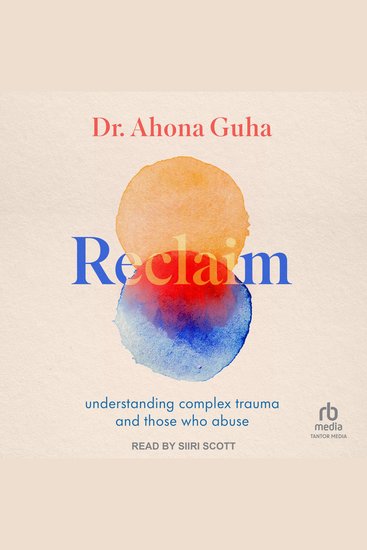
  • Reclaim - understanding complex trauma and those who abuse - cover

    Reclaim - understanding complex...

    Dr. Ahona Guha

    • 0
    • 0
    • 0
    The relationship between trauma and mental health is becoming better recognized, but survivors and professionals alike remain confused about how best to understand and treat it. In Reclaim, through a series of case studies and expert analysis, Dr. Ahona Guha explores complex traumas, how survivors can recover and heal, and the nature of those who abuse. She shines a light on the "difficult" trauma victims that society often ignores, and tackles vital questions such as, "Why are psychological abuse and coercive control so difficult to spot?" and "Why do some people harm others, and how do we protect ourselves from them?" 


    As a clinical and forensic psychologist, Dr. Guha has had extensive experience in working with those who perpetrate harm—including stalkers, sex offenders, violent offenders, and those who threaten, bully, and harass—and she has a deep understanding of the psychological and social factors that cause people to abuse others. In turn, her clinical work in the trauma treatment field has led her to recognize the enormous impacts of complex trauma, and the failures of systems when working with those who have been victimized. 


    By emphasizing compassion above all, Dr. Guha calls for us to become better informed about perpetrators and the needs of victims, so we might reclaim a safer, healthier society for everyone.
    Show book