Junte-se a nós em uma viagem ao mundo dos livros!
Adicionar este livro à prateleira
Grey
Deixe um novo comentário Default profile 50px
Grey
Assine para ler o livro completo ou leia as primeiras páginas de graça!
All characters reduced
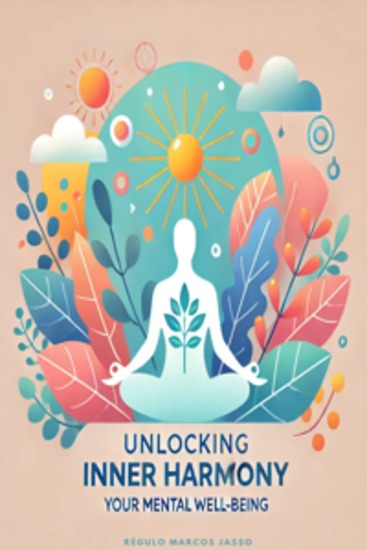
Unlocking Inner Harmony - Your Mental Well-being - cover
LER

Unlocking Inner Harmony - Your Mental Well-being

Régulo Marcos Jasso

Editora: Régulo Marcos Jasso

  • 0
  • 0
  • 0

Sinopse

Embark on an enlightening journey with "Unlocking Inner Harmony: Nurturing Your Mental Well-being," a profound and transformative guide designed to unlock the gates to your inner sanctuary of peace, purpose, and profound self-understanding. This book serves as your personal compass in the quest for self-discovery and empowerment, offering a treasure trove of insights and actionable strategies to awaken your true potential and cultivate a life rich in balance, fulfillment, and emotional well-being.A Holistic Approach to Mental Health:"Unlocking Inner Harmony" weaves together the threads of modern psychological research, timeless wisdom from ancient practices, and compelling personal narratives to explore the intricate tapestry of the human mind. This book provides a comprehensive overview of how our mental landscape—our thoughts, emotions, and behaviors—interacts to shape our reality. It advocates for a holistic approach to mental health, where every aspect of your inner world is acknowledged, understood, and nurtured.A Journey of Self-Discovery:Within its pages, you will navigate through transformative concepts like mindfulness, self-compassion, and introspective reflection. You'll learn to anchor yourself in the present moment, developing a keen awareness that liberates you from the shackles of negative thought patterns and emotional turmoil. With self-compassion as your guiding light, you will heal from past grievances, cultivate a deep-seated love for yourself, and foster healthier, more meaningful connections with those around you.Practical Tools for Everyday Life:This guide is replete with practical techniques and exercises tailored to enhance your mental well-being. Discover the art of setting personal boundaries, mastering stress, and establishing self-care routines that not only rejuvenate your spirit but also maintain your inner equilibrium. You'll delve into the transformative power of gratitude, the efficacy of positive affirmations, and the critical importance of aligning your daily actions with your core values and passions.More Than Self-Help:"Unlocking Inner Harmony" transcends the conventional self-help narrative. It is a detailed roadmap for reclaiming your inner power, finding tranquility amidst life's storms, and crafting a life that resonates with authenticity and purpose. Whether you're grappling with anxiety, recovering from past traumas, or simply aiming to enrich your life with more joy and peace, this book equips you with the tools to take charge of your mental health and unlock a life of harmony.Engaging and Relatable:With an engaging narrative style, this book connects through relatable stories and anecdotes, making the journey of self-improvement both accessible and inspiring. It's designed to resonate with individuals from all walks of life, encouraging each reader to embark on their unique path of personal growth and transformation.Your Invitation to Transformation:"Unlocking Inner Harmony: Nurturing Your Mental Well-being" is not just about reading; it's about doing, feeling, and becoming. It invites you to explore the depth of your own mind, to uncover the harmony that lies within, and to empower yourself to live a life of joy, peace, and fulfillment. This book is your companion in the lifelong journey of self-mastery, where every page turned is a step closer to the life you've always envisioned.Join us on this path to enlightenment and self-realization, where you will learn not only to cope with life's challenges but to thrive amidst them, crafting a life that is not just lived but truly felt and cherished. Whether you are at the beginning of your journey or well on your way, "Unlocking Inner Harmony" promises to be a beacon of light, guiding you to the heart of your own well-being.
Disponível desde: 07/07/2023.

Outros livros que poderiam interessá-lo

  • Top Ten Ancient World Secrets - cover

    Top Ten Ancient World Secrets

    Raphael Terra

    • 0
    • 0
    • 0
    This audiobook has been recorded using Text to speech (TTS). 
     
    Welcome to a world full of mystery, folklore and legend. From supposed stargates to powerful deities; from fantastic giants to steampunk style science-fiction. This is not an alien planet or a fantasy land, this is planet Earth of the past. And yet, it was a world of wonder and great physical and mental achievements. Now, even with our modern day science, there are a great many remnants of the ancient world that remain an enigma. 
     
    From the great civilizations of antiquity we will discover the amazing works of architecture and art. Huge monuments erected for gods and kings. Mysterious artefacts re-discovered after remaining hidden for thousands of years. From the Great Pyramid of Giza to the Statue of Zeus at Olympia; from the Temple of Artemis at Ephesus to the strange Antikythera mechanism. And as we move around the planet we will unlock the secrets of Stonehenge and through that the movements of the planets. 
     
    Welcome to the Top Ten Ancient World Secrets.
    Ver livro
  • Secrets to Spotting Deception Like a Pro - "Master the art of spotting deception with dynamic audio lessons designed for ultimate success!" - cover

    Secrets to Spotting Deception...

    Alaric Winterbourne

    • 0
    • 0
    • 0
    Secrets to Spotting Deception Like a Pro: A Simplified Guide with Inclusive Explanations 
    Are you eager to advance in your career and enhance your understanding by successfully navigating the complexities of spotting deception? 
    Are you on the lookout for a detailed guide that offers everything you need to uncover the truth through keen observation and critical thinking? 
    Your search concludes here! 
    This guide acts as your ultimate resource for deepening your insights, honing your skills, and engaging in practical exercises. With this knowledge at your fingertips, you're set for success. 
    Updated for the latest methodologies in identifying deception. 
    Key features of this comprehensive guide: 
    - In-depth insights into the dynamics of deception detection 
    - Thorough explanations of observational techniques 
    - Effective strategies for thorough analysis and engagement 
    Our guide stands out with its exhaustive coverage, essential for your mastery of this critical skill. Concepts are explored in detail, ensuring a clear understanding. 
    Please note that this guide is an independent resource and is not associated with any official organization focused on deception detection. 
    Crafted with a logical structure and straightforward language, our guide guarantees smooth transitions between topics. Say farewell to complicated jargon, and embrace clear, precise, and technically accurate information. 
    So, why delay? Click the BUY NOW button, secure your guide, and embark on your journey to mastering the art of spotting deception!
    Ver livro
  • Bad Things - The Nature and Normative Role of Harm - cover

    Bad Things - The Nature and...

    Neil Feit

    • 0
    • 0
    • 0
    Bad Things addresses various philosophical questions about the nature and moral relevance of harm. The most basic question is this: under what conditions does an event harm a given individual? Neil Feit focuses primarily on the metaphysics of harm, and he both defends and extends the counterfactual comparative account of harm. On this account, in its most basic form, an act or event harms an individual provided that she would have been better off if it had not occurred. The counterfactual comparative account is widely accepted but also widely criticized. Feit provides detailed and thorough responses to the most challenging objections. He argues that an adequate theory of harm should entail the counterfactual comparative account but also make room for a certain kind plural harm, where two or more events together harm an individual although neither one by itself is harmful. These harmful events are bad things, collectively, even if no single event is itself a bad thing. Feit sets out and defends a detailed account of plural harm, addressing issues about the magnitude and the time of the harm suffered by the victim. The primary focus of the book is on the metaphysics of harm, but issues concerning its normative or moral relevance are addressed.
    Ver livro
  • Norse Mythology: The History of the Norse Pantheon and the Most Famous Myths - cover

    Norse Mythology: The History of...

    Editors Charles River, Andrew Scott

    • 0
    • 0
    • 0
    Much of what is known of the Norse myths comes from the 10th century onwards. Until this time and, indeed, for centuries afterwards, Norse culture (particularly that of Iceland, where the myths were eventually transcribed) was an oral culture. In fact, in all Scandinavian countries well into the 13th century laws were memorized by officials known as “Lawspeakers” who recited them at the “Thing.” The Thing was the legislative assembly in Scandinavia “held for judicial purposes.” 
    One of the most famous of these Lawspeakers was the Icelander Snorri Sturluson, a masterful writer who wrote the Prose Edda in the thirteenth century. There are other sources for the Norse myths, namely the later “Poetic Edda,” a collection of poems and prose work, and other sagas but the Snorri’s Prose Edda is the most complete work whose attribution is known to modern scholars. 
    The Prose Edda is a collection of Norse Myths split into three sections, the Gylfaginning (the Deluding of Gylfi), the Skáldskaparmál (the Language of Poetry) and the Háttatal (the Enumeration of Meters). The first has a frame story that entails a Swedish King, Gylfi, disguising himself as an old man, Gangleri, when he journeys to Asgard to meet the gods. When he arrives, he meets three men - “High One, Just-As-High, and Third” - who reveal to him stories of the world and the gods. The second section contains a warning for Christians not to believe in the Norse gods, specifically the two families, the Aesir and the Vanir, but also refutes the notion that they were demons, which was a common supposition among some Christians at the time. The Prose Edda begins in this line of thought with a euhemeristic prologue, which traces the history of the Norse Gods as human heroes of Troy, making Thor one of King Priam’s sons.
    Ver livro
  • A Rare Recording of Corrie ten Boom Vol 3 - cover

    A Rare Recording of Corrie ten...

    Corrie ten Boom

    • 0
    • 0
    • 0
    Cornelia Arnolda Johanna "Corrie" ten Boom (April 15, 1892 - April 15, 1983) was a Dutch watchmaker who worked with her father Casper and other family members to help, reportedly, 800 Jews escape the Nazi Holocaust during World War II by hiding them in their home. Eventually, the family was caught, and ten Boom was arrested and sent to Ravensbrück concentration camp, but released after ten months due to a clerical error. Later in life, ten Boom wrote, "The Hiding Place," a biography that recounts the story of her family's efforts and how she was able to find hope while imprisoned at the concentration camp. It was later made in to a movie. The following is part one of a speech ten Boom gave called, Authority Over Demons.
    Ver livro
  • Avars and Magyars The: The History of the Medieval Ethnic Groups that Settled in Hungary - cover

    Avars and Magyars The: The...

    Editors Charles River

    • 0
    • 0
    • 0
    The Avars entered Eastern Europe from the Central Asian steppes in the 6th century, and like the Huns before them and the Cumans and Magyars after them, the Avars were raiders and warriors who lived on their horses. The Avars’ impact on Europe was immediately felt, and from the Byzantine Empire to the Merovingian Kingdom in Gaul, some of Europe’s strongest powers had to learn how to deal with these new people through a combination of diplomacy and warfare. Eventually, the Avars established themselves in what is today Hungary and played an important role in the development of European history during its transitional period by earning a reputation as a fearsome and sometimes avaricious group. The medieval sources described the Avars as efficient and brutal horseback warriors who could devastate entire kingdoms in a matter of days and leave just as quickly. 
    Of all the steppe peoples in the medieval period, perhaps none were more important to European history than the Magyars. Like the Huns and Avars before them and the Cumans and Mongols after them, the Magyars burst into Europe as a destructive, unstoppable horde, taking whatever they wanted and leaving a steady stream of misery in their wake. They used much of the same tactics as the other steppe peoples and lived a similar, nomadic lifestyle. The Magyars also had many early cultural affinities with other steppe peoples, following a similar religion and ideas of kingship and nobility, among other things. That said, as similar as the Magyars may have been to other steppe nomads before and after them, they were noticeably different in one way: the Magyars settled down and became a part of Europe and Western Civilization in the Middle Ages. The Magyars exploded onto the European cultural scene in the late 9th century as foreign marauders, but they made alliances with many important kingdoms in less than a century.
    Ver livro