Join us on a literary world trip!
Add this book to bookshelf
Grey
Write a new comment Default profile 50px
Grey
Subscribe to read the full book or read the first pages for free!
All characters reduced
The Grunge Explosion - cover

The Grunge Explosion

Rebecca Murphy

Translator A AI

Publisher: Publifye

  • 0
  • 1
  • 0

Summary

"The Grunge Explosion" dissects the grunge music phenomenon of the late 80s and early 90s, revealing it as more than just a genre but a cultural reset. It examines how socio-economic factors, particularly in the Pacific Northwest, fueled the raw, angst-ridden sound that rejected the excesses of 80s glam metal. Grunge, as a counter-cultural movement, grappled with mainstream adoption, highlighting the tensions between authenticity and commercialism. The book explores the musical elements that defined grunge, like distorted guitars and unfiltered lyrics, and analyzes the contributions of iconic bands such as Nirvana, Pearl Jam, Soundgarden, and Alice in Chains. It also investigates the subculture's fashion, visual aesthetic, and DIY ethos. Grunge challenged established norms and provided a voice for a disillusioned generation, influencing music, fashion, and attitudes that are still relevant today. Beginning with the pre-grunge musical landscape, "The Grunge Explosion" traces the genre's emergence, delves into its key players and subculture, and concludes with an analysis of its lasting legacy. By incorporating archival interviews, concert footage, and sociological studies, the book offers a nuanced perspective on grunge's complex relationship with mainstream culture and its enduring impact.
Available since: 02/25/2025.
Print length: 49 pages.
Other books that might interest you

  • How the Paranormal Affects Mental Illness - And What Additional Therapies Apply - cover

    How the Paranormal Affects...

    Martin K Ettington

    • 0
    • 0
    • 0
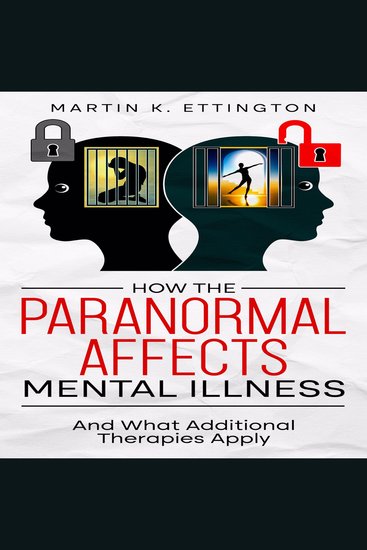
    My career was being trained as and working as an Engineer mostly for Fortune 100 companies. 
    In parallel with that I’ve also been working on spiritual enlightenment and developing my paranormal abilities for the last fifty years. 
    This unusual combination of skills has led me to my passion of writing about the paranormal and many “out of the box” concepts and topics. I’ve actually written twelve books about the paranormal based on my experiences and research into these topics. 
    One topic which has always fascinated me has been how many paranormal experiences are usually interpreted by mental health professionals as delusional and mentally ill behaviors. 
    My thinking is that most people have spiritual and paranormal abilities and these cause experiences which can overwhelm some people to make them fit the diagnosis of them having mental illnesses. 
    Certainly there are a lot of legitimate mental illnesses which cause the need for treatments by mental health professionals. 
    But what happens when persons having these experiences may be normal and stable in their other behaviors but these experiences are so far beyond the norms of society that others think they are “crazy” and therefore treat them as such? 
    I’ve heard and read a number of stories over the years where I wonder if they were real experiences which might have just caused the person who lived them to have a nervous breakdown. 
    This book is my effort to help people understand the interfaces of real paranormal experiences and mental illness and how to tell which is which. 
    Also, what additional therapies can be used to help people who may be overwhelmed by these experiences?
    Show book
  • The Problem of China - cover

    The Problem of China

    Bertrand Russell

    • 0
    • 0
    • 0
    "The Problem of China" by Bertrand Russell is a thought-provoking and insightful exploration of the social, political, and cultural challenges facing China during the early 20th century. Russell delves into the complexities of Chinese society, examining its historical context and the impact of Western influences on its development. In this book, Russell examines China's struggle to reconcile its rich cultural heritage with the pressures of modernization and foreign intervention. He delves into various topics, including the conflict between traditional values and the need for progress, the role of education in shaping Chinese society, and the impact of imperialism on China's political and economic landscape. Read in English, unabridged.
    Show book
  • Civil War in the Roman Republic - A time of great civil military and political strife that mirrors our own | 106 to 44BCE - cover

    Civil War in the Roman Republic...

    Cicero, Cato The Younger, Mark...

    • 0
    • 0
    • 0
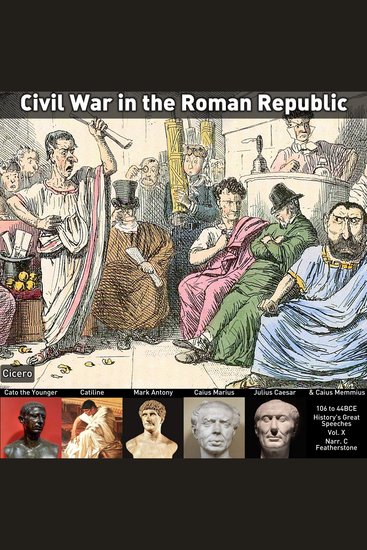
    While compiling and narrating these speeches, I've often been struck by how easily they could be translated into a modern day context. Frequently, a speech has reminded me of the news of the day, somewhere in the world. Nowhere has this been more evident than in these speeches. Given over two thousand years ago, every single one could be applied to situations and people today with barely any revision.The late republic (from about 133BCE) was characterized by civil discontent, with three Servile Wars, two attempted coups, a Social War between Rome and Italian allies, and endless conflict.We begin in 110-106BCE with two speeches railing against the fixed social order and corruption of the highborn, as well as the scorn poured on those of lower birth. We then jump to the Cataline Conspiracy in 63 BCE, an attempt to overthrow the Senate that was only defeated at great cost, and continued to be a symbol of Rome’s troubles. Here we see Cataline exhorting his troops, Cato arguing for harsh punishment, C icero calling Cataline every contemptible name under the sun, and the only known speech of Julius Caesar, in which he argues for a sensible and jurisprudential response to this great crime.Cicero’s leadership of Rome is then documented, covering the beliefs and actions that saw him exiled and then returned to power by the Senate. Finally, we have Mark Antony’s hagiographic oration of Julius Caesar, and then two speeches of Cicero’s railing against the perversion of Caesar’s legacy that Mark Antony was putting into practice, and the need to hold onto tradition for the right reasons, not simply to cover the misdeeds of politicians. Antony became Consul in this time, and Cicero saw in him the final downfall of the republic, which lasted for only seventeen years after this moment before becoming an Empire.
    Show book
  • Four Thousand Hooks - A True Story of Fishing and Coming of Age on the High Seas of Alaska - cover

    Four Thousand Hooks - A True...

    Dean J. Adams

    • 0
    • 0
    • 0
    As Four Thousand Hooks opens, an Alaskan fishing schooner is sinking. It is the summer of 1972, and the sixteen-year-old narrator is at the helm. Backtracking from the gripping prologue, Dean Adams describes how he came to be a crew member on the Grant and weaves a tale of adventure that is like a novel—with drama, conflict, and resonant portrayals of halibut fishing, his ragtag shipmates, maritime Alaska, and the ambiguities of family life. 


    At sea, the Grant's crew teach Dean the daily tasks of baiting thousands of longline hooks and handling the catch, and on shore they lead him through the seedy bars and guilty pleasures of Kodiak. Exhausted by twenty-hour workdays and awed by the ocean's raw power, he observes examples of human courage and vulnerability and emerges with a deeper knowledge of himself and the world. 


    Four Thousand Hooks is both an absorbing adventure story and a rich ethnography of a way of life and work that has sustained Northwest families for generations. This coming of age story will appeal to listeners including young adults and anyone interested in ocean adventures, commercial fishing, maritime life, and the Northwest coast.
    Show book
  • Three Wise Monkeys - The Quest for Wealth Without Work - cover

    Three Wise Monkeys - The Quest...

    Charles van Onselen

    • 0
    • 0
    • 0
    The Three Wise Monkeys trilogy culminates with a forensic examination of South Africa's long struggle to suppress gambling, and especially lotteries. The opposition of the Calvinist churches – both Afrikaans and English-speaking – had its counterpart in the eager embrace of games of chance by the white working class on the Witwatersrand. Focusing on the career of Rufe Naylor, an Australian bookmaker, horse dealer and entrepreneur who, with the help of a defrocked Portuguese Catholic priest, ran the Lourenço Marques Lottery, The Quest for Wealth without Work shows how
    the efforts of church and state to control the leisure time and morals of the working class intersected with the need to ensure the flow of cheap mine labour from Mozambique. Ultimately, in the suppression of the Lourenço Marques Lottery – and in campaigns against pinball machines, dog
    racing and other 'social evils' – can be seen the emerging outlines of the apartheid police state.
    Show book
  • How to Be Sad - cover

    How to Be Sad

    Olivia Werner

    • 0
    • 0
    • 0
    [How to Be Sad] invites readers into an intimate exploration of grief's geography, where sadness isn't a failure of happiness but a complete state of being. With lyrical precision and raw honesty, this meditation on melancholy challenges our culture's relentless pursuit of joy, offering instead a profound understanding of how sadness shapes our internal landscapes. Through delicate observations of daily life—the way light filters through curtains, how time bends around grief, the small rituals we create to anchor ourselves—the book illuminates the unexpected wisdom that comes from embracing our darker emotions. Like the fog that settles between buildings at dawn, this work wraps itself around the reader's consciousness, transforming our understanding of what it means to navigate the full spectrum of human emotion.
    Show book