Join us on a literary world trip!
Add this book to bookshelf
Grey
Write a new comment Default profile 50px
Grey
Subscribe to read the full book or read the first pages for free!
All characters reduced
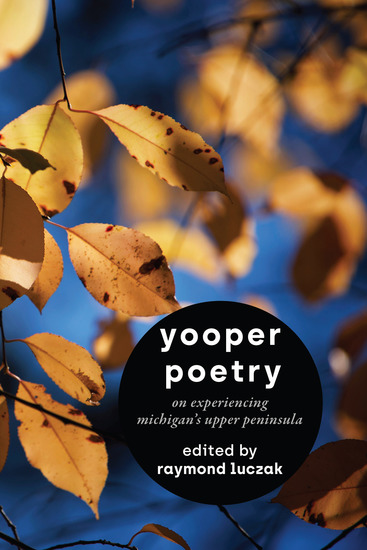
Yooper Poetry - On Experiencing Michigan's Upper Peninsula - cover

Yooper Poetry - On Experiencing Michigan's Upper Peninsula

Raymond Luczak

Publisher: Modern History Press

  • 0
  • 0
  • 0

Summary

Sometimes the best way to learn about a unique region is to listen to the stories told by those who've actually lived there. You learn things that no guidebook would ever tell you. You meet unforgettable characters who've strayed far off the beaten path. And you see clearly again how the power of memory is so strong that they can still recall incidents decades later. Michigan's Upper Peninsula has always been filled with remarkable sensations and indelible stories.  With this anthology, the editor Raymond Luczak sought to include poets who not only live in the U.P., but also who used to live there. What did it mean to be a Yooper then? What about now? Even for those who no longer abide there, the U.P. is indeed a special place, and it isn't just thanks to Mother Nature. The Yooper mindset requires a particular kind of faith in resilience against persistent odds.  The poets in this collection have never forgotten what it means to be a Yooper. Come partake in our celebration!  Featuring Martin Achatz * Jennifer Elen Brid * B. Harlan Deemer * Chad Faries * Deborah K. Frontiera * Kathleen M. Heideman * John Hilden * Jonathan Johnson * Kathleen Carlton Johnson * Ellen Lord * Raymond Luczak * Gala Malherbe * Beverly Matherne * R. H. Miller * Jane Piirto * Dana Richter * T. Kilgore Splake * Suzanne Sunshower * Russell Thorburn  "Yooper Poetry is a very thoughtful and beautifully published book... Some of the best Yooper writing reaches toward the poetic heights that resonate with "danger"... I love the resonance that exists and helps to feed our various literatures across time and distance." -- Mack Hassler, U.P. Book Review  RAYMOND LUCZAK is the author and editor of over 30 books, including U.P.-centric titles such as Far from Atlantis: Poems (Gallaudet University Press), Chlorophyll: Poems about Michigan's Upper Peninsula (Modern History Press), and Compassion, Michigan: The Ironwood Stories (Modern History Press). His poetry collection once upon a twin: poems (Gallaudet University Press) was a top ten U.P. Notable Book of the YearPoetry, Prairie Schooner, and elsewhere. A proud Yooper, he lives in Minneapolis, Minnesota.
Available since: 04/01/2024.
Print length: 168 pages.
Other books that might interest you

  • Treasure - cover

    Treasure

    Jemima Foxtrot

    • 0
    • 0
    • 0
    "religion's been cruel to people like usthe darkwood sluts      the good time girlsbut god as my witnesssome of us           we're just trying to wrangle our powerback from the species that took it"
    Jemima Foxtrot's Treasure is a shining work of alchemy and liberation which explores power dynamics, sex work, desire, and female friendship with a fresh and playful perspective. Foxtrot investigates shimmering sexualities, the economies of desire, the theft of childhood and pathways towards reclaiming it. Her language is lush: intimate, intricate, full of fertile earth's possibility. The poems of Treasure live up to its name: showing us where the gold is—the joy—how to feed it into the soil of our lives.
    "Treasure is an aptly chosen title for this collection, both as a noun (that quantity of precious ore dug from the stuff of experience) and as a verb (the imperative to seek out, sing, and cherish joy through the sharing of it). Foxtrot is a savvy, sometimes savage, sensualist; her poetic speakers alert to injustice, but alive to pleasure in every way that counts. These are superbly tactile poems, poems of being-in-the-body, and being-in-the-world; they are full of wit, vigour and feminist jouissance. These are also formally exciting poems, poems that showcase a beautifully bold and oddly tender lyric defiance." Fran Lock, Hyena, T.S. Eliot Prize Shortlist
    Show book
  • King Lear | Shakespeare for kids - Shakespeare in a language kids will understand and love - cover

    King Lear | Shakespeare for kids...

    Jeanette Vigon

    • 0
    • 0
    • 0
    Dive into the stormy world of "King Lear," a brilliant adaptation of Shakespeare's tragic tale, transformed into an accessible and engaging narrative for young readers by Jeanette Vigon. This rendition captures the essence of the original story, focusing on themes of love, betrayal, and redemption, while simplifying its complex language and situations to suit a younger audience. 
    Highlights Include:Simplified Shakespeare: Jeanette Vigon skillfully adapts the challenging themes and language of "King Lear" into a story that's easy for children to understand and enjoy.Moral Lessons Galore: Through the tumultuous journey of King Lear and his daughters, young readers will explore important lessons about the consequences of our actions and the true meaning of loyalty and forgiveness.Adventure in Every Page: Set in the mystical landscapes of ancient Britain, children will be transported into a world where the lines between right and wrong are blurred, and the quest for understanding and reconciliation takes center stage. 
    "King Lear" is not just a storybook; it's a gateway to the world of classic literature, tailored to spark curiosity and empathy in young minds. Whether for home reading or classroom learning, this book promises to be a cherished addition to any child's library.
    Show book
  • Wonderful - Sunday Times bestselling author - cover

    Wonderful - Sunday Times...

    Harry Baker

    • 0
    • 0
    • 0
    From the Sunday Times bestselling author and former World Poetry Slam Champion, Harry Baker's third collection is his most ambitious yet. Following on from the success of Unashamed (Burning Eye, 2022), Harry Baker combines the insight of a mathematician and the vulnerability of the poet to find wonder in the little things that make life so precious. From a poem about wellies becoming an exploration of masculinity, a poem planning his own funeral inspiring thousands around the world to do the same, or a poem about his favourite German wheat-beer literally just being a poem about his favourite German wheat-beer, The combination of grief and joy in recent poems has led to Harry being described as the Barbenheimer of the poetry world (by himself, but he is hoping it catches on).
    Show book
  • Lycidas - Much shorter poem from the famed author of Paradise Lost - cover

    Lycidas - Much shorter poem from...

    John Milton

    • 0
    • 0
    • 0
    John Milton was born in Bread Street, London, on December 9th, 1608.  His early years were privately tutored before gaining a place at St Paul’s School and in 1625 he matriculated at Christ's College, Cambridge, earning a BA in 1629 and an MA in 1632. At Cambridge he had developed a reputation for poetic skill but also experienced alienation from his peers and university life as a whole.  
    The next 6 years were spent in private study. He read both ancient and modern works of theology, philosophy, history, politics, literature and science, in preparation for a poetical career.  Milton mastered Latin, Greek, Hebrew, French, Spanish, and Italian. To these he would add Old English (whilst researching his History of Britain) and also acquired more than a passing acquaintance in Dutch.  
    Although he was studying, some of his poetry from this time is remarkable; L’Allegro and Il Penseroso in 1631 and Lycidias in 1638. 
    In May 1638, Milton embarked upon a 15 month tour of France and Italy. These travels added a new and direct experience of artistic and religious traditions, especially Roman Catholicism.  He cut the journey short to return home during the summer of 1639 because of what he claimed were "sad tidings of civil war in England."  
    Once home, Milton wrote prose tracts against episcopacy, in the service of the Puritan and Parliamentary cause.  
    He married 16-year-old Mary Powell in June 1643 but she left him after only a few months during which he wrote and published several writings on divorce. Mary did return after 3 years and their life thereafter seemed harmonious.  Milton received a hostile response to the divorce tracts and drove him to write Areopagitica, his celebrated attack on pre-printing censorship.  
    With the parliamentary victory in the Civil War, Milton wrote The Tenure of Kings and Magistrates (1649) which defended popular government and implicitly sanctioned the regicide which led to his appointment as Secretary for Foreign Tongues by the Council of State.  
    On 24 February 1652 Milton published his Latin defense of the English People, Defensio Pro Populo Anglicano, also known as the First Defense. Milton's Latin prose and intellectual sweep, quickly gained him a European reputation.  
    Tragically his first wife, Mary, died on May 5th, 1652 following the birth of their fourth child.   The following year Milton had become totally blind, probably due to glaucoma.  He then had to dictate his verse and prose to helpers, one of whom was the poet Andrew Marvell.  
    He married again to Katherine Woodcock but she died in February 1658, less than four months after giving birth to a daughter, who also tragically died.  
    Though Cromwell’s death in 1658 caused the English Republic to collapse Milton stubbornly clung to his beliefs and in 1659 he published A Treatise of Civil Power, attacking the concept of a state-dominated church. Upon the Restoration in May 1660, Milton went into hiding for his life. An arrest warrant was issued and his writings burnt. He re-emerged after a general pardon was issued, but was nevertheless arrested and briefly imprisoned before influential friends, such as Marvell, now an MP, intervened 
    His third marriage was to Elizabeth Mynshull. Despite a 31-year age gap, the marriage seemed happy and Milton spent the remaining decade of his life living quietly in London, apart from a short spell in Chalfont St. Giles, during the Great Plague of London.  
    Milton was to now publish his greatest works, which had been gestating for many years.  Paradise Lost, perhaps the classic English Epic poem was originally published in 10 books in 1667.  This was followed by Paradise Regained and Samson Agonistes in 1671.  Because of his anti-monarchy views their reception was muted but over the centuries since Milton has established himself as second only to Shakespeare.  He died of kidney failure on November 8th, 1674 and was buried in the church of St Giles Cripplegate.
    Show book
  • My Land of Freedom - A poem of war and freedom - cover

    My Land of Freedom - A poem of...

    Ifeanyi Njoku

    • 0
    • 0
    • 0
    This poem is a powerful reflection on war, displacement, and the struggle for freedom. It tells the tragic story of a people who fought for liberation but were met with violence, loss, and eventual surrender. Likely referencing the Igbo experience during the Nigerian Civil War, it captures the pain of oppression and the resilience of those who endured it. 
    The poem begins with a contradiction: "In my land of freedom, I walked with fear." This highlights the irony of living in a place meant to be free but being consumed by anxiety. The people demand justice, yet their cries are silenced by violence. The line "Killing our brothers, and leaving us undone" conveys both physical loss and emotional devastation. 
    The imagery of "scorching soil" and "separated from families" paints a picture of suffering and displacement. War does not just take lives—it tears families apart and leaves hearts unable to thrive. The mention of "refugee camps" emphasizes how many were forced from their homes, left to question their identity: "Are we unlucky, to be Igbo?" This speaks to a deep sense of abandonment and injustice. 
    The poem also highlights betrayal, as leaders fail to protect their people. "Everyone was a soldier, in this war we couldn't win." This line captures the grim reality of a war where survival itself was a battle. Despite their bravery, they were up against overwhelming forces. 
    The final lines are heartbreaking: "We had to surrender, and say goodbye to our pride." This is not just a loss of battle but a loss of dignity. Yet, even in surrender, their story lives on. This poem is a tribute to resilience, a reminder of suffering, and a call to remember those who fought, even when the world turned away.
    Show book
  • Behind Closed Doors - cover

    Behind Closed Doors

    Dr. Empress Rose Green

    • 0
    • 0
    • 0
    The Behind Closed Doors lists eight (8) autobiographical impactful Short Stories summarized in the form of Poems. The Anthology includes excruciating innate circumstances such as my miracle birth, poverty, sexual assault, homelessness and cancer. The book boasts variations of Poems that are an Ode, Sonnet, Ballad, Haiku, Limerick, Villanelle, Acrostics, and a Free Verse. A bonus variation of a poem, an Elegy is highlighted as a Dedication to my deceased Dad, Dr. Lloyd Green, MDThe publication comes at an important time to motivate others, as well as to redefine my unique strength and for others to understand the art of resilience as documented within the pages of the autobiographical poetic stories.
    Show book